★
Loading archive…
Loading archive…

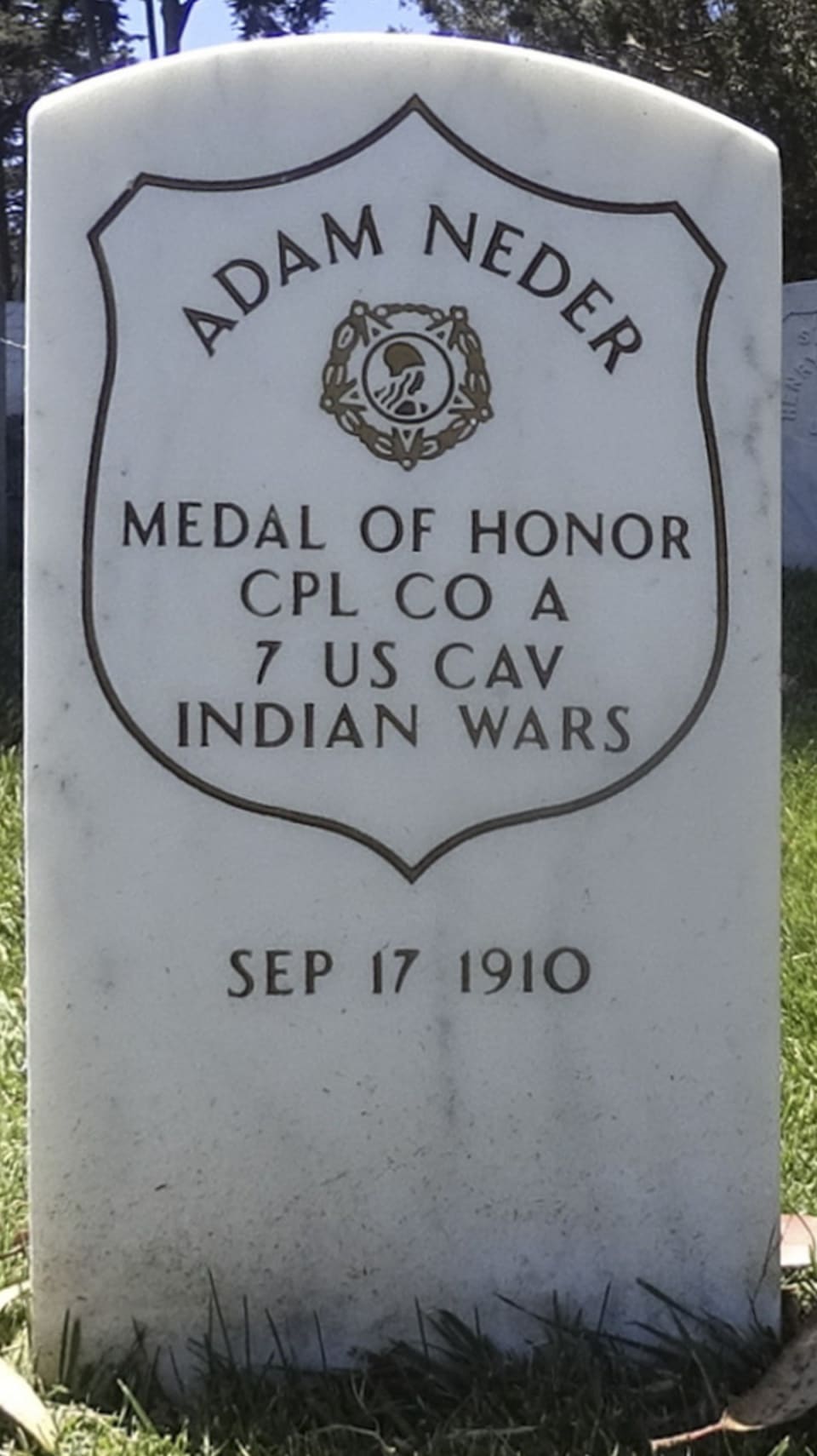
Two words formed Adam Neder’s official Medal of Honor citation: “Distinguished bravery.” Behind that remarkably brief citation was the story of a Bavarian immigrant who served on the American frontier, was wounded at Wounded Knee Creek, rose from private to sergeant, fought again during the Spanish-American War, and spent the final years of his life in government service overseas. Neder’s military career carried him from the plains of South Dakota to the battlefields of Cuba, making his story far broader than the single decoration for which he is best remembered. Congressional Medal of Honor Society Adam Neder was born in Bavaria in 1865 and came to the United States as a young man. By 1886 he was living in St. Louis, Missouri, working as a carpenter. In June of that year, at about twenty-one years of age, he enlisted in the United States Army for a five-year term and was assigned to Troop A, 7th U.S. Cavalry at Fort Riley, Kansas. His military records describe a man who entered the Army as a private and gradually earned greater responsibility. By 1895, after years of service in the United States, Neder became a naturalized American citizen. Army at Wounded Knee The defining moment of Neder’s military career came during the Sioux Campaign of 1890 to 1891. On December 29, 1890, while serving as a private with Troop A of the 7th Cavalry at Wounded Knee Creek, South Dakota, Neder became involved in the violent fighting that followed the attempt to disarm Big Foot’s Lakota band. Contemporary military accounts recorded that Neder was wounded while fighting on the skirmish line. Later accounts also associated him with the effort to assist the wounded Lieutenant Ernest A. Garlington. His commanding officer, Captain Myles Moylan, recommended him for the Medal of Honor in March 1891. Army at Wounded Knee On April 25, 1891, Adam Neder received the Medal of Honor, the United States’ highest military decoration. The Army’s official record gives the place and period as Wounded Knee Creek during the Sioux Campaign and records his citation in only two words: “Distinguished bravery.” The brevity of that citation was characteristic of many nineteenth-century Medal of Honor awards, but contemporary Army records provide additional context. In General Order No. 100 of 1891, Neder was also recognized for bravery at Wounded Knee Creek, where he had been wounded. Army Neder’s Army career did not end with the Medal of Honor. He was promoted after the campaign and had reached the rank of sergeant by the time he reenlisted. In 1893, Sergeant Neder took part in the dedication of the 7th Cavalry’s Wounded Knee monument at Fort Riley. After completing another enlistment, he briefly left the Army, then returned in September 1896. Because of the break in service he reenlisted as a private, initially joining the 5th Artillery before transferring to Company E, 1st U.S. Infantry at the Presidio of San Francisco. Army at Wounded Knee When war with Spain began in 1898, Neder went to Cuba with the 1st Infantry. Historical records place him in the Santiago campaign and identify his participation in the fighting at El Caney, San Juan Hill, and Santiago. His Cuban service is especially important when reconstructing his complete military honours. Army regulations authorize the Spanish Campaign Medal for qualifying Army service in Cuba between May 11 and July 17, 1898, a period that encompassed Neder’s documented combat service. His earlier service in South Dakota during the Sioux Campaign likewise fell within the qualifying period for the Indian Campaign Medal, specifically the campaign against the Sioux in South Dakota from November 1890 through January 1891. Army at Wounded Knee r600_8_22 Unlike the Medal of Honor, these two campaign medals did not carry individual citations for personal acts of gallantry. Their entitlement was based on qualifying military service. Neder’s Indian Campaign Medal reflects his service in the Pine Ridge and Wounded Knee campaign, while his Spanish Campaign Medal represents his service with the 1st Infantry in Cuba. Together with the Medal of Honor, they provide a fuller picture of his military career than the Medal of Honor alone. The Indian Campaign Medal was established in 1907 and the Spanish Campaign Medal in 1905, meaning both existed during Neder’s lifetime. r600_8_22 r600_8_22 Neder was discharged from active Army service in 1899, but his connection to the military continued. He entered civilian service with the Quartermaster Department as a wagon master. In 1900 he went to China during the period of the American relief expedition, and he later transferred to Manila in the Philippines. His subsequent positions included forage master and chief coal stevedore in the Army transport service. These were civilian posts rather than active military service, an important distinction when assessing his medal entitlement. Army at Wounded Knee Adam Neder died in Manila on September 17, 1910, at approximately forty-five years of age. His remains were eventually returned to the United States, and on November 1, 1911, he was interred at San Francisco National Cemetery, where his grave remains under the care of the Department of Veterans Affairs. The Congressional Medal of Honor Society likewise records Manila as his place of death and San Francisco National Cemetery as his final resting place. Congressional Medal of Honor Society From an immigrant carpenter in St. Louis to a sergeant of the United States Army, Adam Neder’s story spans the Indian Campaigns, the Medal of Honor, and the Spanish-American War. His famous citation may contain only two words, but his complete record tells a much larger story of frontier service, combat, wounds, promotion, citizenship, and continued government service overseas. Remembering Neder through his full military record, including the Medal of Honor, Indian Campaign Medal, and Spanish Campaign Medal, restores the broader service history behind those simple words: “Distinguished bravery.”
Become the named supporter for this profile and edit the tribute biography and portrait (Owner account required). Proceeds help keep the archive online.
$25 USD / year — annual sponsorship renewal. Keeps the page online and, where enabled, the family anniversary remembrance emails active.