★
Loading archive…
Loading archive…
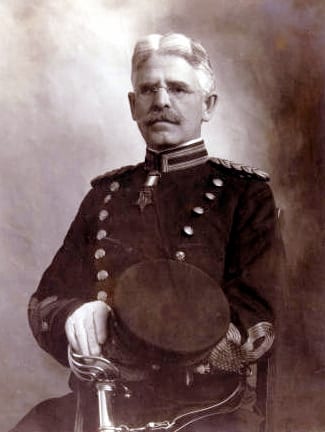
Major general, U.S. Army
Support & adopt this hero ↓
Shot Through the Head, He Kept Encouraging His Men
What does true courage look like when a soldier is struck by a bullet and suddenly loses his sight? For Albert Leopold Mills, it meant remaining composed and encouraging the men around him. That extraordinary conduct during the Spanish-American War made him a Medal of Honor recipient and began a legacy of leadership that would shape the United States Military Academy at West Point.
Born on May 7, 1854, in New York City, Albert Leopold Mills entered the United States Military Academy at West Point in 1874 and graduated in 1879. Commissioned into the 1st U.S. Cavalry, he spent his early military career conducting frontier reconnaissance across Washington, Idaho, Montana, Dakota, Wyoming and Arizona. His service included campaigns against the Crow and Sioux, as well as assignments as an instructor in military science and tactics at the South Carolina Military Academy and later at Fort Leavenworth, Kansas.
When the Spanish-American War began in 1898, Mills joined the U.S. Volunteers as a captain and assistant adjutant general. Serving with the 2nd Brigade, Cavalry Division, Fifth Army Corps, he participated in the Battle of Las Guasimas on June 24 and the Battle of San Juan near Santiago, Cuba, on July 1. His gallantry at Las Guasimas led to a recommendation for promotion to brevet major, while his conduct at San Juan brought a nomination for brevet lieutenant colonel. During the fighting at San Juan, Mills was shot through the head and temporarily blinded. His courage and composure, however, inspired the soldiers around him.
For his extraordinary bravery on July 1, 1898, Mills received the Medal of Honor, presented on July 9, 1902. His official citation reads: “Distinguished gallantry in encouraging those near him by his bravery and coolness after being shot through the head and entirely without sight.”
Remarkably, while still recovering from his wound, Mills was appointed Superintendent of the United States Military Academy on August 22, 1898. He assumed the position on September 19, initially holding the rank of first lieutenant in the Regular Army, with the superintendency carrying the rank of colonel. During his eight-year tenure, he challenged the brutal hazing culture at West Point, strengthened cadet discipline and oversaw the Academy's centennial celebrations and major expansion plans.
After leaving West Point in 1906, Mills continued his distinguished military career overseas. He commanded the Department of the Visayas and subsequently the Department of Luzon in the Philippine Islands, serving during the Pulajanes operations. His later assignments included command of the Department of the Gulf, service on the Army General Staff and the presidency of the Army War College. In September 1912, he became Chief of the Division of Militia Affairs, later known as the Militia Bureau.
Promoted to Major General on July 14, 1916, Mills reached the highest rank of his military career shortly before his death. He died in Washington, D.C., on September 18, 1916, while still serving his country, and was laid to rest at West Point Cemetery.
Albert Leopold Mills is remembered not only as a Medal of Honor recipient of the Spanish-American War, but also as a frontier cavalry officer, military educator and influential West Point superintendent. His story remains a powerful reminder that courage is measured not simply by enduring injury, but by the strength to inspire others even in the face of extraordinary adversity.
Become the named supporter for this profile and edit the tribute biography and portrait (Owner account required). Proceeds help keep the archive online.
$25 USD / year — annual sponsorship renewal. Keeps the page online and, where enabled, the family anniversary remembrance emails active.