★
Loading archive…
Loading archive…
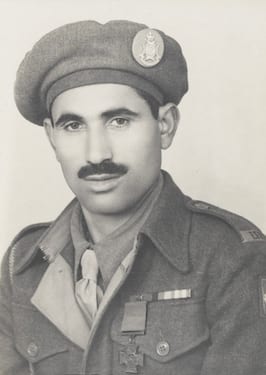
The Soldier Who Attacked Two Enemy Positions Despite Severe Wounds
Three men made it across the River Senio under devastating enemy fire. Within minutes, two of them were covering their wounded comrade as he charged directly towards heavily defended German positions. That soldier was Sepoy Ali Haidar, whose extraordinary courage would earn him the Victoria Cross, Britain's highest award for gallantry.
Born in 1913 in Kohat, in what is now Pakistan, Ali Haidar was a Pashtun soldier who served in the British Indian Army with the 13th Frontier Force Rifles during the Second World War. His military career took him through demanding wartime operations before bringing him to the Italian campaign in 1945.
On 9 April 1945, near Fusignano, Italy, his company was ordered to cross the River Senio and capture strongly fortified enemy positions on the opposite bank. The crossing immediately came under intense machine-gun fire from two German positions. Most of the company was held back, while only three men, including Haidar, managed to reach the far side.
Taking the initiative without waiting for orders, Haidar charged the first enemy post, throwing a grenade and destroying the position despite suffering a severe wound to his back. Four enemy soldiers surrendered. Refusing to withdraw, he then attacked a second position protected by a machine gun and automatic weapons. Wounded again in his right arm and leg, he continued forward, crawled closer to the enemy and launched his final assault with a grenade. Two enemy soldiers were wounded and the remaining two surrendered.
His extraordinary determination transformed a potentially disastrous crossing into a successful operation. His company was able to advance, establish a bridgehead and continue its mission. The official Victoria Cross citation praised his conspicuous gallantry, initiative and determination, noting that his personal bravery had prevented heavy casualties and a serious delay to the battalion's advance.
The award was published in the London Gazette on 3 July 1945, Supplement No. 37156, page 3439. King George VI presented Haidar with his Victoria Cross at Buckingham Palace on 30 October 1945.
Following the Partition of British India, Haidar continued his military career in the Pakistan Army. His later service marked another chapter in a life shaped by military discipline, courage and commitment. After retiring from the Army, he returned to civilian life and farming in his home region.
Ali Haidar died on 15 July 1999 in Shahukhel, Pakistan, and was buried in his village cemetery. His Victoria Cross is preserved as part of the Lord Ashcroft Collection.
The story of Ali Haidar VC is a remarkable reminder that extraordinary courage is not measured by the wounds a soldier receives, but by the determination with which he continues when others might have given up. At the River Senio, despite being seriously wounded twice, he pressed forward and changed the course of a critical battlefield operation. His actions remain an enduring example of bravery, initiative and selfless service.
Become the named supporter for this profile and edit the tribute biography and portrait (Owner account required). Proceeds help keep the archive online.
$25 USD / year — annual sponsorship renewal. Keeps the page online and, where enabled, the family anniversary remembrance emails active.