★
Loading archive…
Loading archive…
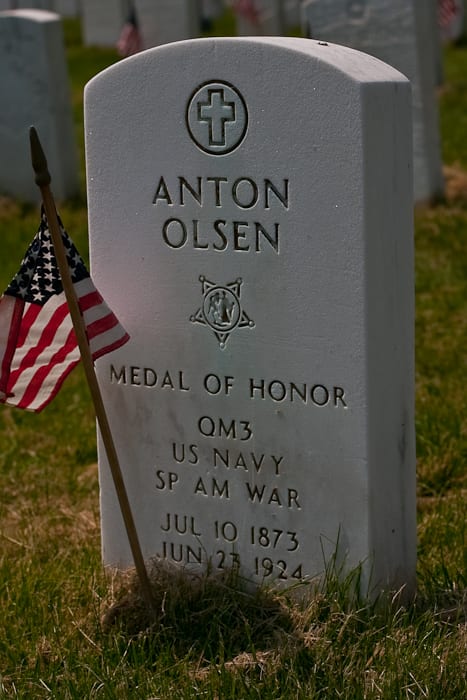
Anton Olsen was a Norwegian-born sailor who served in the United States Navy during the Spanish–American War and earned the Medal of Honor for courage under intense enemy fire during one of the war’s most dangerous naval operations. At the time of the action for which he was decorated, Olsen held the rank of Ordinary Seaman aboard the protected cruiser USS Marblehead. He later advanced in the Navy to Quartermaster Third Class, the highest verified rank associated with his service.
Olsen was born in Christiana, Norway—today known as Oslo—in 1873. At some point before the Spanish–American War, he came to the United States and entered the U.S. Navy. His Medal of Honor record was later accredited to the state of Massachusetts, although the surviving authoritative award records do not establish a specific Massachusetts municipality that should be treated as his hometown or enlistment city.
By 1898, Olsen was serving aboard USS Marblehead, an unarmored protected cruiser operating with American naval forces around Cuba. The United States had gone to war with Spain in April 1898, and one of the Navy’s major responsibilities was to blockade Cuba and disrupt Spanish military communications. At the end of the nineteenth century, long-distance communication depended heavily on submarine telegraph cables, making those cables strategically important targets.
One particularly important group of cables ran from Cienfuegos, Cuba. Spanish authorities depended on these lines to communicate between positions in Cuba and with the outside world. American commanders therefore planned an operation to locate, raise and sever the underwater cables near the shore.
On 11 May 1898, sailors and Marines from USS Marblehead and USS Nashville carried out what became known as the Cienfuegos cable-cutting expedition, or the Battle of Cienfuegos. The operation required small boats to approach dangerously close to the Cuban shoreline. Working parties used grappling equipment to locate the heavy submarine cables, pull them toward the surface and cut them while other boats and the supporting warships attempted to suppress Spanish defensive positions.
Olsen participated in this operation as an Ordinary Seaman from USS Marblehead.
The mission quickly became a fierce combat action. Spanish troops on shore opened heavy rifle and other small-arms fire on the American boats. The men working with the cables had little protection and were exposed while performing physically demanding tasks in open boats. The engagement continued for roughly three hours, with American sailors and Marines maintaining the operation despite the intensity of the enemy fire.
The cable-cutting party ultimately succeeded in severing the principal cables targeted during the operation, thereby disrupting part of the Spanish communications network. The cost was significant. Men from both Marblehead and Nashville were killed and wounded during the fighting.
Olsen distinguished himself throughout this dangerous operation. His official award record emphasizes two qualities in particular: bravery and coolness while under heavy enemy fire. He remained at his duty during the cable-cutting operation rather than withdrawing from the exposed position despite the continuous danger.
His conduct on 11 May 1898 at Cienfuegos became the defining event of his military career.
The Medal of Honor
For his actions during the Cienfuegos cable-cutting expedition, Anton Olsen received the Medal of Honor, the highest military decoration awarded by the United States.
The Medal of Honor had originated during the American Civil War. The Navy Medal of Honor was authorized in 1861, followed by the Army version in 1862. By the time of the Spanish–American War in 1898, it was the United States' principal national decoration for exceptional military gallantry.
The criteria and administrative practices surrounding the medal were different in the late nineteenth century from the much more restrictive modern standards. For the Cienfuegos operation, the Navy recognized the exceptional danger faced by the sailors and Marines who remained in exposed boats and continued trying to sever the cables while subjected to sustained Spanish fire.
Olsen's official Medal of Honor record identifies:
Action: Cable-cutting operation Date: 11 May 1898 Location: Cienfuegos, Cuba Ship: USS Marblehead Branch: United States Navy Rank at Action: Ordinary Seaman
The official Navy record summarized his deed as gallantry under enemy fire while participating in the cutting of the Cienfuegos cables. Later versions of the citation specifically recognized his extraordinary bravery and coolness during the operation.
His Medal of Honor was formally recorded under General Order No. 529, dated 2 November 1899. Olsen was alive when the award was made; it was not a posthumous Medal of Honor.
The decoration therefore represented official recognition of an action he had personally survived more than a year earlier.
From Ordinary Seaman to Quartermaster
An important distinction must be preserved when describing Olsen's rank.
He was an Ordinary Seaman at the time of his Medal of Honor action in 1898.
However, surviving authoritative records identify his highest verified rank as Quartermaster Third Class. Therefore, when a database requires Olsen's highest rank, Quartermaster Third Class is appropriate, while any description of the Cienfuegos action should retain Ordinary Seaman.
In the U.S. Navy of Olsen's period, the quartermaster rating was associated primarily with navigation, steering, signaling and watchstanding duties, rather than the supply-and-logistics meaning commonly associated with the word “quartermaster” in the Army. This is why Olsen's military classification should remain Surface Naval, not Logistics.
The Significance of the Cienfuegos Action
The operation in which Olsen earned the Medal of Honor was much more than an isolated act of shipboard bravery.
Spanish forces in Cuba depended heavily on telegraph cables to coordinate communications. By targeting these underwater lines, the U.S. Navy was attempting to isolate Spanish positions and interfere with communication between Cuba and the wider Spanish command network.
The men in the launches had to perform technical cable-recovery work while exposed to enemy fire from the coast. They had no opportunity simply to fight from behind the protection of a large warship's armor. Their mission required them to remain near the shoreline while grappling for cables, bringing them to the surface and physically severing them.
USS Marblehead and USS Nashville provided supporting fire, but the small-boat crews still endured sustained fire at close range.
Olsen's Medal of Honor therefore reflected not command authority or senior rank, but his willingness as an enlisted sailor to continue performing his assigned duty under direct enemy fire.
Later Life and Legacy
The surviving authoritative record provides far less detail about Olsen's life after the Spanish–American War than it does about his Medal of Honor action. What can be established safely is that he eventually attained the rank of Quartermaster Third Class and lived for more than two decades after the war.
There is no basis for adding further personal decorations or campaign medals to his verified ribbon rack simply because his naval service may have made him eligible for them. Under a recipient-specific research standard, eligibility alone does not prove that a particular medal was actually awarded or issued.
Anton Olsen died on 23 June 1924.
He was buried at Cypress Hills National Cemetery in Brooklyn, New York, where his grave is recorded in Section 2, Site 9158. The U.S. Department of Veterans Affairs continues to recognize him among the Medal of Honor recipients buried at Cypress Hills, identifying him as a Navy veteran of the Spanish–American War whose heroism occurred aboard USS Marblehead in Cuba on 11 May 1898.
His grave therefore remains a permanent link between a Norwegian-born American sailor and one of the most celebrated small-boat actions of the Spanish–American War.
Legacy of Anton Olsen
Anton Olsen's military legacy rests on a remarkably concentrated moment of service.
He did not receive the Medal of Honor because he commanded a fleet, led a major battle or held high rank. He earned it as an Ordinary Seaman, exposed to enemy fire while carrying out a difficult naval mission at close range.
On 11 May 1898, during the attempt to sever Spain's communications from Cienfuegos, Olsen remained at his duty while Spanish fire struck around the American boats. His courage formed part of the collective effort that allowed the cable-cutting party to complete its mission despite casualties and intense resistance.
More than a year later, the United States formally recognized that conduct with the Medal of Honor.
From an Ordinary Seaman aboard USS Marblehead to a Quartermaster Third Class and Medal of Honor recipient, Olsen's story represents the contribution of enlisted sailors whose work during the Spanish–American War often placed them in direct and immediate danger.
Final Verified Award
Medal of Honor — No additional device
Earned: 11 May 1898 Action: Cienfuegos cable-cutting expedition Location: Cienfuegos, Cuba Ship: USS Marblehead Rank at Action: Ordinary Seaman General Order: No. 529, 2 November 1899 Posthumous: No
Become the named supporter for this profile and edit the tribute biography and portrait (Owner account required). Proceeds help keep the archive online.
$25 USD / year — annual sponsorship renewal. Keeps the page online and, where enabled, the family anniversary remembrance emails active.