★
Loading archive…
Loading archive…

Anund Charles Roark was a United States Army infantryman and Medal of Honor recipient whose final combat action during the Vietnam War became an extraordinary example of battlefield leadership and self-sacrifice. Serving as a Sergeant with Company C, 1st Battalion, 12th Infantry Regiment, 4th Infantry Division, Roark gave his life on May 16, 1968, while leading a force attempting to rescue American soldiers trapped at a heavily attacked observation post in Kontum Province, Republic of Vietnam.
Only twenty years old at the time of his death, Roark had already risen to the rank of Sergeant and was serving as a squad leader in active combat. His final actions demonstrated not only personal courage but also the responsibility of a combat leader determined to protect both the men under his command and those his unit had been sent to rescue.
Early Life
Anund Charles Roark was born on February 17, 1948, in Vallejo, Solano County, California.
His official Medal of Honor record later associated his military entry with Los Angeles, California. It is important to distinguish these two facts: Vallejo was his birthplace, while Los Angeles was the location to which his military service was accredited.
Roark entered the United States Army during the Vietnam era and was trained for infantry service. By 1968 he had reached the rank of Sergeant, an enlisted leadership position that placed him in direct responsibility for soldiers operating in combat.
He was assigned to:
Company C 1st Battalion 12th Infantry Regiment 4th Infantry Division
The 4th Infantry Division was deeply involved in combat operations in the Central Highlands of South Vietnam, including the strategically important areas around Kontum. Infantry units operating there faced difficult terrain, remote defensive positions and determined enemy forces using bunkers, automatic weapons, mortars and grenades.
Roark's role was therefore not merely that of an individual rifleman. By May 1968 he was functioning as a point squad leader, responsible for maneuvering soldiers in direct contact with the enemy.
The Rescue Mission — May 16, 1968
Roark's defining action took place on May 16, 1968, in Kontum Province, Republic of Vietnam.
A small American force was ordered to rescue eleven men occupying a hilltop observation post that had come under heavy enemy attack. The position was approximately 1,000 meters from the battalion perimeter and was being assaulted by an enemy force estimated at approximately company strength.
The mission required the relief force to move toward an already contested position, reach the isolated soldiers, protect them while they withdrew and evacuate casualties under enemy fire.
Sergeant Roark served as the point squad leader of this relief force.
As the leading American elements reached the observation post, they encountered intense automatic-weapons fire coming from enemy-held bunkers. The concentrated fire halted their forward movement.
The tactical problem was severe. The trapped men still needed to be evacuated, but the attacking force controlled positions capable of firing directly onto the relief troops and the observation post.
Roark responded immediately.
Leading His Squad Under Fire
Rather than remain protected while his squad attempted to overcome the enemy positions, Roark personally maneuvered his men and repeatedly exposed himself to hostile fire.
He moved where he could throw grenades against enemy positions and directed the fire of his squad in an effort to gain fire superiority.
His actions had a specific purpose: the enemy had to be suppressed long enough for the men at the outpost to withdraw and for the wounded to be evacuated.
Roark therefore combined personal offensive action with battlefield leadership. He was not simply firing at the enemy independently; he was directing his squad and coordinating their fire while repeatedly placing himself in exposed positions.
Gradually, the American soldiers were able to begin withdrawing from the outpost.
But the enemy attack did not end.
Unable to immediately overrun the position, the opposing force intensified its fire on the hilltop. Small-arms fire continued while grenades were thrown into the American position.
Then came the moment that ultimately defined Roark's legacy.
The Grenade
During the fighting, an enemy grenade landed among Roark's men.
There was almost no time to react.
A grenade exploding within a tightly grouped infantry position could kill or severely wound several soldiers at once. Roark immediately recognized the danger.
Instead of attempting to save himself, Sergeant Anund Roark threw himself onto the grenade.
His body absorbed the explosion.
He was killed by the blast.
His decision protected the soldiers surrounding him from the full force of the grenade and became the final act in a sequence of leadership that had already included maneuvering his squad under intense fire, personally attacking enemy positions and covering the withdrawal and evacuation of the observation post.
The rescue effort ultimately succeeded.
Roark had given his life at the age of twenty.
Medal of Honor
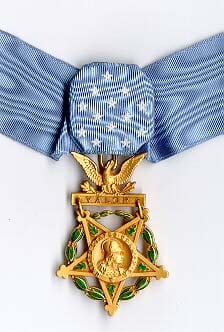
For his actions on May 16, 1968, Sergeant Anund Charles Roark was posthumously awarded the Medal of Honor, the highest United States military decoration for valor in combat.
Final Verified Medal
Medal of Honor — No Device
This is the only medal currently included in Roark's final verified project medal rack. No additional campaign medal, service medal, unit award or foreign decoration has been added solely because his Vietnam service might have made him eligible. Under the project's evidence standard, eligibility alone is not sufficient; recipient-specific entitlement must be established before another medal is placed in the live rack.
History of the Medal of Honor
The Medal of Honor is the highest award for military valor bestowed by the United States.
The decoration originated during the American Civil War. Congress first authorized a Medal of Honor for members of the Navy in 1861, followed by an Army version in 1862. Over time, its standards developed into the modern requirement that the recipient demonstrate extraordinary gallantry at the risk of life above and beyond the call of duty.
By the Vietnam War era, the Medal of Honor represented the highest level of formally recognized battlefield heroism in the United States military.
Roark's actions met that standard because his conduct involved a sustained sequence of deliberate decisions made while exposed to lethal enemy fire.
He led his squad toward an isolated American position.
He exposed himself repeatedly while attacking enemy positions.
He directed his soldiers' fire to protect the withdrawal.
He helped make the evacuation of casualties possible.
Finally, when a grenade threatened the lives of his men, he deliberately placed his own body between the explosion and his fellow soldiers.
His Medal of Honor was therefore not based solely on the final grenade incident. The official account presents the entire rescue mission—his leadership, offensive action under fire and final sacrifice—as the basis of his extraordinary gallantry.
Posthumous Presentation
Because Roark was killed during the action, his Medal of Honor was awarded posthumously.
On April 7, 1970, nearly two years after his death, his family received the Medal of Honor during a ceremony at the White House.
President Richard M. Nixon presented the decoration to Roark's family.
The ceremony formally placed Roark among the small group of American servicemen whose combat actions were judged to have reached the nation's highest standard of military valor.
The Medal recognized not only the fact that he died protecting his comrades but also the battlefield leadership that preceded his death.
Death, Recovery and Identification
Sergeant Roark was killed in action on May 16, 1968, in South Vietnam.
The circumstances following his death were complicated by the continuing battle. His remains could not be immediately evacuated from the hill because the firefight was still underway.
They were subsequently recovered, but the identification process extended well beyond the date of the battle.
The Defense POW/MIA Accounting Agency's historical record shows that the U.S. military's Central Identification Laboratory-Hawaii ultimately identified Roark's remains in November 1977.
This later identification became another important chapter in his story. Although his death had been recognized since the battle in 1968 and his Medal of Honor had been presented to his family in 1970, the physical process of accounting for his remains continued for years afterward.
He is now buried at:
Fort Rosecrans National Cemetery San Diego, California Section O, Site 1855
Fort Rosecrans preserves the graves of generations of American servicemen and women, including a number of Medal of Honor recipients.
Military Identity and Rank
Roark's verified military identity is:
Full Name: Anund Charles Roark Branch: United States Army Highest Verified Rank: Sergeant Rank at Medal of Honor Action: Sergeant Unit: Company C, 1st Battalion, 12th Infantry Regiment, 4th Infantry Division Conflict: Vietnam War
There is no conflict between his heroic-action rank and his highest verified rank. He was serving as a Sergeant when he was killed on May 16, 1968.
His designation as point squad leader also explains why his story is not only one of individual courage but one of combat leadership. At twenty years old, he carried responsibility for directing other soldiers in one of the most dangerous environments imaginable.
A Leader Before the Final Sacrifice
Roark's final sacrifice is often the part of his story most easily remembered: a grenade landed among his soldiers, and he threw himself onto it.
But focusing only on that instant understates what occurred before it.
The rescue force had already encountered fortified enemy positions and automatic-weapons fire. Its advance had been stopped. Roark then took an active leadership role in restoring the momentum of the mission.
He maneuvered his squad.
He repeatedly exposed himself to enemy fire.
He used grenades against hostile positions.
He directed the fire of his soldiers.
He helped establish sufficient fire superiority to protect the withdrawal of the observation post.
He helped cover the evacuation of casualties.
Only after all of this did the grenade fall among his men.
His final decision therefore represented the culmination of a mission during which he had already repeatedly risked his life for others.
Legacy
Anund Charles Roark's life was remarkably short, but his military legacy has endured for decades.
He was born in California in 1948 and died in Vietnam only twenty years later. Yet by the time of his death he had become a Sergeant responsible for leading soldiers in combat.
His Medal of Honor action illustrates several qualities traditionally associated with effective infantry leadership: initiative, control under fire, willingness to lead from the front and responsibility for the survival of others.
His final act added another dimension—complete self-sacrifice.
Roark did not encounter the grenade while isolated from his soldiers. It landed among the men whose safety he was responsible for. In the seconds available to him, he made a decision that eliminated any possibility of protecting himself.
The soldiers around him survived the explosion because Roark absorbed its force.
His actions also contributed to the successful relief of the observation post, meaning that his sacrifice occurred within the broader accomplishment of the mission he had been helping lead.
The United States Army preserved the story through his Medal of Honor citation, while the Congressional Medal of Honor Society continues to record his service and sacrifice. Fort Rosecrans National Cemetery identifies him among the notable Medal of Honor recipients buried there, and the Defense POW/MIA accounting record preserves the later history of the recovery and identification of his remains.
More than half a century after the Vietnam War, Sergeant Anund Charles Roark remains remembered as a young infantry leader who repeatedly exposed himself to enemy fire to protect a rescue operation and who, when confronted with a grenade threatening his soldiers, chose their lives over his own.
His Medal of Honor represents that entire sequence of courage.
Final Project Record
Anund Charles Roark United States Army Sergeant Company C, 1st Battalion, 12th Infantry Regiment, 4th Infantry Division Vietnam War Medal of Honor — No Device Heroic Action: May 16, 1968 — Kontum Province, Republic of Vietnam Medal of Honor Presentation: April 7, 1970 — White House, presented posthumously to his family by President Richard M. Nixon Burial: Fort Rosecrans National Cemetery, San Diego, California — Section O, Site 1855
Become the named supporter for this profile and edit the tribute biography and portrait (Owner account required). Proceeds help keep the archive online.
$25 USD / year — annual sponsorship renewal. Keeps the page online and, where enabled, the family anniversary remembrance emails active.