★
Loading archive…
Loading archive…
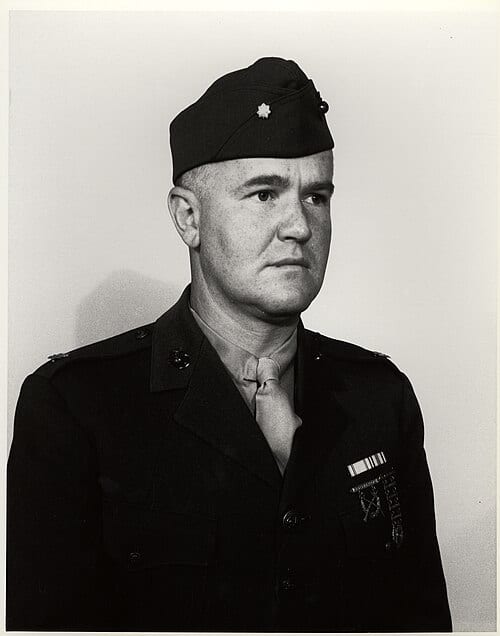
Lieutenant Colonel, U.S. Marine Corps
Support & adopt this hero ↓
Before Aquilla James Dyess became a Medal of Honor hero on the battlefields of the Pacific, he had already risked his life to save a stranger from the ocean. Years later, as Japanese machine guns swept across Namur Island, he would once again place himself in danger, this time leading his Marines into the heart of enemy resistance. His courage in both moments reveals the character of a man whose life was defined by an extraordinary willingness to protect others.
Aquilla James “Jimmie” Dyess was born on 11 January 1909 in Georgia and grew up in the Augusta area. An Eagle Scout with a strong sense of discipline and leadership, he attended Clemson College in South Carolina, where he played varsity football, developed his reputation as an exceptional rifle marksman and served as a cadet major in the Reserve Officers' Training Corps. He received a commission as a second lieutenant in the Army Infantry Reserve in 1931 and graduated from Clemson with a degree in architecture in 1932.
His instinct for courage and service was evident long before the Second World War. On 13 July 1928, while at Sullivan's Island, South Carolina, Dyess entered dangerous Atlantic surf to help rescue Lucy W. Holley, who had been swept far from shore. Working alongside Barbara H. Muller, he helped bring Holley safely back to shallow water. His bravery earned him the Carnegie Medal in 1929, recognizing an act of civilian heroism that foreshadowed the extraordinary sacrifice he would later make in military service.
Dyess entered the Marine Corps Reserve on 4 November 1936, receiving a commission as a first lieutenant. He continued his involvement in competitive marksmanship, earning team bronze medals at the National Matches in 1937 and 1938. On 8 November 1940, as the United States strengthened its military forces ahead of its entry into the Second World War, he reported for active duty with the United States Marine Corps.
By 1944, Dyess had risen to the rank of lieutenant colonel and was commanding the 1st Battalion, 24th Marines, 4th Marine Division. His leadership would be tested during Operation Flintlock, the American assault on the Japanese-held Marshall Islands. On 1 February 1944, his battalion landed on Namur Island, part of Kwajalein Atoll, encountering determined Japanese resistance.
The following day, Dyess demonstrated the exceptional leadership and personal courage that would define his legacy. Rather than directing the battle from a position of safety, he repeatedly exposed himself to intense Japanese automatic weapons fire. Moving between opposing positions, he identified enemy strongpoints, pointed out routes of advance and personally led his Marines whenever resistance threatened to halt the attack. His presence inspired his men to continue advancing against formidable opposition.
As the Japanese defenders were driven back to their final position, Dyess personally directed a flanking assault against the remaining enemy strongpoint. Standing on the parapet of an antitank trench and guiding his Marines forward, he was struck by a burst of Japanese machine-gun fire. He died on 2 February 1944, aged just 35, having led his men until the final moments of his life.
For his extraordinary gallantry, daring leadership and supreme sacrifice during the assault on Namur, Lieutenant Colonel Aquilla James Dyess was posthumously awarded the Medal of Honor, the United States' highest military decoration for valor. He also received the Purple Heart for the fatal wounds sustained in combat.
Aquilla James Dyess's legacy extends beyond the battlefield. From rescuing a drowning woman as a young man to leading Marines through devastating enemy fire, his life reflected a consistent commitment to courage, responsibility and the protection of others. His story stands as a powerful reminder that true leadership is measured not simply by rank or command, but by the willingness to share the dangers faced by those entrusted to one's care.
Today, Aquilla James Dyess is remembered as a Medal of Honor recipient, a courageous Marine Corps commander and one of the American heroes whose sacrifice helped secure victory in the Pacific during the Second World War.
Become the named supporter for this profile and edit the tribute biography and portrait (Owner account required). Proceeds help keep the archive online.
$25 USD / year — annual sponsorship renewal. Keeps the page online and, where enabled, the family anniversary remembrance emails active.