★
Loading archive…
Loading archive…
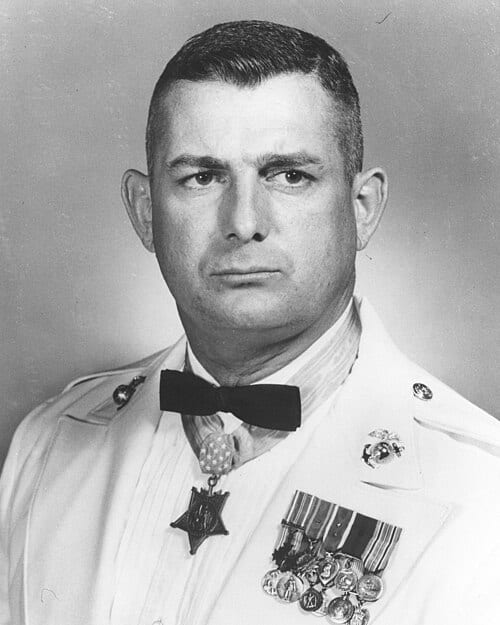
Colonel, U.S. Marine Corps
Support & adopt this hero ↓
A bullet shattered his arm. An enemy grenade struck his chest. Yet Staff Sergeant Archie Van Winkle refused to abandon his Marines. On the night of 2 November 1950, near Sudong, Korea, his extraordinary courage and leadership helped a badly battered platoon repel a determined enemy assault, earning him the Medal of Honor, the United States' highest military decoration.
Born on 17 March 1925 in Juneau, Alaska, Archie Van Winkle enlisted in the United States Marine Corps Reserve on 14 December 1942. During World War II, he served as an aviation radioman-gunner and mechanic, participating in operations in the Solomon Islands, the Philippines and Emirau. His wartime aviation service brought him the Distinguished Flying Cross and two Air Medals. Following his honorable discharge in October 1945, he continued his education before rejoining the Marine Corps Reserve in March 1948.
When the Korean War began, Van Winkle's reserve unit was mobilized and deployed to Korea in August 1950. Serving as a staff sergeant and infantry platoon sergeant with Company B, 1st Battalion, 7th Marines, 1st Marine Division, he participated in the Inchon landing and subsequent operations. His defining moment came near Sudong on 2 November 1950, when a numerically superior enemy force penetrated the Marine defensive line under cover of darkness. Van Winkle immediately rallied his men and spearheaded a counterattack through intense automatic-weapons and grenade fire. Despite suffering an elbow wound that rendered one arm useless, he crossed approximately 40 yards of exposed ground to reunite an isolated squad with the rest of his platoon. When a hostile hand grenade struck his chest, inflicting severe injuries, he refused evacuation and continued directing and encouraging his Marines until he collapsed unconscious from shock and blood loss. His actions enabled the platoon to regain fire superiority, reorganize and successfully repel the attack. For this extraordinary leadership and conspicuous gallantry, he received the Medal of Honor, presented by President Harry S. Truman at the White House on 6 February 1952. The following day, he was commissioned a second lieutenant.
Following his recovery and commissioning, Van Winkle held numerous leadership, aviation and staff assignments. He served as an Air Observer with the 3rd Marine Division, Assistant G-3 of Force Troops, Fleet Marine Force, Pacific, and company executive officer and commander with the 3rd Battalion, 9th Marines. He subsequently served as Regimental Liaison Officer with the 9th Marines, worked in Marine Corps recruiting, and commanded the Marine detachment aboard USS Newport News. After completing his university education, he commanded a company in the 3rd Reconnaissance Battalion, 4th Marines, and became Director of the 1st Marine Brigade Schools. He also helped establish a Brigade Guerrilla Warfare School.
Van Winkle's third war was Vietnam. From August 1967 to September 1968, he served in senior command and operations appointments with the 1st Marine Division, including command of 2nd Battalion, 1st Marines, service as G-3 Operations Officer, and Assistant G-3 with Task Force X-Ray. During the 1968 Khe Sanh operations, he commanded 1st Battalion, 1st Marines. His leadership during Operation Robin and the subsequent operations around Hill 689 demonstrated his commitment to the Marines under his command. He received the Bronze Star Medal with Combat V, followed by a Gold Star in lieu of a second Bronze Star Medal with Combat V for heroic achievement on 6 July 1968 at Hill 689 near Khe Sanh Combat Base. He also received the Republic of Vietnam Gallantry Cross with Gold Star.
His wider military record reflects service across three wars and includes the Purple Heart, Distinguished Flying Cross, Air Medals, campaign medals, unit citations and allied decorations. His service also earned recognition through the Navy Unit Commendation, Presidential Unit Citation and Korean and Vietnamese unit honours.
After returning to the United States, Van Winkle served at Headquarters Marine Corps as Head of the Standards and Utilization Section, Manpower Control Branch, G-1 Division. He retired in February 1974 with the rank of colonel, completing a remarkable career spanning World War II, the Korean War and the Vietnam War.
Colonel Archie Van Winkle died in Ketchikan, Alaska, on 22 May 1986. His remains were cremated and his ashes scattered at sea. Remembered as a courageous combat leader, distinguished Marine aviator and Medal of Honor recipient, Van Winkle's legacy rests not simply on the decorations he received, but on the men he led and the extraordinary devotion to duty he demonstrated under fire.
Become the named supporter for this profile and edit the tribute biography and portrait (Owner account required). Proceeds help keep the archive online.
$25 USD / year — annual sponsorship renewal. Keeps the page online and, where enabled, the family anniversary remembrance emails active.