★
Loading archive…
Loading archive…
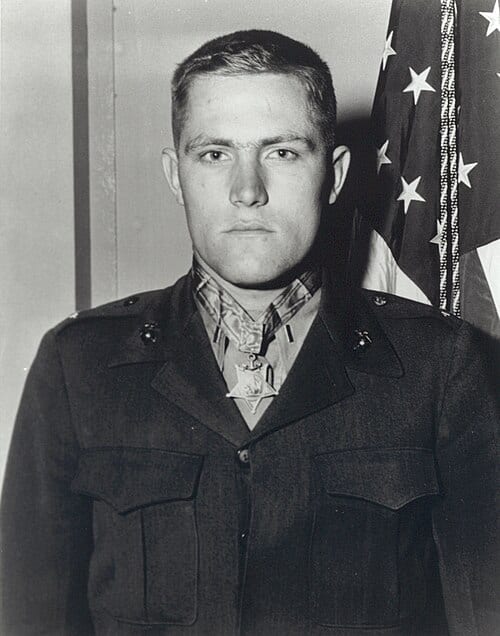
Captain, U.S. Marine Corps
Support & adopt this hero ↓
Twelve enemy pillboxes. Fifty Japanese soldiers. One 19-year-old Marine whose extraordinary courage changed the course of a desperate battle. On 18 September 1944, Private First Class Arthur Junior Jackson advanced almost alone against heavily fortified Japanese defenses on Peleliu. His remarkable assault would earn him the Medal of Honor and establish his place among the most courageous Marines of World War II.
Born on 18 October 1924 in Cleveland, Ohio, Jackson grew up during the Great Depression before his family settled in Portland, Oregon. Inspired by Marines he encountered while working in Alaska, he enlisted in the United States Marine Corps in January 1943. After military training, he joined the 1st Marine Division and began a combat career that would take him across some of the Pacific War's most unforgiving battlefields.
Jackson first experienced major combat during the Battle of Cape Gloucester in New Britain. Amid dense jungle, torrential rain, disease, and fierce Japanese resistance, he demonstrated remarkable determination. During fighting around Hill 660, he rescued a badly wounded Marine under enemy fire. His courage earned him a Letter of Commendation from Major General William H. Rupertus, commander of the 1st Marine Division.
His defining moment came during the Battle of Peleliu. Serving as an automatic rifleman with Company I, 3rd Battalion, 7th Marines, Jackson found his platoon's left flank pinned down by devastating Japanese fire. The enemy occupied a network of reinforced pillboxes that threatened to halt the Marine advance.
Refusing to remain under cover, Jackson moved forward with his automatic rifle, ammunition, and grenades. He charged a large fortified position containing approximately 35 Japanese soldiers, firing into its opening before destroying it with explosives brought forward by a fellow Marine. He then continued attacking enemy positions despite intense fire from every direction.
By the end of the assault, Jackson had destroyed twelve pillboxes and killed fifty Japanese soldiers, enabling his platoon to resume its advance. His official Medal of Honor citation recognized his conspicuous gallantry, courageous initiative, and extraordinary determination in helping eliminate enemy resistance in the island's southern sector.
Jackson was wounded in the neck during the Peleliu campaign and evacuated for treatment. After recovering, he returned to combat during the Battle of Okinawa in April 1945, serving as a platoon sergeant responsible for the men of 2nd Platoon. He sustained another wound during that campaign. His two Purple Hearts reflected the personal sacrifices he made in service to his country.
In August 1945, Jackson received a commission as a Marine second lieutenant. On 5 October 1945, President Harry S. Truman personally presented him with the Medal of Honor at the White House. Yet Jackson remained conscious that his achievements belonged to the Marines who had fought beside him, including those who never returned home.
His military career continued beyond World War II. He served in postwar China, later entered the U.S. Army, and performed duty during the Korean War, including an assignment with the 7th Infantry Division. He also served with the 82nd Airborne Division, returned to the Marine Corps in 1959, and continued his military career through subsequent Army Reserve service.
Jackson eventually retired from the Army Reserve as a captain in 1984. In civilian life, he worked for the United States Postal Service and the Department of Veterans Affairs, continuing his commitment to public service.
Arthur Junior Jackson died on 14 June 2017 in Boise, Idaho, at the age of 92. He was laid to rest at the Idaho State Veterans Cemetery, while his Medal of Honor became part of the National WWII Museum's collection in New Orleans.
His legacy extends far beyond the twelve pillboxes destroyed on Peleliu. It lives in the life of a young Marine who advanced when his comrades were pinned down, rescued fellow servicemen, led Marines through battle, and dedicated decades of his life to serving his country. Arthur J. Jackson remains an enduring symbol of courage, sacrifice, and the fighting spirit of the United States Marine Corps.
Become the named supporter for this profile and edit the tribute biography and portrait (Owner account required). Proceeds help keep the archive online.
$25 USD / year — annual sponsorship renewal. Keeps the page online and, where enabled, the family anniversary remembrance emails active.