★
Loading archive…
Loading archive…
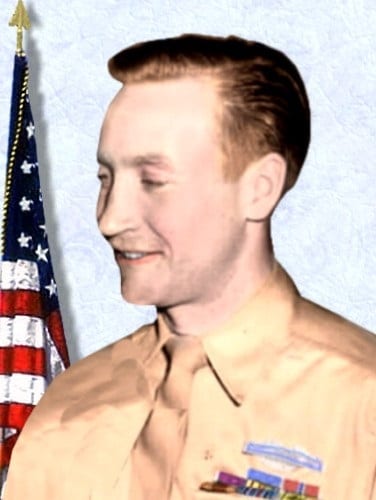
Second Lieutenant, U.S. Army
Support & adopt this hero ↓
How does a soldier hold an exposed flank against an overwhelming enemy assault, armed with little more than a carbine and mortar shells? On 13 April 1945, Technical Sergeant Beauford T. “Andy” Anderson answered that question on the blood-soaked slopes of Okinawa. Facing a powerful Japanese counterattack, he ordered his men into the shelter of an old tomb before confronting the attackers alone. His extraordinary courage would earn him the Medal of Honor, America's highest military decoration for valor.
Born on 6 July 1922 in Eagle, Wisconsin, Anderson enlisted in the United States Army on 8 October 1942. Before the war, he operated a small trucking business, transporting dairy products and farm equipment across Wisconsin's rural roads. Following extensive training with the 96th Infantry Division, he deployed to the Pacific Theater in 1944 as part of the 381st Infantry Regiment.
Anderson first distinguished himself during the Battle of Leyte in the Philippines. Under intense enemy observation and fire, he crossed approximately fifty yards of exposed terrain to rescue two wounded soldiers. He carried them to comparative safety and administered first aid until litter bearers arrived. His Bronze Star citation specifically recognized this courageous rescue. The 96th Infantry Division's wartime award records also document an additional Bronze Star award, represented by an Oak Leaf Cluster.
His greatest test came during the Battle of Okinawa. In the early hours of 13 April 1945, Japanese troops launched a determined counterattack against his company's vulnerable flank near Kakazu Ridge. After directing his men to safety, Anderson stood against the advancing force with his M1 carbine. When his ammunition ran low, he seized an unexploded enemy mortar round and hurled it back at the attackers. He then armed American mortar shells by removing their safety pins and striking their bases against a rock before throwing them into the advancing Japanese formation. Alternating between his carbine and the improvised mortar weapons, he repeatedly drove back the assault. His actions accounted for 25 enemy killed and several destroyed machine guns and knee mortars. Despite suffering a severe shrapnel wound and bleeding heavily, he refused immediate evacuation and made his way to his company commander to report the enemy's withdrawal.
For this extraordinary display of courage, Anderson received the Medal of Honor under War Department General Orders No. 63, dated 27 June 1946. Its official citation praised his conspicuous gallantry and intrepidity above and beyond the call of duty. President Harry S. Truman personally presented the medal to him at the White House. Anderson also received the Purple Heart for his wounds sustained during the Okinawa action.
Following World War II, Anderson returned to civilian life in Wisconsin before reenlisting in the Army in 1948. He served again during the Korean War and subsequently continued his military career in the Army Reserve, eventually earning a commission. After settling in Seaside, California, he established a successful floor and wall covering business and became deeply involved in public service. He served on the Seaside City Council, became Mayor of Seaside, and later served as a Monterey County supervisor. He and his wife, Phyllis, also spent many years raising cattle on a ranch near Fort Hunter Liggett.
Despite his extraordinary military achievements, Anderson remained a modest man who rarely discussed his wartime experiences. He once reflected on his approach to danger with characteristic simplicity: “In a crisis, it's either do something, or else.” Beauford T. Anderson died in Salinas, California, on 7 November 1996. He and his wife are laid to rest together at Arlington National Cemetery.
From the battlefields of Leyte to the desperate fighting at Kakazu Ridge, Beauford T. Anderson exemplified courage, determination, and devotion to his fellow soldiers. His Medal of Honor story remains a powerful testament to the extraordinary bravery of an American soldier who refused to abandon his comrades when their lives depended on him.
Become the named supporter for this profile and edit the tribute biography and portrait (Owner account required). Proceeds help keep the archive online.
$25 USD / year — annual sponsorship renewal. Keeps the page online and, where enabled, the family anniversary remembrance emails active.