★
Loading archive…
Loading archive…

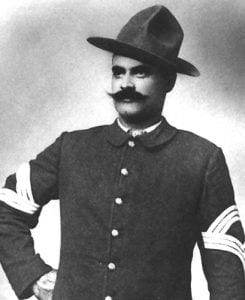
Benjamin Brown was a United States Army soldier, Buffalo Soldier, and Medal of Honor recipient whose courage during the Wham Paymaster Robbery in Arizona on 11 May 1889 became the defining action of his long military career. Serving as a Sergeant in Company C, 24th U.S. Infantry, Brown continued fighting after being shot in the abdomen and remained in action until he was wounded again through both arms. He survived, continued his Army career, later served as a Drum Major, and retired in 1905 after suffering a stroke.
Early Life
Benjamin Brown was born in 1859 in Spotsylvania County, Virginia, only a few years before the American Civil War transformed the nation and ended legal slavery in the United States.
Surviving official records provide relatively little information about his childhood or family circumstances. The National Park Service notes that Brown never married, and much more documentation survives concerning his Army career than his early civilian life.
Brown eventually enlisted in the United States Army and joined the 24th U.S. Infantry, one of the historic African American Regular Army regiments commonly associated with the term Buffalo Soldiers.
The 24th U.S. Infantry and the Buffalo Soldiers
The 24th Infantry had been created in 1869 through the consolidation of the 38th and 41st Infantry Regiments. Its enlisted ranks were predominantly African American during the segregated Army era. Together with the 25th Infantry and the 9th and 10th Cavalry, the regiment formed part of the Regular Army's Buffalo Soldier tradition.
Buffalo Soldier units performed demanding service throughout the American West. Their responsibilities included garrison duty, escorting military and government transportation, scouting, guarding routes and installations, and maintaining communications and infrastructure across remote frontier regions.
Brown's own record reflects this wide geographical range.
The National Park Service documents his service with Companies C and H and with the Band of the 24th Infantry. During his career he held the ranks or appointments of Private, Corporal, Sergeant, and Drum Major. His surviving discharge records repeatedly rated his character either “Very Good” or “Excellent.”
His postings included locations such as Fort Sill, Oklahoma; Fort Grant, Fort Bowie and Fort Huachuca in Arizona; Fort Douglas, Utah; Fort Assinniboine, Montana; and service in the Philippines.
Sergeant Brown in Arizona
By May 1889, Brown was serving as a Sergeant in Company C, 24th U.S. Infantry in Arizona Territory.
His Medal of Honor action did not occur during a conventional battle against Native American forces. Although Medal of Honor records classify him within the broader Indian Campaigns period, his actual heroic action occurred during an armed robbery of an Army paymaster convoy.
The incident became known as the Wham Paymaster Robbery.
On 11 May 1889, Major Joseph W. Wham, an Army paymaster, was traveling between Fort Grant and Fort Thomas with a military payroll worth more than $28,000. The convoy was protected by Buffalo Soldiers, principally from the 24th Infantry, with additional escort personnel from the 10th Cavalry.
The Wham Paymaster Ambush — 11 May 1889
As the convoy proceeded along the road, it encountered a large boulder deliberately placed in its path.
While members of the escort attempted to deal with the obstruction, armed men positioned above the road opened fire.
Major Wham's later account described a sudden and concentrated attack from the elevated position. The escort returned fire, and the engagement continued for roughly half an hour while casualties accumulated among the soldiers.
It was under these circumstances that Benjamin Brown demonstrated the courage for which he would receive the Medal of Honor.
Brown was shot in the abdomen.
The injury alone could have removed him from the fight.
He did not leave.
Brown continued participating in the defense of the convoy despite the wound. He remained on the field until he was struck again, this time suffering wounds through both arms.
His persistence under repeated serious wounds became the central fact recorded in his official Medal of Honor citation.
The soldiers ultimately could not prevent the robbers from taking the payroll. The stolen money was never recovered. Nevertheless, the escort's resistance was later praised for its courage; the encounter became one of the best-known episodes involving the 24th Infantry during the frontier period.
Medal of Honor
Benjamin Brown received the Medal of Honor for his conduct during the Wham Paymaster Robbery.
His official award record gives:
Rank at Action: Sergeant Organization: Company C, 24th U.S. Infantry Branch: United States Army Action Date: 11 May 1889 Location: Arizona Territory Date of Issue: 19 February 1890
Brown's citation focuses specifically on his refusal to abandon the fight despite being badly wounded.
First struck in the abdomen, he remained in action. Only after receiving additional wounds through both arms was his ability to continue effectively ended.
The decoration was not posthumous. Brown survived the engagement and continued serving in the Army for many years afterward. The Congressional Medal of Honor Society likewise records 19 February 1890 as his presentation date.
History of Brown's Medal of Honor
The Medal of Honor is the United States' highest military decoration for valor.
The Navy version was first authorized in 1861, and Congress authorized the Medal of Honor for soldiers of the United States Army in 1862, during the Civil War. By the period in which Brown served, it had become the nation's principal decoration for exceptional battlefield courage.
Brown's award belongs to the nineteenth-century Army Medal of Honor tradition, when the United States had far fewer grades of individual valor decorations than would exist during the twentieth century.
For the VictoriaCross.ca project, his Medal of Honor is therefore displayed as:
Medal of Honor (U.S. Army) — No device
No additional star, oak-leaf cluster, clasp, numeral or other attachment has been verified for Brown's Medal of Honor.
Continued Army Career
Brown's career did not end with his Medal of Honor.
He continued with the 24th Infantry and served in several different organizational roles. National Park Service research based on his military records shows service in Companies C and H as well as the regimental Band.
His career progression is particularly important when recording his rank.
At the Wham action he was unquestionably a Sergeant.
Later records show that Brown also held the position or rank of Drum Major, the highest verified rank or appointment identified in his surviving service history.
That is why his database fields should remain:
Highest Verified Rank: Drum Major Rank at Medal of Honor Action: Sergeant
These two historical facts should not be merged.
Service Beyond Arizona
Brown's military life extended well beyond the Arizona frontier.
The National Park Service traces his assignments across numerous installations in the United States and also records service in the Philippines.
The surviving evidence establishes that he was physically stationed there, but it does not, by itself, establish a separate campaign medal or specific combat participation. For that reason, his verified medal record should remain distinct from the broader chronology of places where he served.
Brown eventually returned to duty in the United States and continued his Army career into the early twentieth century.
Retirement
In 1905, Brown's long Army service came to an end after he suffered a stroke.
The National Park Service records that the resulting disability caused his retirement from the Army.
After leaving military service, Brown lived at the U.S. Soldiers' Home in Washington, D.C.
He never married and spent the remainder of his life there.
Death and Burial
Benjamin Brown died at the Soldiers' Home in Washington, D.C., on 5 September 1910. He was approximately fifty-one years old.
He was buried in the United States Soldiers' and Airmen's Home National Cemetery, Washington, D.C.
The National Park Service verifies his burial location as:
Section K, Site 7519.
Legacy
Benjamin Brown's legacy is inseparable from the history of the Buffalo Soldiers.
He served in the segregated Regular Army at a time when African American soldiers faced institutional discrimination while simultaneously performing demanding military duty across the American frontier and overseas.
His defining moment came not during a large conventional battle, but during the sudden ambush of a military payroll escort.
On 11 May 1889, Brown was wounded in the abdomen and nevertheless continued fighting. Even after suffering that serious wound, he refused to leave the field. Only after gunfire wounded both of his arms was his participation effectively brought to an end.
For that determination, the United States awarded him its highest decoration for military valor.
He then continued serving rather than allowing the Medal of Honor to define the end of his career. He served in multiple companies, with the regimental band, at posts across the United States and in the Philippines, and ultimately attained the verified rank or appointment of Drum Major before retiring after a stroke in 1905.
Final Verified Medal Group
Medal of Honor (U.S. Army) — No device
For Benjamin Brown, that single medal represents an extraordinary episode of endurance under fire and remains the fully verified decoration at the center of his military legacy.
Become the named supporter for this profile and edit the tribute biography and portrait (Owner account required). Proceeds help keep the archive online.
$25 USD / year — annual sponsorship renewal. Keeps the page online and, where enabled, the family anniversary remembrance emails active.