★
Loading archive…
Loading archive…
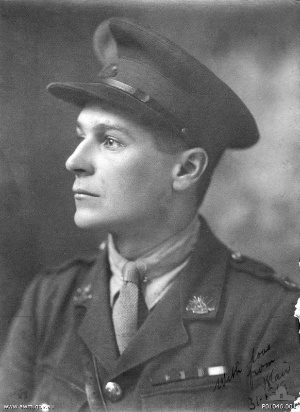
Lieutenant colonel, Australian Army
Support & adopt this hero ↓
How does an ordinary schoolteacher become one of Australia's most celebrated battlefield leaders? For Lieutenant Colonel Blair Anderson Wark, the answer lay in extraordinary courage under relentless fire. His fearless leadership during the final months of the First World War earned him the Victoria Cross, while his determination, tactical skill, and devotion to duty secured his place among Australia's most distinguished soldiers.
Blair Anderson Wark was born on 27 July 1894 at Bathurst, New South Wales. He was educated at Fairbridge Farm School in England before returning to Australia, where he worked as a schoolteacher. After serving in the Citizen Forces, he enlisted in the Australian Imperial Force on 18 August 1915 and was commissioned into the 32nd Battalion. He embarked for Egypt in November 1915 before joining the Western Front in France during 1916.
Wark quickly established a reputation as a capable and courageous officer. During the Battle of Polygon Wood in September 1917, he displayed exceptional leadership while commanding troops under intense enemy fire. His conduct throughout the operation earned him the Distinguished Service Order, which was announced in the London Gazette on 1 January 1918.
His gallant service continued throughout 1918. For distinguished work in the field he was Mentioned in Despatches, an honour published in the London Gazette on 28 December 1917, and represented on his Victory Medal ribbon by a bronze oak leaf.
Wark achieved lasting fame during the assault on the Hindenburg Line between 29 September and 1 October 1918. As commander of "B" Company, 32nd Battalion, he repeatedly led attacks against heavily defended German positions near Bellicourt, Nauroy, Magny-la-Fosse, Joncourt, and Étricourt. Despite heavy casualties, he personally directed assaults, reorganised scattered troops, captured enemy strongpoints, and inspired his men to continue advancing under fierce resistance. For these actions he was awarded the Victoria Cross, the highest award for gallantry in the British Empire. The award was announced in the London Gazette on 14 December 1918.
Following the war, Wark returned to civilian life and resumed his teaching career while remaining active in the Militia. With the outbreak of the Second World War, he returned to full-time military service in April 1940 and was appointed to command the 1st Battalion. His service during this period qualified him for the War Medal 1939 to 1945 and the Australia Service Medal 1939 to 1945. He had also been awarded the King George VI Coronation Medal in 1937 in recognition of his standing and service.
Lieutenant Colonel Blair Anderson Wark died on 13 June 1941 at Puckapunyal, Victoria, while still serving his country. He was only 46 years old. Remembered as one of Australia's bravest infantry officers, his leadership at the Hindenburg Line remains one of the finest examples of courage displayed by an Australian commander during the First World War. His Victoria Cross, Distinguished Service Order, and Mention in Despatches stand as enduring symbols of exceptional gallantry, leadership, and devotion to duty.
Become the named supporter for this profile and edit the tribute biography and portrait (Owner account required). Proceeds help keep the archive online.
$25 USD / year — annual sponsorship renewal. Keeps the page online and, where enabled, the family anniversary remembrance emails active.