★
Loading archive…
Loading archive…
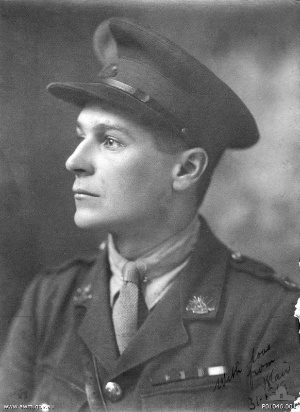
Lieutenant colonel, Australian Army
Support & adopt this hero ↓
At just twenty-four years of age, Blair Anderson Wark was entrusted with temporary command of an Australian infantry battalion during some of the hardest fighting of the First World War. His fearless leadership during the final advance against the Hindenburg Line earned him the Victoria Cross, while his earlier courage and determination had already brought him the Distinguished Service Order and a Mention in Despatches.
Blair Anderson Wark was born on 27 July 1894 at Bathurst, New South Wales. He was educated at Fairleigh Grammar in Bathurst, St Leonards Superior Public School in North Sydney, and Sydney Technical College. He worked as a quantity surveyor while pursuing an active interest in soldiering, serving as a senior cadet before joining the 18th Infantry of the Australian Military Forces and receiving a provisional commission in 1913.
On 5 August 1915, Wark was appointed to the Australian Imperial Force and initially joined the 30th Battalion. He embarked for Egypt in November 1915 and was promoted captain on 20 February 1916. As a company commander he reached the Western Front in June, but was wounded during the Battle of Fromelles the following month. After recovering, he returned to duty in November 1916 and transferred to the 32nd Battalion.
Wark's conduct at Fromelles and at Sunray Trench in March 1917 led to an early recommendation for the Distinguished Service Order, although that recommendation did not result in an award. Promoted major on 27 April 1917, he later distinguished himself while commanding the front line east of Ypres during the fighting around Polygon Wood. Through vigorous patrolling, personal reconnaissance and careful defensive arrangements, he helped defeat and disrupt German counter-attacks. For this service, together with his previous record of courage and devotion to duty, he was awarded the Distinguished Service Order. The details of the award were published in the London Gazette on 3 June 1918.
Wark was also Mentioned in Despatches for distinguished service. His name appeared in Field Marshal Sir Douglas Haig's despatch of 7 April 1918, which was published in the London Gazette on 28 May 1918. The distinction is represented on his Victory Medal ribbon by the authorised bronze oak-leaf emblem.
His greatest distinction came during operations against the Hindenburg Line from 29 September to 1 October 1918. Wark had been given temporary command of the 32nd Battalion, rather than merely commanding one of its companies. During the advance from Bellicourt through Nauroy, Étricourt, Magny-la-Fosse and Joncourt, he repeatedly moved at or ahead of his troops under heavy fire. Near Bellicourt he obtained the assistance of a passing tank and incorporated about 200 leaderless American soldiers into his command. He later led men against a German battery, capturing four 77 mm guns and ten crewmen, then advanced with only two non-commissioned officers and surprised about fifty German soldiers near Magny-la-Fosse. On 1 October he again led from the front and personally silenced machine-gun positions that were inflicting severe casualties.
For these actions Wark was awarded the Victoria Cross for "most conspicuous bravery, initiative and control." The full award citation was published in the London Gazette on 26 December 1918, not 14 December as stated in the previous biography. He received the Victoria Cross from King George V in February 1919 before returning to Australia later that year.
After the war Wark resumed his civilian profession as a quantity surveyor and became a principal of Thompson & Wark. He also remained active in public and military affairs. In 1937 he received the King George VI Coronation Medal. With the outbreak of the Second World War he returned to military service. He was appointed to the 1st Battalion, Australian Military Forces, in April 1940 and assumed command on 26 July 1940 with the rank of temporary lieutenant colonel. These are separate events and should not be presented as occurring simultaneously.
While the battalion was bivouacked at Puckapunyal, Victoria, Lieutenant Colonel Blair Anderson Wark died suddenly of coronary heart disease on 13 June 1941, aged 46. His Second World War service subsequently formed part of his entitlement to the War Medal 1939–1945 and Australia Service Medal 1939–1945. His complete recorded honours included the Victoria Cross, Distinguished Service Order, Mention in Despatches, First World War campaign medals, Second World War service medals and the King George VI Coronation Medal.
Wark's record combined personal courage with unusually early responsibility. From Fromelles and Polygon Wood to his temporary command of the 32nd Battalion during the Hindenburg Line offensive, his service demonstrated the leadership, initiative and disregard for personal danger recognised by his Victoria Cross, Distinguished Service Order and Mention in Despatches.
Become the named supporter for this profile and edit the tribute biography and portrait (Owner account required). Proceeds help keep the archive online.
$25 USD / year — annual sponsorship renewal. Keeps the page online and, where enabled, the family anniversary remembrance emails active.