★
Loading archive…
Loading archive…

The Medal of Honor Hero Who Conquered Crucifix Hill
Three German pillboxes. Relentless enemy fire. One American captain who refused to retreat. On 8 October 1944, during the fierce Battle of Aachen in World War II, Captain Bobbie Evan Brown Jr. accomplished what seemed almost impossible. Armed with explosive charges and extraordinary determination, he attacked three fortified enemy positions, suffered multiple wounds, and helped secure one of the most strategically important hills in Germany. His actions would earn him the Medal of Honor, America's highest military decoration for valor.
Born on 2 September 1903 in Dublin, Georgia, Brown rose from humble beginnings to become one of the most decorated soldiers of the U.S. Army's 1st Infantry Division, famously known as the Big Red One. Having risen through the enlisted ranks, he developed a reputation for fearless leadership and an unwavering commitment to the soldiers under his command.
Long before his legendary stand at Aachen, Brown had already demonstrated exceptional courage. While serving as a first lieutenant with Company B, 18th Infantry Regiment, he earned his first Silver Star for gallantry during operations in North Africa and Sicily between April and August 1943. Despite intense mortar and small-arms fire, he led his outnumbered platoon against a stronger enemy force and forced it to withdraw. His bravery was recognized in 1st Infantry Division General Orders No. 47, dated 17 September 1943.
His courage was tested again during the Normandy campaign. On 9 June 1944, just three days after the D-Day landings, Brown distinguished himself in combat against German forces in France. His gallantry and devotion to duty earned him a second Silver Star, awarded through General Orders No. 33, dated 10 July 1944.
But Brown's most extraordinary battle was still ahead.
On 8 October 1944, commanding Company C of the 18th Infantry Regiment, Brown faced heavily fortified German defenses on Crucifix Hill outside Aachen. Enemy machine guns and artillery pinned down his advancing soldiers. Recognizing that the fortified positions threatened the entire assault, Brown seized a pole charge and advanced alone through devastating enemy fire.
He destroyed the first pillbox, returned for another explosive charge, and eliminated a second. When a third emplacement continued to threaten his company, he crawled forward once more and destroyed it. Even after being wounded by mortar fire, Brown refused medical attention. He continued directing his men and ventured beyond their positions to locate concealed German guns, deliberately drawing enemy fire. Wounded twice more, he gathered intelligence that enabled his company to destroy enemy weapons and repel two powerful counterattacks.
Only after the hill was secure did Brown allow his three wounds to be treated.
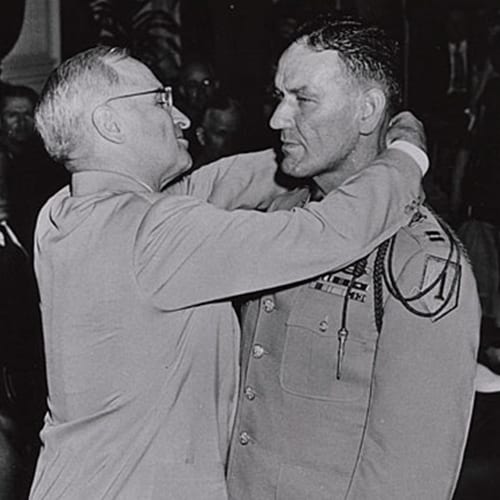
For his extraordinary heroism, Brown received the Medal of Honor, authorized by War Department General Orders No. 74, dated 1 September 1945. President Harry S. Truman personally presented the decoration at the White House on 23 August 1945.
Throughout World War II, Brown sustained 13 combat wounds and received eight Purple Hearts, a remarkable testament to the dangers he repeatedly faced. His distinguished service was also recognized with the Bronze Star Medal.
After a lengthy military career, Brown left the Army in 1952 and later worked at the United States Military Academy at West Point. He died on 8 November 1971 and was laid to rest at Arlington National Cemetery.
Captain Bobbie Evan Brown Jr.'s legacy is not defined solely by the enemy positions he destroyed or the medals he earned. It lives in the leadership he demonstrated under fire, the soldiers he fought to protect, and his refusal to abandon his duty even when severely wounded. His story remains a powerful example of courage, sacrifice, and service.
Become the named supporter for this profile and edit the tribute biography and portrait (Owner account required). Proceeds help keep the archive online.
$25 USD / year — annual sponsorship renewal. Keeps the page online and, where enabled, the family anniversary remembrance emails active.