★
Loading archive…
Loading archive…
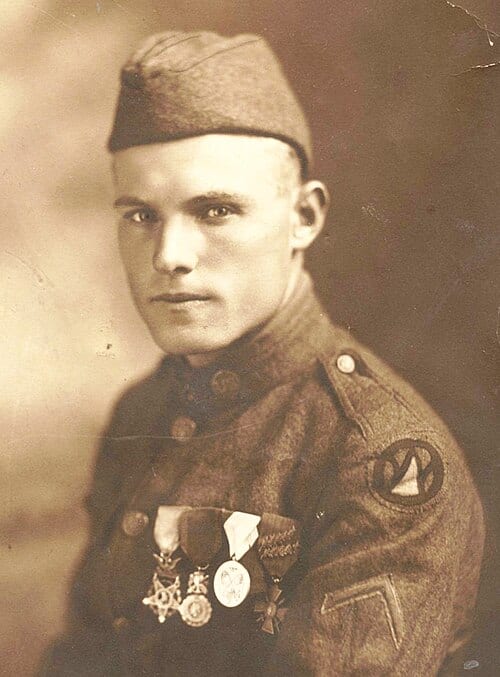
Private First Class, U.S. Army
Support & adopt this hero ↓
How far would a soldier go to save a wounded comrade? For Private First Class Charles Denver Barger, the answer was 500 yards across enemy-controlled ground under relentless machine-gun fire. On 31 October 1918, near Bois-de-Bantheville, France, Barger and fellow soldier Jesse N. Funk volunteered to rescue American patrolmen trapped in No Man's Land. Their extraordinary courage would earn them the United States Medal of Honor and recognition from several Allied nations.
Born in Mount Vernon, Missouri, Barger was raised by Sidney and Phoebe Barger in Stotts City, where he worked as a farmhand before enlisting in the United States Army on 1 April 1918. He was assigned to Company L, 354th Infantry Regiment, 89th Division, and arrived in France that June. Selected as an automatic rifle gunner, he served during the Saint-Mihiel Offensive and the Meuse-Argonne Offensive, becoming known for his courage under fire.
His defining act occurred on 31 October 1918. After two American patrols became trapped by German machine-gun fire, Barger and Funk crossed approximately 500 yards of exposed ground carrying a stretcher. They rescued two wounded officers, returning through the same dangerous terrain under constant enemy fire. According to the Department of War's account, they also made another journey to recover a wounded enlisted man near a German machine-gun position. The official Medal of Honor citation, published in War Department General Orders No. 20 on 30 January 1919, specifically recognizes their rescue of the two wounded officers. General John J. Pershing presented Barger with the Medal of Honor in France in February 1919.
Barger's courage was not confined to a single day. His French Croix de Guerre 1914-1918 citations recorded several acts of exceptional bravery. Near Bouillonville on 12 September 1918, he volunteered to search for a missing member of a raiding party, engaging a German machine-gun position and rescuing his comrade. On 31 October, he helped bring two wounded officers back to American lines. On 1 November, he attacked a German machine-gun position from the rear with another soldier, helping capture its crew and weapons. On 2 November, another citation recognized his defence of a group of soldiers near Barricourt against repeated enemy attacks. These four citations were represented by three bronze palms and one bronze star on his French Croix de Guerre.
His Allied recognition extended across Europe. France awarded him the prestigious Médaille militaire by presidential decree on 5 May 1919. Montenegro conferred its Silver Medal for Bravery under Order No. 311, dated 31 May 1919. Belgium recognized his rescue work with the Croix de Guerre, while Great Britain awarded him the Military Medal, recorded in War Office Bulletin WO/338 in 1919. Italy also awarded him the Croce al Merito di Guerra, authorized under Royal Decree No. 205 and registered by the Italian Army in 1921. Missouri separately recognized his wartime service with its War with Germany Medal. His post-Armistice occupation service in Germany also qualified him retrospectively for the Army of Occupation of Germany Medal, established in the 1940s.
After returning home, Barger resumed farming, attempted construction work and briefly returned to military service in 1921. In 1922, he joined the Kansas City Police Department. His courage was tested again when he became involved in a gunfight with suspected criminals and was shot five times. Remarkably, he survived and continued serving as a police officer for approximately twelve years before eventually returning to farm work near Oak Grove, Missouri.
Charles Denver Barger died on 25 November 1936 and was buried at Blue Springs Cemetery. His Medal of Honor had been donated to the Liberty Memorial Museum after his death, but it was stolen during a 1967 burglary and never recovered. Following decades of efforts by his family, the United States Army issued a replacement Medal of Honor in January 2014. An Army Reserve Center in Kansas City was subsequently named in his honour.
Charles D. Barger remains a remarkable example of courage, initiative and selfless service during the First World War. From the battlefields of France to the streets of Kansas City, his life reflected a determination to protect others, even at extraordinary personal risk.
Become the named supporter for this profile and edit the tribute biography and portrait (Owner account required). Proceeds help keep the archive online.
$25 USD / year — annual sponsorship renewal. Keeps the page online and, where enabled, the family anniversary remembrance emails active.