★
Loading archive…
Loading archive…
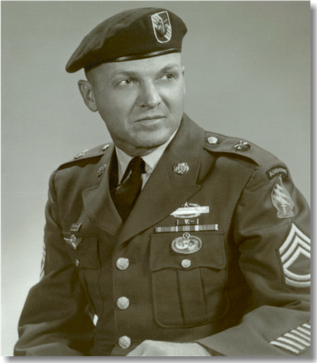
Master Sergeant (posthumous), U.S. Army
Support & adopt this hero ↓
What kind of courage makes a soldier choose certain death so that others may live? On March 21, 1967, deep in South Vietnam, American Green Beret Charles Ernest Hosking Jr. answered that question with his life. A battle-hardened veteran of World War II and one of the early pioneers of U.S. Army Special Forces, Hosking survived some of Europe's fiercest fighting before making the ultimate sacrifice in Vietnam. His extraordinary final act earned him the Medal of Honor, America's highest military decoration for valor.
Born on May 12, 1924, in Ramsey, New Jersey, Charles Ernest Hosking Jr. seemed determined to become a soldier long before he was old enough to serve. At sixteen, he traveled to Canada and enlisted in the Canadian Army, only to be discharged when his true age was discovered. Undeterred, he subsequently joined the United States Coast Guard, but a heart condition brought another premature discharge. In June 1943, he entered the U.S. Army, beginning a remarkable military career that would span nearly twenty-four years.
During World War II, Hosking served with Company B, 509th Parachute Infantry Battalion, participating in the Rome-Arno, Southern France and Ardennes-Alsace campaigns. His unit took part in the invasion of Southern France, while the bitter winter fighting of the Battle of the Bulge left him seriously wounded. His wartime service was recognized with the Bronze Star Medal for valor, an additional Bronze Star Medal, and the Purple Heart with Oak Leaf Cluster, representing two awards for wounds received in military service. His European service also brought the European-African-Middle Eastern Campaign Medal with campaign stars and an assault-landing arrowhead, alongside the World War II Victory Medal.
For Hosking, the end of World War II was not the end of his military calling. He remained in uniform, served in airborne training assignments, and joined the newly established U.S. Army Special Forces. Known as "The Snake" for his exceptional ability to move quietly and skillfully, he developed expertise in demolitions, languages and unconventional warfare. His lengthy career included service in Germany and three deployments to Vietnam. His record also included the Army Commendation Medal, six awards of the Army Good Conduct Medal, the Army of Occupation Medal and the National Defense Service Medal.
By March 1967, Hosking was serving as a Sergeant First Class with Detachment A-302, Company A, 5th Special Forces Group (Airborne), advising a Civilian Irregular Defense Group reaction battalion in South Vietnam. His Vietnam service was recognized with the Vietnam Service Medal and three bronze campaign stars, the Republic of Vietnam Campaign Medal, and qualifying unit awards.
Then came the moment that would define his legacy forever.
On March 21, 1967, during operations in Don Luan District, Phuoc Long Province, a captured Viet Cong suspect was identified as an enemy sniper. As Hosking prepared to transfer the prisoner to a nearby Special Forces camp, the man suddenly seized a grenade from Hosking's belt, armed it, and rushed toward a command group consisting of two American and two South Vietnamese soldiers.
Hosking had only seconds to react. Rather than seek cover, he leaped onto the fleeing prisoner, locked him in a powerful embrace and forced the armed grenade against the man's chest. He wrestled the prisoner to the ground and covered him with his own body. When the grenade exploded, both men were killed. By absorbing the blast, Hosking saved the four members of the command group from death or serious injury.
His official Medal of Honor citation recognized his conspicuous gallantry, extraordinary self-sacrifice and willingness to risk his life far beyond the call of duty. The United States Army formally announced the posthumous award in General Orders No. 39 on June 13, 1969. On May 23, 1969, President Richard Nixon presented the Medal of Honor during a White House ceremony, placing it around the neck of Hosking's eight-year-old son, Wesley.
Posthumously promoted to Master Sergeant, Charles Ernest Hosking Jr. was laid to rest at Valleau Cemetery in Ridgewood, New Jersey. His legacy lives on through the U.S. Army Special Forces community, the family he left behind and the four men whose lives he saved.
In the final seconds of his life, Charles Hosking made a decision that revealed the true meaning of heroism: he gave up his own future so that four other men could keep theirs.
Become the named supporter for this profile and edit the tribute biography and portrait (Owner account required). Proceeds help keep the archive online.
$25 USD / year — annual sponsorship renewal. Keeps the page online and, where enabled, the family anniversary remembrance emails active.