★
Loading archive…
Loading archive…

He kept directing his guns despite wounds from hostile fire.
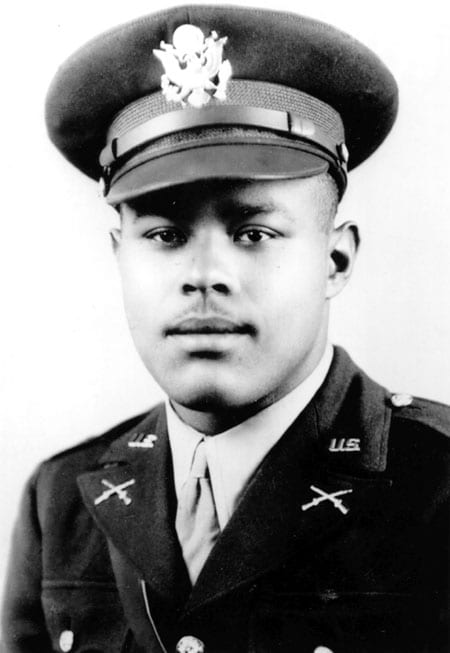
Charles Leroy Thomas was a U.S. Army officer whose leadership under fire at Climbach, France, became the basis for a posthumous Medal of Honor. Born in Birmingham, Alabama, on April 17, 1920, he grew up in Detroit, graduated from Cass Technical High School in 1938, and worked as a molder at a Ford Motor Company plant while studying mechanical engineering at Wayne State University. Drafted on January 20, 1942, Thomas entered the Army as an infantryman, attended officer training, and received his commission as a second lieutenant on March 11, 1943. He was assigned to Company C of the 614th Tank Destroyer Battalion, a segregated African American unit whose company officers, noncommissioned officers, and enlisted ranks were Black, although its senior battalion leadership was white.
The 614th reached England in September 1944 and entered combat in France later that year as part of General George S. Patton’s Third Army. Attached to the 103rd Infantry Division, the battalion’s towed antitank guns were used against German armor and fortified positions. On December 14, Thomas, then a first lieutenant and commander of Company C, volunteered to lead its Third Platoon as the advance element of a task force ordered to capture Climbach, a village near the German border. With little intelligence about the defenders and no reconnaissance, he rode at the head of the column in an M-20 scout car, accepting the danger that the lead vehicle would draw the first enemy fire.
German artillery, self-propelled guns, and small arms struck Thomas’s scout car as it reached exposed high ground southeast of Climbach. The first burst disabled the vehicle and severely wounded him. Thomas signaled the column to stop, helped his crew leave the wreck, and was hit again by gunfire, suffering multiple wounds in his chest, legs, and left arm. Despite his injuries, he directed the emplacement of the platoon’s first two antitank guns; within minutes, they were returning fire. Knowing he could no longer command effectively, he called the platoon commander forward, briefed him on the enemy positions, ammunition, and situation, and refused evacuation until he was satisfied that the officer had control. The platoon fought on, helping the task force take Climbach. Its action earned a Distinguished Unit Citation, later known as the Presidential Unit Citation, and it was recognized as the first African American combat unit to receive that award.
Thomas received the Distinguished Service Cross for Climbach and was promoted to captain in February 1945. After recovering from his wounds, he remained in the Army and retired as a major on August 10, 1947. In civilian life he worked as a missile technician at Selfridge Air Force Base and later as a computer programmer for the Internal Revenue Service. He married and had two children. Thomas died in Wayne, Michigan, on February 15, 1980, and was buried at West Lawn Cemetery.
A U.S. Army-commissioned review in the 1990s documented racial discrimination in the World War II decorations process and recommended that Thomas’s Distinguished Service Cross be upgraded. President Bill Clinton posthumously presented him the Medal of Honor at the White House on January 13, 1997; his niece accepted it. The belated award recognized both Thomas’s own courage and the injustice that had prevented Black servicemen from receiving full consideration during and immediately after the war.
### Medal of Honor citation
“For conspicuous gallantry and intrepidity at the risk of his life above and beyond the call of duty: Then Lieutenant Charles L. Thomas distinguished himself by extraordinary heroism in action on 14 December 1944. One platoon of Company C, 614th Tank Destroyer Battalion, was designated as the lead element in a task force formed to storm and capture the village of Climbach, France. Lieutenant Thomas, the Commanding Officer of Company C, realized, with the obscurity of information regarding the enemy and a complete lack of reconnaissance, the mission would be an extremely dangerous one. Fully cognizant of the danger, Lieutenant Thomas volunteered to command the selected platoon of his company and ride in the column's leading vehicle - a highly maneuverable, but equally vulnerable, M-20 scout car.
Lieutenant Thomas knew that if there was a concentration of enemy armor in the village, as was believed, he would absorb the initial shock of the first enemy resistance. The task force left Preuschdorf, France, at 1023 hours, and proceeded to advance in column toward Climbach. Lieutenant Thomas in his scout car stayed well in front of the column. At 1400 hours, upon reaching the high ground southeast of the village, Lieutenant Thomas experienced initial contact with the enemy. As his scout car advanced to an exposed position on the heights, he received intense direct fire from enemy artillery, self-propelled guns, and small arms at a range of seven hundred yards. The first burst of hostile fire disabled the scout car and severely wounded Lieutenant Thomas. He immediately signaled the column to halt. Before leaving the wrecked vehicle, Lieutenant Thomas and the crew found themselves subjected to a veritable hail of enemy fire.
Lieutenant Thomas received multiple gunshot wounds in his chest, legs, and left arm. In spite of the intense pain caused by his wounds, Lieutenant Thomas ordered and directed the dispersion and emplacement of his first two antitank guns. In a few minutes these guns were effectively returning the enemy fire. Realizing that it would be impossible for him to remain in command of the platoon because of his injuries, Lieutenant Thomas then signaled for the platoon commander to join him. Lieutenant Thomas then thoroughly oriented him as to the enemy gun positions, his ammunition status, and the general situation. Although fully cognizant of the probable drastic consequences of not receiving prompt medical attention, Lieutenant Thomas refused evacuation until he felt certain that his junior officer was in full control of the situation. Only then did Lieutenant Thomas allow his evacuation to the rear. Throughout the action, Lieutenant Thomas displayed magnificent personal courage and a complete disregard for his own safety. His extraordinary heroism spurred the soldiers of the platoon to a fierce determination to triumph, and resulted in a mass display of heroism by them. Lieutenant Thomas' intrepid actions throughout the operation reflect the highest traditions of military service.”
### Sources
1. Congressional Medal of Honor Society. “Charles Leroy Thomas.” Recipient record, including service details, presentation date, burial information, and the full Medal of Honor citation. 2. Katie Lange, DOD News. “Medal of Honor Monday: Army Maj. Charles L. Thomas.” U.S. Department of War, December 14, 2020. Service history, Climbach action, postwar career, and 1997 presentation. 3. National Park Service. “Charles L. Thomas.” Biography, account of the Climbach action, postwar life, discrimination review, and award presentation. Last updated August 31, 2022. 4. Ed Lengel, PhD. “Major Charles L. Thomas and the 614th Tank Destroyer Battalion.” The National WWII Museum, July 24, 2020. Unit history, segregation and racism, combat role, and the Presidential Unit Citation at Climbach.
Become the named supporter for this profile and edit the tribute biography and portrait (Owner account required). Proceeds help keep the archive online.
$25 USD / year — annual sponsorship renewal. Keeps the page online and, where enabled, the family anniversary remembrance emails active.