★
Loading archive…
Loading archive…
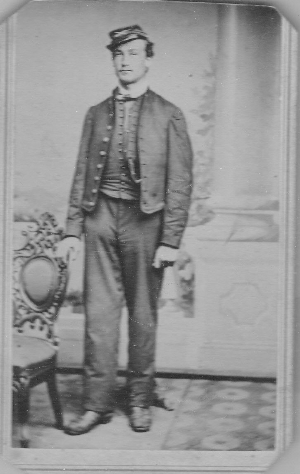
In the closing days of the American Civil War, when victory was finally within reach, one cavalry bugler performed an act of extraordinary bravery that earned the nation's highest military decoration. Charging into the fighting at Appomattox, Chief Bugler Charles Schorn captured the battle flag of the Confederate Sumter Flying Artillery, an achievement that secured his place among the Medal of Honor recipients whose courage helped bring the conflict to its historic conclusion.
Charles Schorn was born on 1 May 1842 in Germany and later immigrated to the United States. With the Civil War underway, he enlisted in the Union Army on 8 September 1861 and joined Company M, 1st West Virginia Cavalry. Although serving as a bugler, Schorn's duties extended far beyond sounding military calls. Like many cavalry buglers, he often found himself in the thick of combat, accompanying mounted troops during some of the war's most demanding campaigns. His dedication and leadership earned him promotion to Chief Bugler in June 1863.
Schorn's defining moment came on 8 April 1865 during the Appomattox Campaign in Virginia. As Union forces pressed the retreating Army of Northern Virginia in the final days of the Civil War, fierce fighting erupted near Appomattox Station. During the action, Schorn boldly captured the battle flag of the Confederate Sumter Flying Artillery, depriving the enemy of one of its most important military symbols. The official Medal of Honor citation simply records: "Capture of flag of the Sumter Flying Artillery (C.S.A.)." His heroism was recognized almost immediately, and he was awarded the Medal of Honor on 3 May 1865, less than a month after the action.
Schorn continued serving with the 1st West Virginia Cavalry until the regiment was mustered out of Federal service on 8 July 1865. His wartime service qualified him for the Civil War Campaign Medal when it was established by the War Department in 1907, commemorating the service of Union soldiers who had fought to preserve the United States during its greatest internal conflict.
Following the war, Charles Schorn returned to civilian life and remained a respected veteran of the Union Army. Like many former soldiers, he became part of the growing community of Civil War veterans whose service helped shape the nation's memory of the conflict. His Medal of Honor stood as lasting recognition of exceptional courage displayed during one of the war's final and most decisive campaigns.
Charles Schorn died on 29 October 1915 and was buried at Arlington National Cemetery, where many of America's most distinguished servicemen and women are laid to rest. His Medal of Honor continues to commemorate a remarkable act of battlefield bravery at Appomattox, symbolizing the courage, determination, and sacrifice of the Union cavalrymen who fought through the Civil War to its victorious conclusion.
Become the named supporter for this profile and edit the tribute biography and portrait (Owner account required). Proceeds help keep the archive online.
$25 USD / year — annual sponsorship renewal. Keeps the page online and, where enabled, the family anniversary remembrance emails active.