★
Loading archive…
Loading archive…
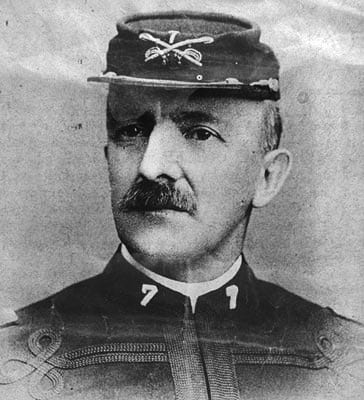
Colonel, U.S. Army
Support & adopt this hero ↓
He survived the Battle of the Little Bighorn. Fourteen years later, he defied a withdrawal order and led his cavalrymen into danger to protect fellow soldiers. Colonel Charles Albert Varnum, a United States Army officer and Medal of Honor recipient, witnessed some of the most consequential and controversial events of the American Indian Wars. His military career spanned nearly five decades and brought him both the Medal of Honor and the Silver Star.
Born on June 21, 1849, in Troy, New York, Varnum graduated from the United States Military Academy at West Point in 1872 and received his commission in the 7th U.S. Cavalry. He participated in the Yellowstone Expedition of 1873, fighting at Tongue River and Yellowstone River, before joining Lieutenant Colonel George Armstrong Custer's 1876 campaign. Serving as Custer's chief of Indian scouts, Varnum witnessed the disastrous Battle of the Little Bighorn on June 25 and 26, 1876, where he was wounded but survived.
On December 29, 1890, Captain Varnum commanded Troop B of the 7th Cavalry during the Battle of Wounded Knee in South Dakota, an event remembered as the Wounded Knee Massacre because of the deaths of numerous Lakota men, women and children. His conduct was officially commended for gallant service in action against Sioux fighters, recognition that subsequently formed the basis for his Silver Star.
The following day brought the action that earned Varnum the Medal of Honor. On December 30, 1890, during fighting near White Clay Creek, also known as the Drexel Mission engagement, his regiment began withdrawing under pressure from Lakota forces. Varnum recognized that continuing the retreat would expose another cavalry troop to encirclement. Disregarding the order to retire, he placed himself at the front of his men, led a charge against the advancing force and regained commanding ground. His decisive intervention enabled two detachments to withdraw without further loss. The Medal of Honor citation recognized his courage and battlefield judgment, and the decoration was issued on September 22, 1897.
Varnum continued serving through the Spanish-American War period, helping organize volunteer cavalry before deploying to Havana, Cuba, with American occupation forces in 1899. His documented service qualified him for the Indian Campaign Medal, Spanish War Service Medal and Army of Cuban Occupation Medal. He subsequently commanded the military post at Malabang, Mindanao, during his 1905 to 1907 Philippine assignment, although his personal participation in a qualifying Philippine combat expedition remains unverified.
Retired for disability in October 1907, Varnum nevertheless continued performing military duties. During World War I, he served in recruiting and quartermaster assignments in the United States, qualifying for the World War I Victory Medal. He attained the rank of colonel on the retired list in July 1918 and completed his final active-duty assignment in April 1919.
Colonel Charles Albert Varnum died on February 26, 1936, aged 86, and was buried at San Francisco National Cemetery. The National Park Service identifies him as the last surviving veteran officer of the Battle of the Little Bighorn. His life connects the frontier campaigns of the 1870s, the tragedy of Wounded Knee and the changing United States Army of the early twentieth century. His legacy combines documented personal gallantry with the complex history of American military expansion.
Become the named supporter for this profile and edit the tribute biography and portrait (Owner account required). Proceeds help keep the archive online.
$25 USD / year — annual sponsorship renewal. Keeps the page online and, where enabled, the family anniversary remembrance emails active.