★
Loading archive…
Loading archive…
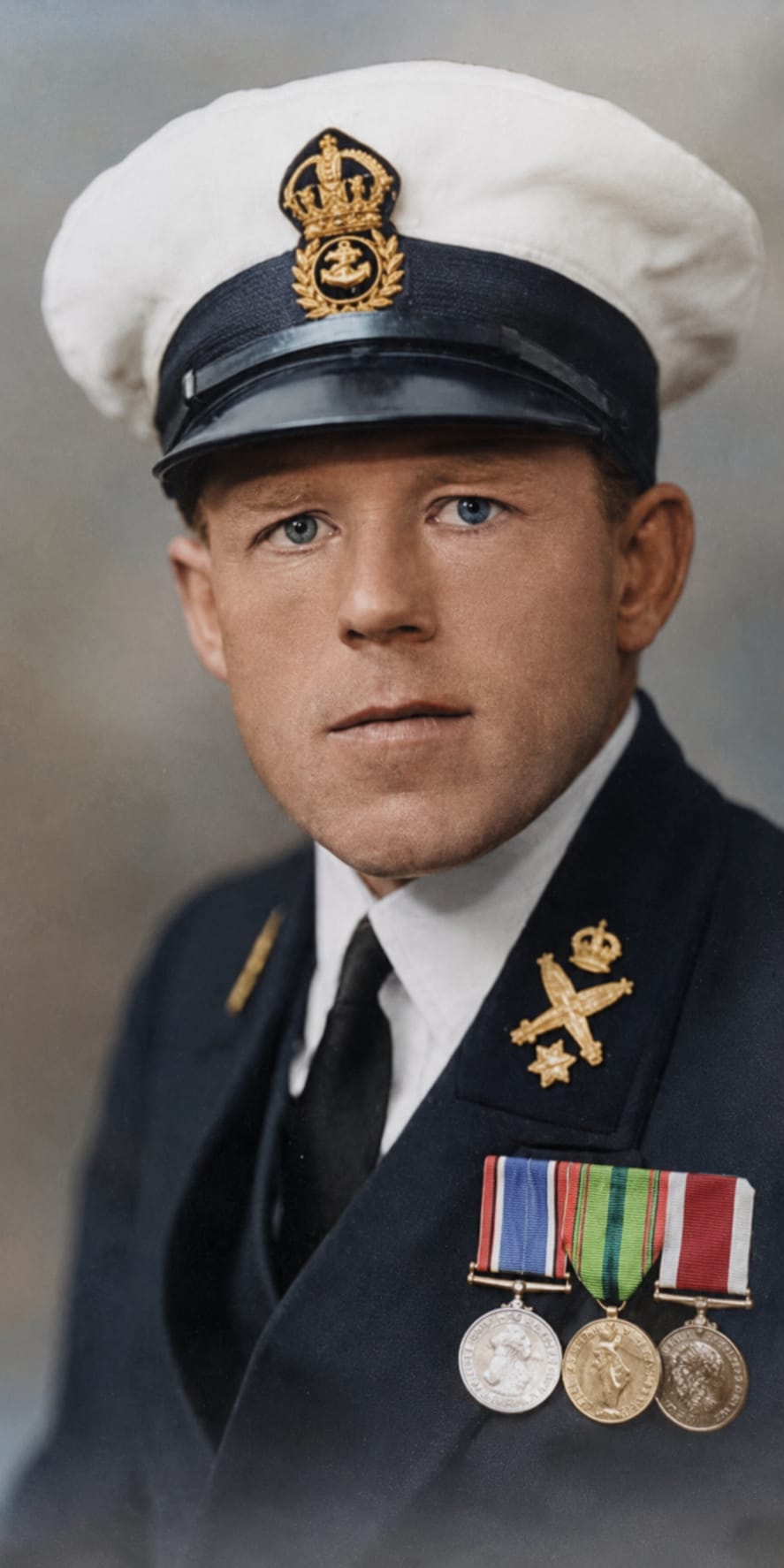
Chief Petty Officer, Royal Australian Navy
Support & adopt this hero ↓
The Last Combat Veteran of the First World War
Few sailors have witnessed the surrender of an enemy fleet, watched that same fleet sink beneath the waves, served through another world war, and lived long enough to become the final surviving combat veteran of the First World War. Chief Petty Officer Claude Stanley Choules did all of these things. His extraordinary journey stretched from the age of battleships and imperial navies to the modern Royal Australian Navy, creating a living connection between two world wars and more than a century of naval history.
Claude Stanley Choules was born in Pershore, Worcestershire, England, on 3 March 1901. Determined to pursue a life at sea, he joined the Royal Navy as a Boy on 10 October 1916 and trained aboard HMS Impregnable at Devonport. In 1917 he was posted to the battleship HMS Revenge, flagship of the First Battle Squadron of the Grand Fleet. From her decks, the young sailor witnessed the surrender of the German High Seas Fleet in November 1918. The following year, he was present at Scapa Flow when the interned German warships were deliberately scuttled by their own crews, one of the most dramatic episodes in twentieth-century naval history. He later served in the Black Sea during the upheaval that followed the collapse of the Russian and Ottoman empires.
Choules remained with the Royal Navy after the war, serving in HMS Valiant with the Mediterranean Fleet and later aboard HMS Eagle, Britain’s first purpose-built aircraft carrier. In 1926 he travelled to Australia with a group of experienced Royal Navy sailors to serve as an instructor at Flinders Naval Depot. He soon decided to make Australia his permanent home and transferred to the Royal Australian Navy. After qualifying as a Chief Torpedo and Anti-Submarine Instructor, he became a commissioning crew member of the heavy cruiser HMAS Canberra and served aboard her until 1931.
When the Second World War began, Choules was serving in Western Australia as an Acting Torpedo Officer and specialist in anti-submarine warfare, mines and explosives. He disposed of the first German mine recorded as having washed ashore in Australia during the war. As Chief Demolition Officer for Western Australia, he was also entrusted with an alarming responsibility. Should Japanese forces invade, Choules was prepared to destroy Fremantle Harbour’s facilities and oil-storage installations before they could fall into enemy hands. During the crisis of 1942, explosive charges were positioned around the harbour, while depth charges were placed aboard vessels that might have needed to be sunk to block the port.
His service was recognised by the British War Medal 1914 to 1920, Victory Medal, War Medal 1939 to 1945, Australia Service Medal 1939 to 1945, Queen Elizabeth II Coronation Medal, Centenary Medal, Australian Defence Medal, and Naval Long Service and Good Conduct Medal with Clasp. The long-service medal was awarded in December 1935, followed by a clasp in 1950, reflecting three decades of qualifying naval service. The Royal Australian Navy records that his Queen Elizabeth II Coronation Medal was awarded for his long service, while the Australian Defence Medal was added late in his life to recognise his qualifying postwar service.
Choules remained in Australian naval service after 1945 and transferred to the Naval Dockyard Police, allowing him to continue serving until March 1956. By then, his career in naval uniform had spanned approximately four decades across the Royal Navy and Royal Australian Navy. Yet the most striking part of his story was not simply how long he served. Despite experiencing two world wars, he came to oppose the glorification of conflict and viewed war as a mixture of long periods of tedium interrupted by moments of extreme danger. His perspective gave unusual moral weight to the memories of a man who had witnessed history at exceptionally close range.
Claude Choules died in Perth, Western Australia, on 5 May 2011 at the age of 110. At his death, he was recognised as the last surviving combat veteran of the First World War and the last veteran known to have served in both world wars. His name did not disappear with his passing. Later that year, the Royal Australian Navy commissioned HMAS Choules in his honour, making his name part of the fleet he had served for so many years. The ship remains a fitting memorial to an ordinary sailor whose remarkable life carried the memory of an entire generation.
Become the named supporter for this profile and edit the tribute biography and portrait (Owner account required). Proceeds help keep the archive online.
$25 USD / year — annual sponsorship renewal. Keeps the page online and, where enabled, the family anniversary remembrance emails active.