★
Loading archive…
Loading archive…
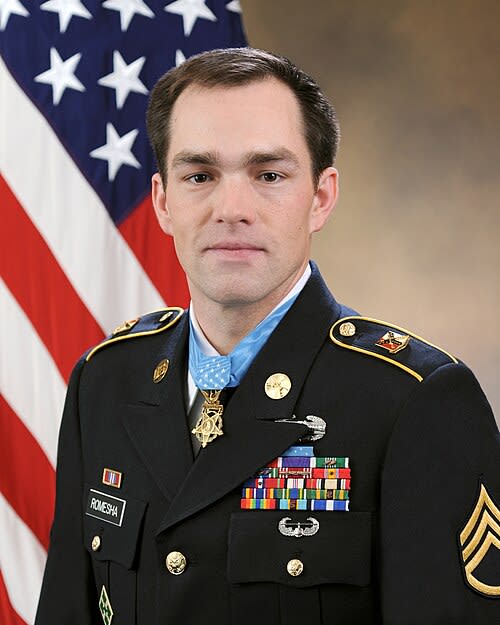
Staff Sergeant, U.S. Army
Support & adopt this hero ↓
Staff Sergeant Clinton Lovar Romesha was born on 17 August 1981 in Lake City, California. He came from a family with a strong tradition of military service and enlisted in the United States Army in September 1999. He entered the Army as an M1 Armor Crewman and completed his initial training at Fort Knox, Kentucky.
After training, Romesha was assigned as a tank gunner with B Company, 1st Battalion, 63rd Armor Regiment at Vilseck, Germany. During that assignment he deployed operationally to Kosovo. He later transferred to A Company, 2nd Battalion, 72nd Armor Regiment at Camp Casey, South Korea, where he served as a gunner and assistant tank commander. His Korean assignment also included a combat deployment to Iraq.
Romesha later joined 3rd Squadron, 61st Cavalry Regiment at Fort Carson, Colorado, where he served as a section leader and transitioned into the 19D Cavalry Scout specialty. During this period he completed the Long Range Reconnaissance Course, Advanced Leader Course and Air Assault Training. Over the course of his Army career, he deployed twice to Iraq in support of Operation Iraqi Freedom and once to Afghanistan in support of Operation Enduring Freedom.
In 2009, Romesha deployed to Afghanistan with Bravo Troop, 3rd Squadron, 61st Cavalry Regiment, 4th Brigade Combat Team, 4th Infantry Division. His unit was assigned to Combat Outpost Keating, a remote base in the Kamdesh District of Nuristan Province. The outpost sat at the bottom of a steep valley surrounded by high ground, terrain that made it exceptionally vulnerable to attack.
On the morning of 3 October 2009, Combat Outpost Keating came under a large, coordinated assault by an estimated 300 enemy fighters positioned on the surrounding high ground. The attackers opened fire with recoilless rifles, rocket-propelled grenades, heavy machine guns, mortars and small arms. Romesha was serving as a section leader when the attack began.
Romesha immediately moved through exposed ground under intense fire to assess the battlefield and reinforce defensive positions. He checked a forward battle position, then moved to the barracks, obtained an MK-48 machine gun, and returned to the fight with an assistant gunner. From limited cover behind a generator, he engaged and destroyed an enemy machine-gun team.
While he was engaging a second enemy machine-gun position, a rocket-propelled grenade struck the generator he was using for cover. The explosion wounded him with shrapnel, including injuries to his hip, arm and neck. Despite those wounds, Romesha remained in the fight rather than withdrawing for treatment.
As enemy fighters penetrated the outpost perimeter, Romesha continued moving between positions and organizing the defense. He obtained a sniper rifle, assembled a five-man team, and helped lead efforts to retake key areas of the outpost. During the fighting he personally engaged enemy fighters who had entered the compound and helped secure critical positions, including the ammunition supply point and entry control point.
Romesha maintained radio communication with the tactical operations center and identified enemy positions from which the attack was being coordinated. According to his official Medal of Honor citation, he directed air support that destroyed more than 30 enemy fighters. This wording is important: the official citation specifically attributes the destruction of more than 30 enemy fighters to the air support he directed.
Official Army battle reporting separately records that Romesha also helped coordinate broader supporting fires during the battle, but that broader narrative should not be conflated with the specific wording of the Medal of Honor citation. The citation itself attributes the “more than 30” result to air support.
During the battle, Romesha and his team also provided covering fire that allowed seriously wounded soldiers to escape from an exposed position and reach the aid station. Later, his team advanced approximately 100 meters under intense enemy fire to recover fallen American soldiers and prevent enemy fighters from taking their bodies.
The fight for Combat Outpost Keating lasted roughly half a day and became known as the Battle of Kamdesh. Eight American soldiers were killed, and more than twenty others were wounded. Romesha’s actions were critical in helping Bravo Troop regroup, counterattack and regain control of the outpost.
For his actions on 3 October 2009, Romesha was awarded the Medal of Honor, the United States’ highest military decoration. President Barack Obama presented the medal to him during a ceremony in the East Room of the White House on 11 February 2013.
During the ceremony, the White House emphasized that Romesha’s actions were part of a larger collective defense by the soldiers of Bravo Troop. Romesha himself repeatedly stressed that the battle had been a team effort and that the Medal of Honor also represented the sacrifice of the eight soldiers who were killed and the courage of the men who fought beside him.
Romesha remained in the Army until 4 April 2011, when he separated from active service after more than eleven years in uniform. His Army career had included assignments in Germany, Kosovo, South Korea and Colorado, as well as two deployments to Iraq and one to Afghanistan.
After leaving the Army, Romesha moved with his family to North Dakota and entered the oil industry. He worked in field safety and quality-assurance roles, drawing on many of the same leadership, risk-management and standards-enforcement skills he had used as a noncommissioned officer.
His military record includes numerous decorations and service awards. Among those listed by the U.S. Army are the Bronze Star Medal, Purple Heart, Army Commendation Medals, Army Achievement Medals, Army Good Conduct Medal, National Defense Service Medal, Afghanistan Campaign Medal, Iraq Campaign Medal, Kosovo Campaign Medal, Korean Defense Service Medal, Global War on Terrorism Service Medal, NATO Medal, Combat Action Badge and other service ribbons. The Army specifically records his Overseas Service Ribbon with Numeral 5—the correct device is the ordinary Numeral 5, not a Strike/Flight numeral.
Romesha later became an active public speaker on military service, leadership and the experience of combat. In 2016, he published Red Platoon: A True Story of American Valor, his firsthand account of the Battle of Combat Outpost Keating and the soldiers who fought there.
The book describes the battle from the perspective of the soldiers inside the outpost and places particular emphasis on teamwork, responsibility and the eight Americans who lost their lives. Romesha has consistently framed his own recognition within the broader story of the unit rather than presenting the battle as the achievement of a single individual.
Clinton Romesha’s Medal of Honor action was therefore not one isolated moment, but a sustained series of decisions made throughout an intense battle: moving through exposed ground, engaging enemy positions, continuing to fight after being wounded, organizing soldiers for a counterattack, directing air support, protecting wounded comrades and helping recover fallen soldiers. His conduct at Combat Outpost Keating became one of the best-known examples of small-unit leadership and battlefield courage from the war in Afghanistan.
Become the named supporter for this profile and edit the tribute biography and portrait (Owner account required). Proceeds help keep the archive online.
$25 USD / year — annual sponsorship renewal. Keeps the page online and, where enabled, the family anniversary remembrance emails active.