★
Loading archive…
Loading archive…
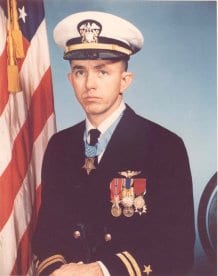
Commander, U.S. Navy
Support & adopt this hero ↓
With his helicopter damaged, enemy fire closing in, and barely five minutes of fuel remaining, U.S. Navy pilot Clyde Everett Lassen faced a decision that would define his place in American military history. Rather than abandon two downed aviators deep inside enemy territory, he made another attempt to bring them home. On 19 June 1968, during the Vietnam War, Lieutenant Junior Grade Lassen piloted a UH-2A Seasprite helicopter into North Vietnam to rescue Lieutenant Commanders John Holtzclaw and John Burns, whose F-4J Phantom II had been shot down by a surface-to-air missile.
Flying through darkness over hostile terrain, Lassen repeatedly attempted to reach the stranded airmen. Enemy fire, dense vegetation, and extinguished flares made the rescue extraordinarily dangerous. During one approach, his helicopter struck a tree and suffered significant damage. Yet Lassen recovered control and refused to abandon the mission. When the flares went out again, he switched on his landing lights, knowingly exposing his position to enemy forces. The two aviators finally reached the helicopter, and Lassen evaded further antiaircraft fire before landing safely aboard USS Jouett with approximately five minutes of fuel remaining.
The official Medal of Honor citation recognised Lassen for conspicuous gallantry and intrepidity above and beyond the call of duty. Presented by President Lyndon B. Johnson at the White House on 16 January 1969, the Medal of Honor made Lassen the first naval aviator to receive the nation's highest award for an act of heroism during the Vietnam War.
Born on 14 March 1942 in Fort Myers, Florida, Lassen grew up in Englewood and graduated from Venice High School in 1960. He enlisted in the United States Navy on 14 September 1961, initially serving as an aviation electronics technician. Selected for the Naval Aviation Cadet Program in 1964, he received his commission and naval aviator wings on 12 October 1965. He began his operational career with Helicopter Combat Support Squadron 1, serving as Officer in Charge of Detachment Cubi Point in the Philippines and H-2 combat search-and-rescue detachments in the Gulf of Tonkin. These detachments became part of Helicopter Combat Support Squadron 7 in 1967. He later served as Officer in Charge of HC-7 Detachment 104 aboard USS Preble.
His recorded personal decorations included the Bronze Star Medal with Combat V, the Air Medal with Award Numeral 1 for his first Strike/Flight award, and the Navy Presidential Unit Citation earned through his unit's qualifying service. His other documented awards included the Navy Good Conduct Medal, National Defense Service Medal, Vietnam Service Medal with four bronze campaign stars, and Republic of Vietnam Campaign Medal with the 1960 device.
Lassen continued serving his country after Vietnam, with assignments that included VT-1, USS Austin, Naval Air Station Norfolk, HS-11, and HS Wing One. He eventually commanded Helicopter Training Squadron Eight before retiring as a Commander in December 1982. He died on 1 April 1994 in Pensacola, Florida, and was laid to rest at Barrancas National Cemetery. His legacy lives on through the guided-missile destroyer USS Lassen (DDG-82), commissioned in 2001 in his honour. Commander Clyde Everett Lassen remains an enduring example of courage, determination, and selfless devotion to duty in the finest traditions of United States naval aviation.
Medal of Honor citation
For conspicuous gallantry and intrepidity at the risk of his life above and beyond the call of duty as pilot and aircraft commander of a search-and-rescue helicopter, attached to Helicopter Support Squadron 7, during operations against enemy forces in North Vietnam. Launched shortly after midnight to attempt the rescue of two downed aviators, Lt. (then Lt. (j.g.) Lassen skillfully piloted his aircraft over unknown and hostile terrain to a steep, tree-covered hill on which the survivors had been located. Although enemy fire was being directed at the helicopter, he initially landed in a clear area near the base of the hill, but, due to the dense undergrowth, the survivors could not reach the helicopter. With the aid of flare illumination, Lt. Lassen successfully accomplished a hover between two trees at the survivors' position. Illumination was abruptly lost as the last of the flares were expended, and the helicopter collided with a tree, commencing a sharp descent. Expertly righting his aircraft and maneuvering clear, Lt. Lassen remained in the area, determined to make another rescue attempt, and encouraged the downed aviators while awaiting resumption of flare illumination. After another unsuccessful, illuminated rescue attempt, and with his fuel dangerously low and his aircraft significantly damaged, he launched again and commenced another approach in the face of the continuing enemy opposition. When flare illumination was again lost, Lt. Lassen, fully aware of the dangers in clearly revealing his position to the enemy, turned on his landing lights and completed the landing. On this attempt, the survivors were able to make their way to the helicopter. En route to the coast he encountered and successfully evaded additional hostile antiaircraft fire and, with fuel for only five minutes of flight remaining, landed safely aboard U.S.S. Jouett (DLG-29).
Become the named supporter for this profile and edit the tribute biography and portrait (Owner account required). Proceeds help keep the archive online.
$25 USD / year — annual sponsorship renewal. Keeps the page online and, where enabled, the family anniversary remembrance emails active.