★
Loading archive…
Loading archive…
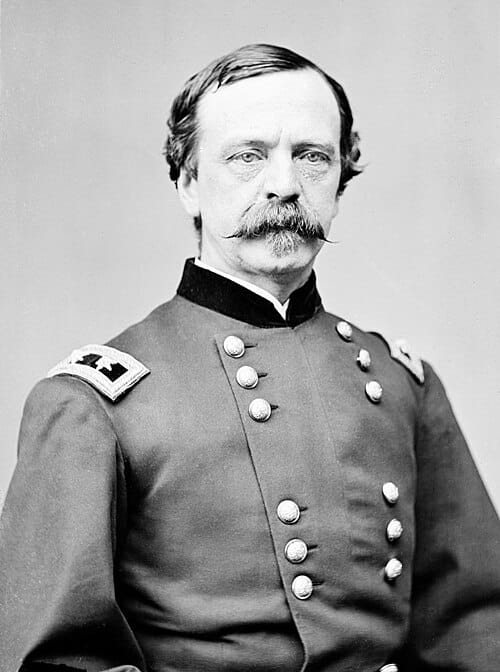
Major general, U.S. Army
Support & adopt this hero ↓
Daniel Edgar Sickles was born on October 20, 1819, in New York City. Long before the American Civil War, he had already built a prominent public career in law, politics, and diplomacy. He served in public office in New York and later represented the state in the United States Congress. When the Civil War began, Sickles entered military service and became one of the most politically prominent officers to rise to high command in the Union Army.
Sickles served in the United States Army as a major general of volunteers. His military career was closely associated with the Army of the Potomac, and he eventually commanded III Corps. His service placed him in several major campaigns and battles during the war, including the Peninsula Campaign, Chancellorsville, and Gettysburg.
As a corps commander, Sickles was responsible for thousands of soldiers and for making decisions that could affect the outcome of entire sections of a battlefield. His leadership style was aggressive and sometimes controversial, but his personal courage in combat was never in serious doubt.
The defining action of his military career came during the Battle of Gettysburg in July 1863. Gettysburg became one of the largest and most important battles of the American Civil War, as Confederate General Robert E. Lee’s Army of Northern Virginia invaded Pennsylvania and was confronted by the Union Army of the Potomac.
On July 2, 1863, Sickles commanded III Corps on the Union left. During the battle, he moved his corps forward from the originally assigned defensive position to a more advanced line. This decision created a large exposed salient and became one of the most debated command decisions of the battle.
The advanced III Corps position was soon struck by powerful Confederate attacks. Fighting became extremely intense in areas including the Peach Orchard, the Wheatfield, and nearby ground. Sickles remained with his troops as the Confederate assault developed and his corps came under enormous pressure.
During the fighting, Sickles was struck in the right leg by a Confederate cannonball. The wound was catastrophic and required amputation. Despite the severity of his injury, he remained composed and continued encouraging his soldiers while being carried from the battlefield.
This conduct under fire became the basis for his Medal of Honor. His recognition focused on his conspicuous gallantry and leadership at Gettysburg while under heavy enemy attack and after suffering a devastating wound.
Sickles survived the amputation and the battle. His injury ended his effective field command, but it did not end his public career. His amputated leg was preserved and later became one of the most famous medical artifacts associated with a Civil War officer.
The Medal of Honor had been established during the Civil War and became the highest military decoration of the United States. The Army Medal of Honor was authorized in 1862 to recognize extraordinary acts of courage and distinguished conduct in military service.
For Sickles, the Medal of Honor recognized his conduct at Gettysburg on July 2, 1863. Although the heroic action occurred during the Civil War, the award was presented many years later, on October 30, 1897.
For the project database, his decoration should be represented as:
Medal of Honor 1862–1895 Army — No device or clasp
This is the only medal that should currently appear in his final verified ribbon rack under the project’s evidence standard.
The Army Civil War Campaign Medal should not be added automatically. Sickles clearly served extensively in the Civil War and unquestionably participated in major Union campaigns, but campaign service alone does not establish recipient-specific entitlement to a later-issued medal.
Because the project requires individual evidence for campaign-medal entitlement rather than simple historical eligibility, the Civil War Campaign Medal remains excluded from his final rack.
Sickles’s military career before Gettysburg had already been significant. He had raised and organized troops in New York and rose quickly through command responsibility. His political connections helped accelerate his advancement, but his battlefield experience became substantial as the war continued.
During the Peninsula Campaign, Sickles and his troops participated in the difficult fighting associated with Union operations near Richmond. His forces later took part in the Battle of Chancellorsville in May 1863, where the Army of the Potomac suffered a major defeat.
Only two months later came Gettysburg, the battle that permanently defined Sickles’s military reputation.
His decision to advance III Corps from its assigned position at Gettysburg has remained controversial among military historians. Critics have argued that the movement disrupted the intended Union defensive line and exposed the corps to severe attack. Others have argued that the movement forced combat onto ground that played a role in absorbing Confederate momentum.
What is not in serious dispute is that Sickles personally remained in the combat zone under heavy fire and suffered a devastating wound while directing his troops.
After recovering from his Gettysburg injury, Sickles continued to serve the United States in important military and diplomatic roles. He was assigned to various duties rather than returning to major battlefield command.
After the Civil War, Sickles became involved in Reconstruction-era military administration in the South. He later served as United States Minister to Spain, continuing the diplomatic career he had begun before the war.
His years in Spain added another major chapter to his public life. Sickles became a prominent American representative abroad and remained active in political and diplomatic affairs.
He later returned to the United States and again served in Congress. His postwar public career demonstrated that his influence extended far beyond his Civil War military service.
Sickles also became closely associated with the preservation of the Gettysburg battlefield. In later life, he supported efforts to preserve and commemorate the ground where the battle had been fought.
This role was especially significant because Gettysburg was the place where his military career had reached both its most controversial and most heroic moment.
His combat specialty for the project should be classified as Infantry. Although Sickles was a general officer rather than an enlisted infantryman, his principal battlefield command at Gettysburg was an Army corps composed primarily of infantry formations engaged in ground combat.
The most appropriate metadata classifications are Male heroes, Army, and Ground combat (Army focus).
His major documented engagements include service in the Peninsula Campaign, Chancellorsville, and Gettysburg. His defining mission remains his Medal of Honor action at Gettysburg on July 2, 1863.
Daniel Edgar Sickles lived for more than fifty years after the Battle of Gettysburg. His long life allowed him to become one of the most recognizable surviving Union generals of the Civil War era.
He died on May 3, 1914, in New York City and was buried at Arlington National Cemetery.
His legacy remains complex. Sickles was a politician, diplomat, controversial commander, wounded corps general, and Medal of Honor recipient. His military decisions have continued to generate debate, but his personal courage at Gettysburg is securely established in the historical record.
His final project medal record is:
Medal of Honor 1862–1895 Army — No device or clasp
That single decoration represents the defining military honor of his life and permanently associates Daniel Edgar Sickles with the courage, controversy, and sacrifice of the Battle of Gettysburg.
Become the named supporter for this profile and edit the tribute biography and portrait (Owner account required). Proceeds help keep the archive online.
$25 USD / year — annual sponsorship renewal. Keeps the page online and, where enabled, the family anniversary remembrance emails active.