★
Loading archive…
Loading archive…
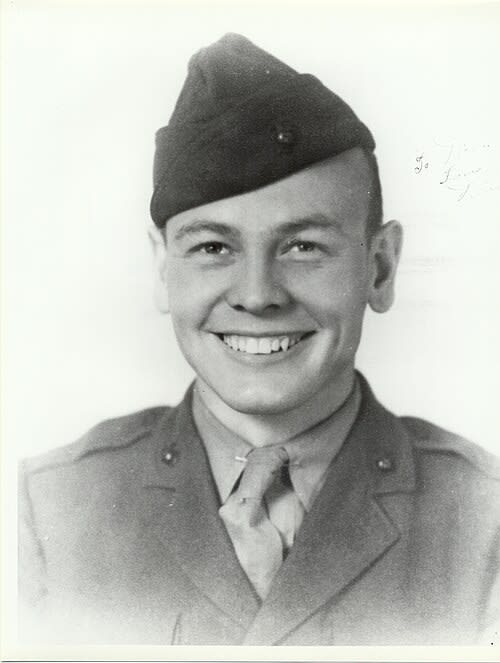
Sergeant, U.S. Marine Corps
Support & adopt this hero ↓
On the black volcanic sand of Iwo Jima, Sergeant Darrell Samuel Cole finally stood in the role he had spent much of the war fighting to obtain. He had entered the United States Marine Corps Reserve as a young man whose skill with the French horn sent him to Field Music School. Less than four years later, he was leading a Marine machine-gun section through some of the fiercest combat of World War II. On 19 February 1945, at just 24 years old, Cole launched a series of attacks against fortified Japanese positions that opened the way for his company to advance. He did not survive the assault. His actions earned him the Medal of Honor and made the Marine once known as the "Fighting Field Music" one of the enduring heroes of the Battle of Iwo Jima.
Darrell Samuel Cole was born on 20 July 1920 in Flat River, Missouri. He graduated from high school in nearby Esther in 1938, and as a young man enjoyed basketball, hunting and photography. He also learned to play the French horn, an accomplishment that seemed ordinary at the time but would unexpectedly influence the opening chapter of his Marine Corps career. After graduation, Cole joined the Civilian Conservation Corps, where he worked as an assistant forestry clerk and assistant educational adviser. About a year later he moved to Detroit, Michigan, and found work operating a skiver machine for a company that manufactured engine gaskets.
On 25 August 1941, months before the United States formally entered World War II, Cole enlisted in the United States Marine Corps Reserve for the duration of the national emergency. He trained at Parris Island, South Carolina. His ability with the French horn made him a natural candidate for Field Music School, and he was trained for field music duties, the Marine Corps equivalent of a bugler. After completing the course, he joined the 1st Marines, 1st Marine Division. Yet Cole had not joined the Marines simply to play music. He wanted to fight.
That determination became clear on Guadalcanal. On 7 August 1942, Cole landed with Company H, 2d Battalion, 1st Marines, as American forces opened the Guadalcanal campaign. When one of the unit's regular machine gunners was wounded, Cole took over the weapon and performed well enough to earn the praise of his commanding officer. After the campaign, he formally asked to leave field music and serve in a regular combat role. The request was denied because the Marine Corps was short of field musicians. Cole returned to the United States on 2 February 1943, still officially tied to the bugle despite having already proved himself behind a machine gun.
In March 1943, Cole joined 1st Battalion, 23d Marines, which was forming at Camp Lejeune as part of the new 4th Marine Division. He again requested assignment to line duties and again was refused. The paperwork might still have called him a field music, but combat increasingly told a different story. At Roi-Namur in the Kwajalein Atoll, Cole once more went into action as a machine gunner. By the time the 4th Marine Division assaulted Saipan in June 1944, his battlefield ability had earned him designation as a machine-gun section leader.
Saipan marked another turning point. When his squad leader was killed, Cole, though wounded himself, assumed command and continued directing the fight. His conduct earned him the Bronze Star Medal. The official Marine Corps account preserves the central language of his Bronze Star citation, praising his "resolute leadership, indomitable fighting spirit and tenacious determination in the face of terrific opposition." It was formal recognition of what his fellow Marines had already seen in battle. The former field musician had become a proven combat leader.
Only days after the Saipan campaign, Cole led his squad ashore during the invasion of Tinian. By then his reputation as the "Fighting Field Music" was firmly established. After the Marianas fighting, he submitted another request to leave field music permanently, arguing that his combat experience made him more valuable in line duties. This time the Marine Corps agreed. Cole was redesignated as a corporal, and in November 1944 he was promoted to sergeant. In January 1945, he sailed again with the 4th Marine Division, bound for an island whose name would become inseparable from his own: Iwo Jima.
On 19 February 1945, Sergeant Cole landed with Company B, 1st Battalion, 23d Marines, 4th Marine Division, leading a machine-gun section in the initial assault. Heavy Japanese small-arms, mortar and artillery fire swept the Marines as they advanced toward Airfield No. 1. Cole moved forward and personally destroyed two enemy emplacements with grenades, allowing his men to continue. The advance soon stopped again when three Japanese pillboxes poured fire into the Marines. Cole brought his remaining machine gun into action and silenced the nearest position, but the weapon jammed. With his section pinned down, he chose to attack alone.
Carrying only a pistol and a grenade, Cole advanced against the Japanese positions, threw his grenade and returned to his own lines for more. Then he went forward again. With enemy weapons still firing, he made the dangerous journey a third time and completed the destruction of the strongpoint and its defending garrison. His assault broke the obstacle that had stopped his company and enabled the Marines behind him to storm the remaining fortifications and continue toward their objective. As Cole returned to his squad, an enemy grenade killed him.
The official Medal of Honor citation recognized not only the positions Cole destroyed, but the leadership and courage that made the attack possible. It praised his "dauntless initiative, unfaltering courage, and indomitable determination" during a critical period of the battle and recorded that his actions inspired the Marines around him. Cole had repeatedly crossed fire-swept ground alone, not for personal glory, but because his company could not advance while the Japanese strongpoint remained active. His Medal of Honor citation concludes that his leadership upheld the highest traditions of the United States Naval Service.
Cole's Medal of Honor was awarded posthumously. On 17 April 1947, it was presented to his widow, Margaret B. Cole, at the Naval Armory in Detroit, Michigan. The presentation came more than two years after the action for which he had given his life. His Marine Corps record also reflects the Bronze Star Medal, Purple Heart with Gold Star in lieu of a second award, Presidential Unit Citation, American Defense Service Medal, Asiatic-Pacific Campaign Medal and World War II Victory Medal, documenting a combat career that stretched from Guadalcanal through the Central Pacific and Marianas to Iwo Jima.
Sergeant Cole was first buried in the 4th Marine Division Cemetery on Iwo Jima. At his father's request, his remains were later returned to the United States and reinterred at Park View Cemetery near Farmington, Missouri. His story, however, did not end there. The United States Navy later named the Arleigh Burke-class guided-missile destroyer USS Cole (DDG-67) in his honor, ensuring that the name of the Marine who once fought to exchange his bugle for a machine gun would continue to serve at sea.
Darrell Samuel Cole's journey from Missouri, to Field Music School, to Guadalcanal, Roi-Namur, Saipan, Tinian and finally Iwo Jima is remarkable not because he began the war as a musician, but because he repeatedly proved what he believed he could become. He asked again and again for the opportunity to serve in the fighting line. When that opportunity finally became official, he had already earned it in battle. On Iwo Jima, with his Marines pinned down and the advance in danger, Sergeant Cole made his final decision alone. His actions opened the way forward for his company, cost him his life, and secured his place among the most honored Marines of World War II.
Become the named supporter for this profile and edit the tribute biography and portrait (Owner account required). Proceeds help keep the archive online.
$25 USD / year — annual sponsorship renewal. Keeps the page online and, where enabled, the family anniversary remembrance emails active.