★
Loading archive…
Loading archive…

Surrounded, he held his post for more than forty-eight hours
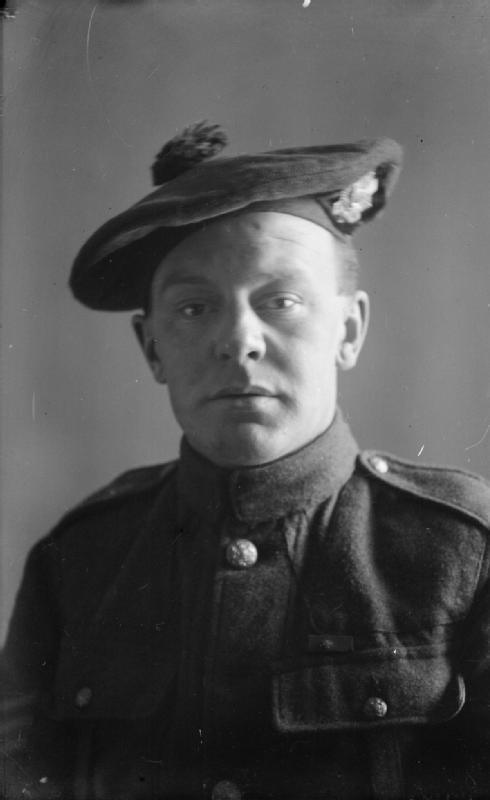
David Ferguson Hunter VC was a Scottish soldier whose defence of an isolated outpost near Moeuvres, France, earned him the Victoria Cross during the First World War. Cut off with six men in September 1918, he resisted repeated German attacks until British troops fought their way back to his position.
Born at Kingseat, near Dunfermline, Fife, on 28 November 1891, Hunter worked as a coal miner before joining the Territorial Force in 1910 with the 7th Battalion, Argyll and Sutherland Highlanders. After war began, he volunteered for a cyclist battalion and subsequently transferred to the Royal Engineers. He served in France from 1916, where a wound required six weeks in hospital. He later transferred to the 1/5th Battalion, Highland Light Infantry.
On 16–17 September 1918, Corporal Hunter commanded an advanced post established in shell holes near Moeuvres, west of Cambrai. The British Army was approaching the formidable defences of the Hindenburg Line, and the surrounding ground remained fiercely contested. Hunter had been unable to reconnoitre the area before occupying his position. By the following afternoon, German troops had established posts around him, isolating his small command.
Rather than abandon the outpost, Hunter organised its defence. For more than forty-eight hours, he and his six men repelled repeated attacks while desperately short of food and water. Their exposed position also came under British artillery fire during counterattacks. When British troops finally relieved them, the party was still holding its ground, with ammunition almost exhausted. Hunter received the Victoria Cross for his leadership and determination; his six companions received the Military Medal.
King George V presented Hunter with his Victoria Cross at Buckingham Palace on 16 November 1918. He attained the rank of sergeant and, after discharge, returned to his former work at Dean Colliery, Kingseat.
In 1919, sculptor Jacob Epstein created a bronze portrait bust of Hunter, now preserved in the Imperial War Museum. The following year, Hunter attended the Buckingham Palace garden party for Victoria Cross recipients. His later medal group included the Imperial Service Medal, British War Medal, Victory Medal, Efficiency Medal with the Territorial designation, and the coronation medals of King George VI and Queen Elizabeth II.
In 1962, Hunter considered selling his Victoria Cross after his ageing Morris car failed its road test. Increasing difficulty getting about made a replacement important to him and his wife. A London motor dealer provided another car on condition that Hunter retained his decoration. His former regiment had also offered to purchase the medals, but he chose instead to leave the group to its museum.
Sergeant David Ferguson Hunter died in Dunfermline on 14 February 1965, aged seventy-three. Fellow Victoria Cross recipients John Carmichael and John Hamilton attended his funeral. He was buried in Dunfermline Cemetery, where a memorial stone was dedicated over his previously unmarked grave on 12 August 2004. His medal group was bequeathed to the Royal Highland Fusiliers Museum in Glasgow.
Become the named supporter for this profile and edit the tribute biography and portrait (Owner account required). Proceeds help keep the archive online.
$25 USD / year — annual sponsorship renewal. Keeps the page online and, where enabled, the family anniversary remembrance emails active.