★
Loading archive…
Loading archive…
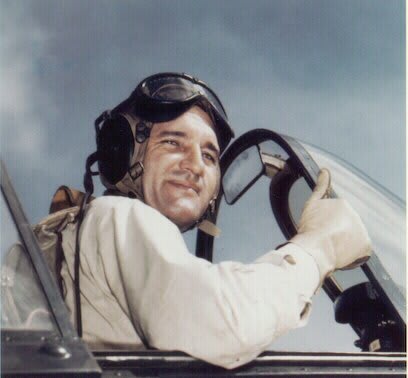
Captain, U.S. Navy
Support & adopt this hero ↓
On 24 October 1944, David McCampbell took on an enemy formation of roughly 60 aircraft with only one other American fighter beside him. By the time the battle was over, he had personally shot down nine Japanese aircraft, one of the greatest single-flight combat records in American aviation history. Yet that extraordinary day was only part of the story of the man who became the United States Navy's all-time leading fighter ace.
Captain David McCampbell, Medal of Honor recipient, naval aviator, and World War II flying ace, was born on 16 January 1910 in Bessemer, Alabama. He entered the United States Naval Academy and graduated in 1933, although Depression-era economy measures delayed his commission as an ensign in the Regular Navy until the following year. After early service aboard USS Portland, he entered flight training at Naval Air Station Pensacola and earned his wings as a naval aviator in April 1938. He later served with Fighting Squadron 4 aboard USS Ranger and joined the air group of USS Wasp. McCampbell survived the sinking of Wasp by Japanese submarine I-19 on 15 September 1942 during the Guadalcanal campaign.
His career changed decisively when he took command of Fighting Squadron 15 and later Air Group 15 aboard USS Essex. Flying the Grumman F6F Hellcat, McCampbell emerged as both an exceptional combat pilot and a battlefield leader. On 19 June 1944, during the Battle of the Philippine Sea, he led his fighters against approximately 80 Japanese carrier aircraft attacking the American fleet. He personally destroyed seven aircraft that day. Four months later, on 24 October during the Battle of Leyte Gulf, McCampbell and one accompanying fighter attacked a formation of about 60 enemy aircraft. He shot down nine of them and helped scatter the remainder before they could reach the American fleet.
Those two actions formed the basis of his Medal of Honor. His official citation praised his "conspicuous gallantry and intrepidity" and described how his leadership and aggressive attacks helped protect the fleet against overwhelming numerical odds. It specifically recorded his seven victories on 19 June and nine on 24 October, noting that the second enemy formation was so thoroughly disrupted that none of its aircraft reached the American ships. President Franklin D. Roosevelt presented the Medal of Honor to McCampbell at the White House on 10 January 1945.
Remarkably, McCampbell's decorations reflected far more than those two famous air battles. On 25 October 1944, only one day after his nine-victory mission, he served as Target Coordinator for aircraft from three task groups during operations around Luzon. His Navy Cross citation credited his cool judgment and leadership with coordinating attacks that sank or heavily damaged a major group of Japanese warships while limiting American losses. The official citation described the destruction of a medium carrier, a light cruiser and two destroyers, along with heavy damage to additional carriers, destroyers and a battleship.
His Silver Star recognized another remarkable combat mission on 12 September 1944 in the Central Philippines. McCampbell led an attack group against Japanese forces, personally destroyed four enemy aircraft in aerial combat, then pressed through anti-aircraft fire to strafe and seriously damage an enemy merchant vessel. The citation emphasized both the destruction inflicted on the enemy and his relentless devotion to duty.
McCampbell also received the Legion of Merit with Combat "V" for his performance as Target Coordinator during carrier attacks in the Philippines from 11 to 14 November 1944. His citation credited him with skillfully directing numerous attacking groups, helping destroy a large enemy troop convoy and inflicting severe damage on Japanese shipping and harbor installations. It particularly praised the courageous and resourceful leadership he provided to the pilots under his direction.
His three Distinguished Flying Cross awards reveal just how consistently dangerous his combat flying had been. The first came for the 19 May 1944 attack on Marcus Island. Anti-aircraft fire badly damaged his fighter, impaired its controls and set an auxiliary fuel tank on fire, yet McCampbell remained over the target and continued directing his air group until its ammunition was exhausted before leading the formation home.
A second Distinguished Flying Cross recognized his leadership on 19 June 1944, when he coordinated strafing, dive-bombing, low-level bombing and rocket attacks against Japanese shipping near the Mariana Islands. The citation credited the coordinated attack with destroying more than 50,000 tons of merchant shipping, at least one destroyer and three escort vessels, while damaging additional ships.
The third Distinguished Flying Cross, represented by a second gold star on his ribbon, followed his actions on 13 September 1944. Leading a fighter sweep over the Central Philippines, McCampbell personally destroyed three Japanese aircraft in aerial combat and then strafed two additional aircraft on the ground despite enemy anti-aircraft fire.
His record also included two awards of the Air Medal, represented by a gold star, and later the Joint Service Commendation Medal, alongside his unit, campaign, occupation and service awards. Together, they trace a career that extended well beyond the spectacular air battles of 1944. By the end of his combat tour, McCampbell had been credited with 34 aerial victories, making him the leading fighter ace in U.S. Navy history. Naval History and Heritage Command also identifies him as the only U.S. aviator to achieve ace-in-a-day status twice during World War II. Air Group 15 itself became one of the most destructive carrier air groups of the conflict, credited with hundreds of enemy aircraft destroyed in the air and on the ground.
McCampbell continued serving long after World War II. His postwar assignments included duty at the Armed Forces Staff College, service as Senior Naval Aviation Advisor to the Argentine Navy, executive officer of USS Franklin D. Roosevelt, Flight Test Coordinator at Patuxent River, and service with the Sixth Fleet. Promoted to Captain in 1952, he later commanded the fleet oiler USS Severn and the aircraft carrier USS Bon Homme Richard. His final assignments included duty with the Joint Chiefs of Staff, the Bureau of Naval Personnel and the Continental Air Defense Command. He retired from active naval service in 1964 after approximately three decades in uniform.
David McCampbell died on 30 June 1996 and was buried at Arlington National Cemetery. His legacy did not end there. The United States Navy later named the Arleigh Burke-class guided-missile destroyer USS McCampbell (DDG-85) in his honor, ensuring that the name of the Navy's greatest fighter ace would continue to serve at sea.
McCampbell's 34 victories made him a record-setting fighter pilot, but his citations reveal something larger. Again and again they describe leadership under fire, calm judgment when heavily outnumbered, and a willingness to remain in combat when his aircraft, ammunition and fuel were nearly exhausted. That combination of flying skill and command leadership is what transformed David McCampbell from a successful fighter pilot into one of the defining figures of United States naval aviation.
Become the named supporter for this profile and edit the tribute biography and portrait (Owner account required). Proceeds help keep the archive online.
$25 USD / year — annual sponsorship renewal. Keeps the page online and, where enabled, the family anniversary remembrance emails active.