Loading archive…
Loading archive…

Lieutenant Colonel, British Army
Support & adopt this hero ↓Derek Anthony Seagrim was born in Bournemouth, Hampshire, on 24 September 1903, the third of five sons born to the Reverend Charles Paulet Cunningham Seagrim and Amabel Emma Halsted Seagrim. Raised in the rural rectory of Whissonsett, Norfolk, he attended Norwich School before entering the Royal Military College, Sandhurst. Commissioned into the Green Howards (Alexandra, Princess of Wales's Own Yorkshire Regiment) on 30 August 1923 under service number 26914, his early military career encompassed protracted overseas deployments to Jamaica, Shanghai, and Palestine, followed by a seconded appointment to the King's African Rifles in East Africa between 1934 and 1939. He qualified for the King George VI Coronation Medal during his home leave in 1937, returning to the 1st Battalion, Green Howards, as Intelligence Officer during the final operations of the Arab Revolt in Palestine.
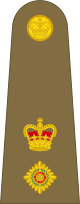
With the outbreak of the Second World War, Seagrim served as an Air Liaison Officer with the Royal Air Force in East Africa, subsequently moving to the Mediterranean to join the staff during the 1941 campaign in Greece. For his leadership and planning during operational service across the Middle East, he was Mentioned in Despatches in June 1942. In October 1942, Seagrim received promotion to temporary lieutenant colonel and took command of the 7th Battalion, Green Howards, within the 69th Infantry Brigade of the 50th (Northumbrian) Infantry Division. Leading the battalion through the Second Battle of El Alamein and the advance across Libya, he prepared his men for the assault against the fortified defensive line established by Axis forces in southern Tunisia.
During the opening phase of the assault on the Mareth Line on the night of 20/21 March 1943, the 7th Battalion was committed against a fortified redoubt along the Wadi Zigzaou. The action earned Seagrim the Victoria Cross, the highest operational honour for gallantry in the face of the enemy.
The verbatim citation published in the Supplement to The London Gazette on 13 May 1943 records the action:
"On the night of the 20th / 21st March 1943, the task of a Battalion of the Green Howards was to attack and capture an important feature on the left flank of the main attack on the Mareth Line. The defence of this feature was very strong and it was protected by an anti-tank ditch twelve feet wide and eight feet deep with minefields on both sides. It formed a new part of the main defences of the Mareth Line and the successful capture of this feature was vital to the success of the main attack.
From the time the attack was launched the Battalion was subjected to the most intense fire from artillery, machine-guns and mortars and it appeared more than probable that the Battalion would be held up, entailing failure of the main attack. Realizing the seriousness of the situation Lieutenant-Colonel Seagrim placed himself at the head of his Battalion which was, at the time, suffering heavy casualties, and led it through the hail of fire. He personally helped the team which was placing the scaling ladder over the anti-tank ditch, and was himself the first to cross it. He led the assault firing his pistol, throwing grenades and personally assaulting two machine-gun posts which were holding up the advance of one of his Companies. It is estimated that in this phase he killed or captured twenty Germans.
This display of leadership and personal courage led directly to the capture of the objective. When dawn broke the Battalion was firmly established on the position, which was of obvious importance to the enemy who immediately made every effort to regain it. Every post was mortared and machine-gunned unmercifully and movement became practically impossible but Lieutenant-Colonel Seagrim was quite undeterred. He moved from post to post organising and directing the fire until the attackers were wiped out to a man.
By his valour, disregard for personal safety and outstanding example he so inspired his men that the Battalion successfully took and held its objective thereby allowing the attack to proceed. Lieutenant Colonel Seagrim subsequently died of wounds received in action."
Sixteen days after the assault at Mareth, Seagrim led his battalion into the assault on the Roumana Ridge during the Battle of Wadi Akarit on 6 April 1943. Struck down by enemy counter-battery fire while directing his companies, he was evacuated to a military hospital near Sfax where he died of his wounds that same evening, aged thirty-nine. He lies buried in Sfax War Cemetery. His younger brother, Major Hugh Paul Seagrim of the 19th Hyderabad Regiment, was posthumously awarded the George Cross in September 1946 for his resistance and sacrifice behind Japanese lines in Burma, establishing the brothers as the only siblings in British military history to be decorated with both the Victoria Cross and the George Cross.
Become the named supporter for this profile and edit the tribute biography and portrait (Owner account required). Proceeds help keep the archive online.
$25 USD / year — annual sponsorship renewal. Keeps the page online and, where enabled, the family anniversary remembrance emails active.