★
Loading archive…
Loading archive…
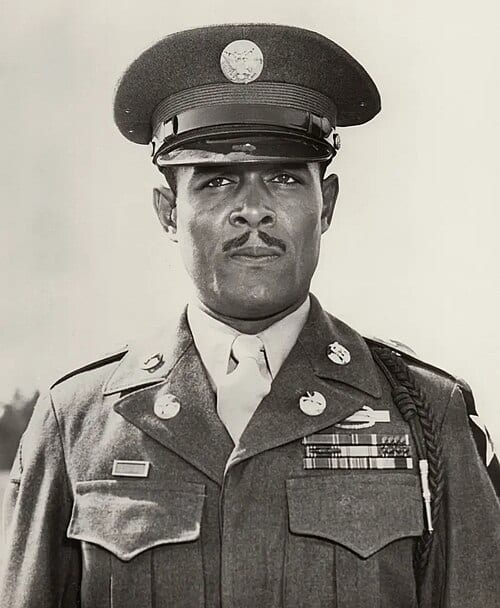
Sergeant first class, U.S. Army
Support & adopt this hero ↓
Before the United States recognised him with its highest military decoration, Edward Allen Carter Jr. had already lived a life of extraordinary courage across three continents. A teenage volunteer during the Shanghai Incident, a fighter in the Spanish Civil War, and ultimately a decorated United States Army soldier, Carter's remarkable journey culminated in an act of heroism near Speyer, Germany, that would take more than five decades to receive its full recognition.
Born on May 26, 1916, in Los Angeles, California, Edward Allen Carter Jr. was raised in Calcutta, India, and Shanghai, China, where he attended the Shanghai Military Academy and learned several languages, including Hindi, Mandarin and German. In January 1932, at just 15 years old, he briefly joined Chinese forces during the Shanghai Incident, fighting against Japanese forces. His precise role is described differently in historical accounts, but his early military experience left a lasting impression. In 1937, Carter travelled to Spain and joined the Abraham Lincoln Battalion, fighting alongside Republican forces against Francisco Franco's Nationalists during the Spanish Civil War. He was eventually captured and interned in a concentration camp in North Africa before being liberated and returning to the United States.
Carter enlisted in the United States Army on September 26, 1941. Despite his exceptional military abilities, racial segregation initially restricted him to support duties. Determined to serve at the front, he volunteered for combat infantry service in Europe. He was assigned to the 3535th Quartermaster Truck Company, where his experience, language skills and battlefield leadership distinguished him.
His defining moment came on March 23, 1945, near Speyer, Germany. When German bazooka and small-arms fire threatened the American advance, Staff Sergeant Carter volunteered to lead a three-man patrol to locate the enemy position. After two members of the patrol were killed and another seriously wounded, Carter continued alone across an exposed field. Despite being wounded five times, he crawled towards the objective and held his position for approximately two hours. When eight German riflemen approached to capture him, Carter killed six and captured the remaining two. He then used the prisoners to obtain vital intelligence and refused evacuation until he had reported everything he had observed. His actions significantly facilitated the American advance on Speyer.
Carter's extraordinary heroism initially earned him the Distinguished Service Cross, recommended on July 10 and awarded on July 25, 1945. He also received the Bronze Star Medal and Purple Heart for his wartime service and wounds. His military record additionally recognises the American Defense Service Medal, American Campaign Medal, European-African-Middle Eastern Campaign Medal with two bronze service stars, Army Good Conduct Medal with two bronze loops, World War II Victory Medal and Army of Occupation Medal with Germany clasp. He also earned the Combat Infantryman Badge and Honorable Service Lapel Button.
Following the war, Carter reenlisted in the Army in 1946 and continued serving at several installations, including Fort Lee, Virginia, and Fort Lewis, Washington. He eventually attained the rank of Sergeant First Class. However, his earlier service in China and Spain led to unfounded suspicions of communist sympathies, and his attempt to reenlist in 1949 was denied. Subsequent investigations established that the allegations had no basis, and in 1999 the Army formally rescinded the unjust denial and apologised to his family.
The long-overdue recognition of Carter's battlefield courage finally arrived in January 1997, when President Bill Clinton posthumously awarded him the Medal of Honor. His son, Edward A. Carter III, accepted the nation's highest military decoration on his father's behalf. The Medal of Honor citation recognised Carter's extraordinary gallantry, his determination to continue despite repeated wounds, and his refusal to leave until the intelligence from his captured prisoners had been delivered.
Edward A. Carter Jr. died on January 30, 1963, in Los Angeles, California, aged 46. He was reinterred at Arlington National Cemetery with full military honours in January 1997. His legacy stands as a powerful testament to courage, determination and the fight for recognition. A soldier who repeatedly volunteered to confront tyranny abroad, Carter became one of the African American World War II heroes whose extraordinary service was denied its rightful recognition by racial prejudice. His story remains an enduring reminder that true heroism transcends discrimination, politics and the passage of time.
Medal of Honor citation
For conspicuous gallantry and intrepidity at the risk of his life above and beyond the call of duty: Staff Sergeant Edward A. Carter, Jr. Distinguished himself by extraordinary heroism in action on 23 March 1945. At approximately 0830 hours, 23 March 1945, near Speyer, Germany, the tank upon which Staff Sergeant Carter was riding received bazooka and small arms fire from the vicinity of a large warehouse to its left front. Staff Sergeant Carter and his squad took cover behind an intervening road bank. Staff Sergeant Carter volunteered to lead a three-man patrol to the warehouse where other unit members noticed the original bazooka fire. From here they were to ascertain the location and strength of the opposing position and advance approximately 150 yards across an open field. Enemy small arms fire covered this field. As the patrol left this covered position, they received intense enemy small arms fire killing one member of the patrol instantly. This caused Staff Sergeant Carter to order the other two members of the patrol to return to the covered position and cover him with rifle fire while he proceeded alone to carry out the mission. The enemy fire killed one of the two soldiers while they were returning to the covered position, and seriously wounded the remaining soldier before he reached the covered position. An enemy machine gun burst wounded Staff Sergeant Carter three times in the left arm as he continued the advance. He continued and received another wound in his left leg that knocked him from his feet. As Staff Sergeant Carter took wound tablets and drank from his canteen, the enemy shot it from his left hand, with the bullet going through his hand. Disregarding these wounds, Staff Sergeant Carter continued the advance by crawling until he was within thirty yards of his objective. The enemy fire became so heavy that Staff Sergeant Carter took cover behind a bank and remained there for approximately two hours. Eight enemy riflemen approached Staff Sergeant Carter, apparently to take him prisoner, Staff Sergeant Carter killed six of the enemy soldiers and captured the remaining two. These two enemy soldiers later gave valuable information concerning the number and dispostion of enemy troops. Staff Sergeant Carter refused evacuation until he had given full information about what he had observed and learned from the captured enemy soldiers. This information greatly facilitated the advance on Speyer. Staff Sergeant Carter's extraordinary heroism was an inspiration to the officers and men of the Seventh Army, Infantry Company Number 1 (Provisional) and exemplify the highest traditions of the military service.
Become the named supporter for this profile and edit the tribute biography and portrait (Owner account required). Proceeds help keep the archive online.
$25 USD / year — annual sponsorship renewal. Keeps the page online and, where enabled, the family anniversary remembrance emails active.