★
Loading archive…
Loading archive…
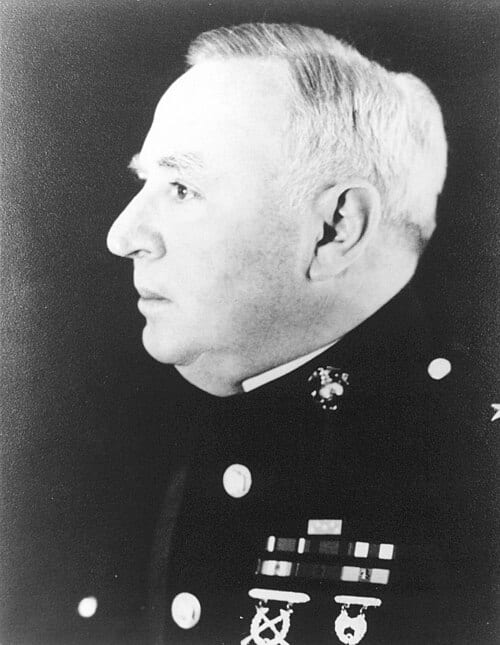
Major General, U.S. Marine Corps
Support & adopt this hero ↓
A night ambush by approximately 400 Haitian insurgents could have ended his life. Instead, First Lieutenant Edward Albert Ostermann led his Marines through the darkness, drove back the enemy and helped capture Fort Dipitie. His courage in Haiti in 1915 earned him the Medal of Honor and began a legacy of distinguished service that would ultimately take him to the rank of Major General in the United States Marine Corps.
Born on 23 November 1882 in Columbus, Ohio, Ostermann began his military career in the United States Army, enlisting on 21 October 1899. He served as a chief trumpeter with the First Band, Artillery Corps, before leaving the Army in November 1905. On 20 March 1907, he accepted a commission as a second lieutenant in the United States Marine Corps, beginning a career that spanned more than three decades.
His defining act of heroism occurred on 24 October 1915 near Fort Liberte, Haiti. While conducting a six-day mounted reconnaissance with the 15th Company of Marines, Ostermann's detachment was ambushed while crossing a river through a deep ravine. Approximately 400 Cacos opened fire from three directions. The Marines fought their way to a defensible position and held it throughout the night under continuous attack. At daybreak, Ostermann commanded one of three squads advancing in separate directions. His leadership helped surprise and scatter the enemy, leading to the capture of Fort Dipitie. The official citation records the extraordinary courage of the small detachment, which faced an enemy force many times its size. For his conspicuous gallantry, Ostermann received the Medal of Honor in 1917. Later in the Haitian campaign, on 11 November 1915, he was wounded in action and returned to the United States for hospitalization, subsequently receiving the Purple Heart.
Ostermann's military career extended across Cuba, Panama, China, Nicaragua, Mexico, Haiti, Hawaii and the Philippines. His service was recognized through the Cuban Pacification Medal, Marine Corps Expeditionary Medal with two stars, Mexican Service Medal, Nicaraguan Campaign Medal, Haitian Campaign Medal, World War I Victory Medal with the West Indies clasp, American Defense Service Medal, American Campaign Medal and World War II Victory Medal. He also received the Republic of Haiti's Distinguished Service Medal in the grade of Officer.
In 1938, Ostermann was ordered to Washington, D.C., to serve as Assistant Adjutant and Inspector of the Marine Corps. In February 1939, he became Adjutant and Inspector with the rank of Brigadier General. When the United States entered the Second World War, he requested a return to combat duty, demonstrating that his commitment to military service had not diminished with seniority. His request was declined as impracticable at the time.
Retired because of physical disability on 1 January 1943, Ostermann was advanced to Major General on the retired list in recognition of his Medal of Honor service and special commendation for performance of duty in actual combat.
Major General Edward Albert Ostermann died on 18 May 1969 and was laid to rest at Arlington National Cemetery, Virginia. His legacy is defined by the courage he displayed at Fort Dipitie, the Marines he led throughout a distinguished career, and a lifetime of service to the United States. His story remains an enduring example of leadership, determination and extraordinary courage under fire.
Become the named supporter for this profile and edit the tribute biography and portrait (Owner account required). Proceeds help keep the archive online.
$25 USD / year — annual sponsorship renewal. Keeps the page online and, where enabled, the family anniversary remembrance emails active.