★
Loading archive…
Loading archive…
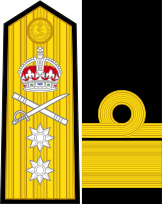
Few Royal Navy officers demonstrated the daring and determination of Rear Admiral Edward Courtney Boyle during the First World War. As captain of the submarine HMS E14, he undertook one of the most hazardous naval missions of the Gallipoli Campaign, navigating the heavily defended Dardanelles and carrying the fight into the Sea of Marmara. His remarkable leadership and courage earned him the Victoria Cross, while his distinguished naval career continued through two world wars, culminating in the rank of rear admiral.
Edward Courtney Boyle was born on 23 March 1883 in Carlisle, Cumberland, England. He entered the Royal Navy as a cadet in 1897 and quickly established himself as a capable officer during a period of rapid technological change in naval warfare. Fascinated by the emerging potential of submarines, Boyle volunteered for the Royal Navy's Submarine Service, becoming one of Britain's early pioneers in undersea operations.
At the outbreak of the First World War, Boyle commanded the submarine HMS E14. On 27 April 1915, during the Gallipoli Campaign, he undertook the perilous task of forcing the Dardanelles Strait and entering the Sea of Marmara, waters heavily protected by minefields, coastal artillery, and Ottoman naval patrols. Once inside, E14 conducted an aggressive campaign against enemy shipping, sinking or disrupting numerous transports and supply vessels that sustained Ottoman forces defending Gallipoli. Boyle's bold operations significantly hindered enemy logistics and demonstrated the strategic value of submarine warfare at a time when the weapon was still relatively new.
For his outstanding gallantry, exceptional leadership, and successful conduct of this historic patrol, Edward Courtney Boyle was awarded the Victoria Cross. His daring voyage through the Dardanelles became one of the Royal Navy's most celebrated submarine operations of the First World War and established Boyle as one of Britain's foremost submarine commanders. Earlier in the conflict, he had also been Mentioned in Despatches for distinguished service during North Sea patrols, an honour represented by the bronze oak leaf worn on the ribbon of the Victory Medal.
Boyle continued to serve with distinction throughout the remainder of the war, commanding further submarine operations and earning international recognition from Britain's allies. France appointed him a Chevalier of the Legion of Honour, while Italy invested him as an Officer of the Order of Saints Maurice and Lazarus in recognition of his contributions to Allied naval operations. His wartime service was further recognized with the 1914–15 Star, British War Medal, Victory Medal with Mention in Despatches, and later the Defence Medal and War Medal 1939–1945 for his service after being recalled during the Second World War. He also received the King George VI Coronation Medal in 1937 and the Queen Elizabeth II Coronation Medal in 1953.
Following the First World War, Boyle continued his naval career, rising steadily through the senior ranks. He was promoted to rear admiral upon retirement in 1932 but returned to active duty after the outbreak of the Second World War. From 1939 to 1942, he served as Flag Officer-in-Charge, London, helping oversee the administration and security of one of Britain's most important naval commands during a critical period of the conflict.
Rear Admiral Edward Courtney Boyle died on 16 December 1976 at the age of 93, having witnessed nearly the entire twentieth century and the transformation of naval warfare from coal-fired battleships to the nuclear age. Remembered as one of the Royal Navy's great submarine pioneers, his courage beneath the waves during the Gallipoli Campaign and his lifelong dedication to naval service secured his place among Britain's most distinguished Victoria Cross recipients. His legacy continues to inspire sailors and historians alike as an enduring example of leadership, determination, and gallantry in the face of overwhelming odds.
Become the named supporter for this profile and edit the tribute biography and portrait (Owner account required). Proceeds help keep the archive online.
$25 USD / year — annual sponsorship renewal. Keeps the page online and, where enabled, the family anniversary remembrance emails active.
