★
Loading archive…
Loading archive…
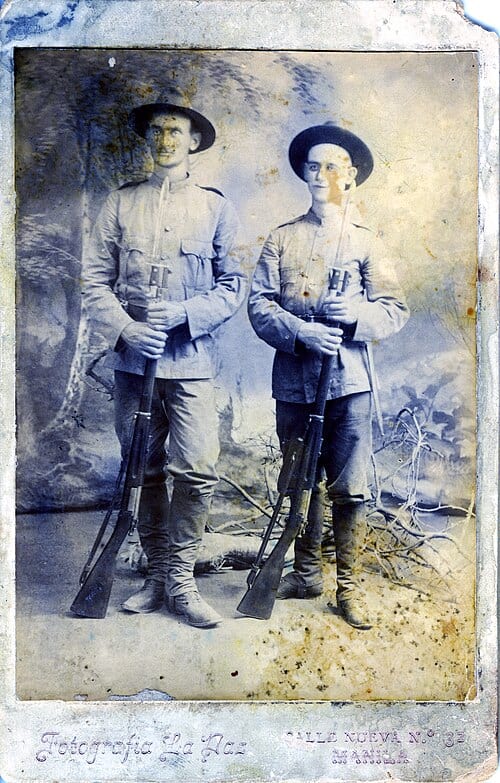
Private, U.S. Army
Support & adopt this hero ↓
Twelve American soldiers. An enemy force of nearly 300. A fortified position that seemed impossible to capture without a frontal assault. On May 13, 1899, Private Edward Eugene Lyon and eleven fellow scouts made a decision that would earn them a place in American military history. Rather than wait for reinforcements, they charged directly toward the enemy. What followed was an extraordinary display of courage that would earn Lyon the Medal of Honor, the United States military's highest decoration for valor.
Born on August 8, 1871, in Hixton, Wisconsin, Edward E. Lyon grew up in an America undergoing rapid transformation. When the Spanish-American War erupted in 1898, he entered military service with Company B, 2nd Oregon Volunteer Infantry Regiment. His unit deployed to the Philippine Islands, where American forces participated in the campaign against Spain. The regiment was involved in the surrender of Manila in August 1898, an event that marked a turning point in American expansion into the Pacific. Yet for Lyon, the most defining moment of his military career was still to come.
Following Spain's defeat, tensions in the Philippines escalated into the Philippine-American War. American troops faced determined Filipino resistance, and the conflict quickly developed into a brutal struggle marked by difficult terrain, fortified positions, and unpredictable engagements. It was during this campaign that Lyon demonstrated the extraordinary battlefield courage for which he would be remembered.
On May 13, 1899, near San Miguel de Mayumo on the island of Luzon, Lyon was serving as one of twelve scouts confronting an enemy force estimated at approximately 300 men. The defenders occupied a position that could be captured only through a direct frontal attack. Their supporting American battalion had not yet moved into position to assist.
The odds were overwhelming. The danger was unmistakable. But Lyon and his fellow scouts did not wait.
In a remarkable act of collective bravery, the twelve soldiers charged approximately 150 yards across exposed ground toward the enemy line. Despite being vastly outnumbered and lacking immediate support, they pressed forward with such determination that they completely routed the opposing force. Their assault transformed a seemingly impossible tactical situation into an American victory.
What makes Lyon's actions especially remarkable was not simply the numerical disadvantage. It was the willingness to advance against a defended enemy position without the protection of a supporting battalion. Every step toward that line brought extraordinary personal danger. Yet Lyon continued the attack alongside his comrades, demonstrating the initiative, resolve, and courage that define battlefield heroism.
On January 24, 1906, Edward Eugene Lyon was awarded the Medal of Honor in recognition of his extraordinary actions at San Miguel de Mayumo. His official citation memorialized the courage of the twelve scouts who attacked without waiting for support and routed a vastly superior enemy force. His decoration remains a lasting testament to one of the most daring small-unit assaults of the Philippine-American War.
Lyon's military service also connected him to two significant chapters of American history: the Spanish-American War of 1898 and the Philippine-American War that followed. As a member of the 2nd Oregon Volunteer Infantry, he belonged to a generation of citizen-soldiers whose overseas service helped shape the United States' emerging role as a Pacific power.
After his military service, Lyon lived to see the world change dramatically through the early decades of the twentieth century. He died on November 18, 1931, in Los Angeles, California, at the age of 60, and was laid to rest at Hollywood Cemetery.
Edward Eugene Lyon's legacy is not defined by rank, command, or the size of the force he led. He was a private whose courage under extraordinary circumstances earned the nation's highest military honor. His story reminds us that heroism does not always emerge from carefully prepared plans or overwhelming strength. Sometimes it emerges in a single decisive moment, when ordinary soldiers confront seemingly impossible odds and choose to advance.
More than a century after the charge at San Miguel de Mayumo, the bravery of Edward E. Lyon and his eleven fellow scouts remains an enduring example of determination, sacrifice, and extraordinary courage in American military history.
Become the named supporter for this profile and edit the tribute biography and portrait (Owner account required). Proceeds help keep the archive online.
$25 USD / year — annual sponsorship renewal. Keeps the page online and, where enabled, the family anniversary remembrance emails active.