★
Loading archive…
Loading archive…
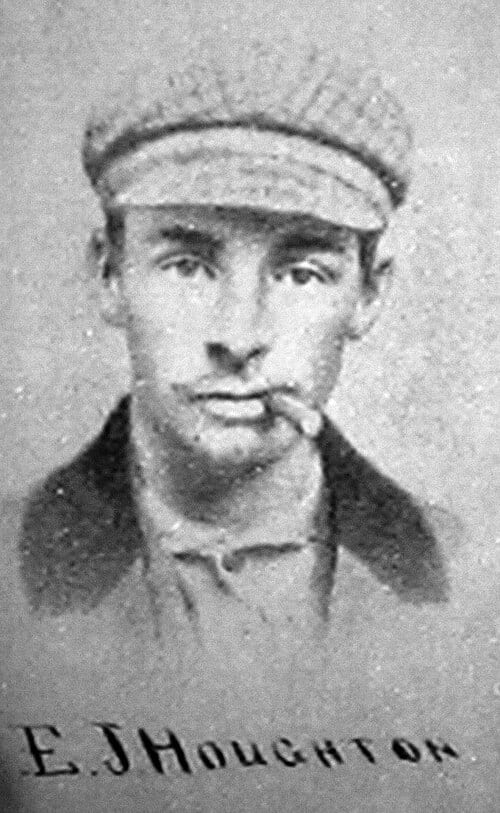
Ordinary Seaman, U.S. Navy
Support & adopt this hero ↓
How do you destroy a heavily armored Confederate warship with a small wooden boat? For Edward J. Houghton, the answer was extraordinary courage, a daring nighttime attack, and a willingness to face almost certain death. On 27 October 1864, during the American Civil War, this young United States Navy sailor joined one of the most dangerous naval missions of the conflict. His bravery during the destruction of the Confederate ironclad CSS Albemarle would earn him the Medal of Honor, America's highest military decoration for valor.
Born in Mobile, Alabama, in 1843, Edward J. Houghton followed a remarkable path into military history. Although born in a Southern state, he served the Union during the Civil War. He initially enlisted in Company K of the 39th Massachusetts Volunteer Infantry in 1862 before transferring to the United States Navy in 1864. Serving as an Ordinary Seaman, Houghton entered a war increasingly defined by ironclad vessels, powerful artillery, and dangerous naval operations along America's rivers and coastlines. His greatest test of courage was still to come.
By October 1864, the Confederate ironclad CSS Albemarle had become a formidable threat to Union naval operations in North Carolina. Its armored hull had withstood attacks from Union warships, while its powerful guns and commanding position near Plymouth complicated efforts to regain control of the region. Conventional assaults had failed to eliminate the threat. Destroying the ironclad would require an unconventional plan, exceptional determination, and sailors prepared to risk everything.
Lieutenant William B. Cushing proposed a daring solution. Under cover of darkness, a small steam-powered picket boat equipped with a spar torpedo would approach the Confederate vessel and detonate an explosive charge against its hull. Houghton joined the expedition aboard U.S. Picket Boat No. 1, becoming part of a mission in which discovery could mean immediate destruction.
On the night of 27 October 1864, the raiding party advanced along the Roanoke River toward Plymouth, navigating waters guarded by Confederate sentries. For a time, darkness concealed their movements. But as the little vessel neared its target, the defenders discovered the approaching boat and opened fire.
Suddenly, the mission became a desperate race against death.
Confederate gunfire swept across the water as Cushing's boat accelerated toward the Albemarle. A protective barrier of floating logs surrounded the ironclad, threatening to stop the attack before the explosive could reach its target. Rather than retreat, the raiders pressed forward. Their small craft surged over the obstruction and closed with the Confederate warship.
At point-blank range, the spar torpedo exploded beneath the Albemarle's port bow, tearing open its hull. The ironclad began to sink, but the attacking boat was also destroyed amid the gunfire and explosion. The river became a scene of chaos as the crew struggled to survive. Most of the raiders were captured or lost. Houghton and Cushing were the only two men from the attacking party known to have escaped death or capture.
The mission succeeded against extraordinary odds. The destruction of CSS Albemarle removed a major Confederate naval obstacle and helped clear the way for Union forces to regain control of Plymouth and the surrounding waterways. What heavily armed Union vessels had struggled to accomplish, a small volunteer crew achieved through surprise, determination, and remarkable bravery.
For his courageous participation in this historic operation, Edward J. Houghton received the Medal of Honor under General Order No. 45, dated 31 December 1864. His award recognized his service during the hazardous attack, when the crew continued toward its objective despite intense enemy fire and the overwhelming danger posed by the Confederate ironclad.
Tragically, Houghton's life was brief. His Medal of Honor was delivered to the United States Receiving Ship at Norfolk, Virginia, on 5 May 1865. Just over two months later, on 16 July 1865, he died in Norfolk at approximately 22 years of age. He was eventually laid to rest in Holyhood Cemetery in Brookline, Massachusetts, where his memory remains connected to one of the American Civil War's most remarkable naval exploits.
Edward J. Houghton's legacy is not defined by military rank, commanding a fleet, or a long career of distinguished service. It rests upon a single extraordinary night when an Ordinary Seaman helped accomplish what larger warships had been unable to achieve. From his early service in the Union Army to his courageous participation in the destruction of CSS Albemarle, his story reflects the bravery of ordinary servicemen who accepted extraordinary risks.
More than a century and a half later, Edward J. Houghton remains an enduring example of American Civil War naval heroism. His Medal of Honor preserves the memory of a young sailor who faced overwhelming fire, survived a seemingly impossible mission, and helped change the course of the struggle for control of North Carolina's waterways. His story reminds us that history is not shaped by famous commanders alone, but also by the courage of those willing to follow them into the greatest danger.
Medal of Honor citation
Houghton served on board the U.S. Picket Boat No. 1, in action, 27 October 1864, against the Confederate ram, Albemarle, which had resisted repeated attacks by our steamers and had kept a large force of vessels employed in watching her. The picket boat, equipped with a spar torpedo, succeeded in passing the enemy pickets within 20 yards without being discovered and then made for the Albemarle under a full head of steam. Immediately taken under fire by the ram, the small boat plunged on, jumped the log boom which encircled the target, and exploded its torpedo under the port bow of the ram. The picket boat was destroyed by enemy fire and almost the entire crew taken prisoner or lost.
Become the named supporter for this profile and edit the tribute biography and portrait (Owner account required). Proceeds help keep the archive online.
$25 USD / year — annual sponsorship renewal. Keeps the page online and, where enabled, the family anniversary remembrance emails active.