★
Loading archive…
Loading archive…
Lieutenant commander, U.S. Navy
Support & adopt this hero ↓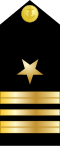
Fought alone against bombers to guard his carrier from harm.
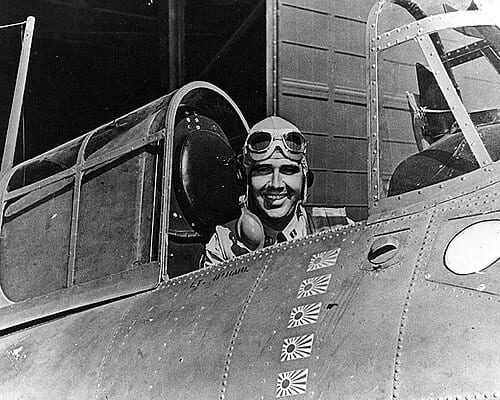
On 20 February 1942, Lieutenant Edward O’Hare flew an F4F Wildcat from USS Lexington against Japanese bombers approaching his carrier. Separated from supporting fighters, he repeatedly attacked the formation and was credited with destroying five bombers and damaging a sixth. His action helped protect Lexington and earned the Medal of Honor.
Born in St. Louis on 13 March 1914, O’Hare graduated from the United States Naval Academy in 1937. After service aboard USS New Mexico, he completed flight training and became a naval aviator in May 1940, joining Fighting Squadron 3. He was promoted to Lieutenant Commander in April 1942. After war-bond tours, he commanded VF-3 and instructed pilots in combat tactics in Hawaii.
In 1943 he commanded VF-6 in carrier operations in the central Pacific. His leadership in the Marcus Island and Wake Island attacks earned two Distinguished Flying Cross awards. As Air Group Six commander aboard USS Enterprise, he participated in the Gilbert Islands invasion and led a night interception mission on 26 November 1943. He disappeared during that mission and was awarded the Navy Cross posthumously. His body was never recovered. Chicago’s airport was renamed O’Hare in 1949 in his honour.
Official Medal of Honor citation:
“For conspicuous gallantry and intrepidity in aerial combat, at grave risk of his life above and beyond the call of duty, as Section Leader and Pilot of Fighting Squadron THREE, on 20 February 1942. Having lost the assistance of his teammates, Lieutenant O' Hare interposed his plane between his ship and an advancing enemy formation of nine attacking twin-engine heavy bombers. Without hesitation, alone and unaided, he repeatedly attacked this enemy formation, at close range in the face of intense combined machine-gun and cannon fire. Despite this concentrated opposition, Lieutenant O'Hare, by his gallant and courageous action, his extremely skillful marksmanship in making the most of every shot of his limited amount of ammunition, shot down five enemy bombers and severely damaged a sixth before they reached the bomb release point. As a result of his gallant action--one of the most daring, if not the most daring, single action in the history of combat aviation--he undoubtedly saved his carrier from serious damage.”
Become the named supporter for this profile and edit the tribute biography and portrait (Owner account required). Proceeds help keep the archive online.
$25 USD / year — annual sponsorship renewal. Keeps the page online and, where enabled, the family anniversary remembrance emails active.