★
Loading archive…
Loading archive…
Seaman, U.S. Navy
Support & adopt this hero ↓
Edward Swatton was a United States Navy sailor during the American Civil War whose courage during the final assault on Fort Fisher, North Carolina, earned him the Medal of Honor. At the time of the action for which he was recognized, Swatton was serving as a Seaman aboard USS Santiago de Cuba. His highest verified rank for this profile is also Seaman.
Swatton’s service placed him in one of the most important combined naval and land operations of the final months of the Civil War. Fort Fisher protected the approaches to Wilmington, North Carolina, one of the Confederacy’s last major ports still available to blockade runners. As long as Fort Fisher remained in Confederate hands, Wilmington could continue receiving supplies from overseas and supporting Confederate forces in the field.
The Union therefore made the capture of Fort Fisher a major strategic objective.
In January 1865, a powerful Union naval force and supporting ground troops launched another assault against the fort.
USS Santiago de Cuba was one of the naval vessels involved in the operation.
Edward Swatton was serving aboard the ship as a Seaman.
His defining Medal of Honor action took place on January 15, 1865.
Unlike sailors whose heroism occurred at a gun aboard ship, Swatton’s action took him ashore.
He became part of a boat crew detailed for service near the attacking forces.
During the assault, Swatton advanced into Fort Fisher itself.
This was an extremely dangerous assignment.
The fort was heavily defended, and the fighting involved artillery, rifle fire, close-range combat, and rapidly changing positions.
Naval personnel who went ashore during such operations were exposed to many of the same dangers as infantry troops.
Swatton distinguished himself further by carrying dispatches during the battle.
This was not a routine communication task.
In the middle of intense fighting, dispatches could contain critical orders, battlefield information, requests for support, or instructions necessary to coordinate different parts of the attacking force.
A messenger had to move through exposed terrain and reach the correct officers while the battle was still underway.
Swatton carried out this duty under dangerous conditions.
His official record places him among the small number of sailors from the fleet who succeeded in entering the fort during the assault.
That fact alone highlights the extraordinary nature of his service.
He had left the relative protection of his ship, gone ashore with the attacking force, entered a heavily defended Confederate fortification, and continued carrying messages during the most intense phase of the fighting.
For his conduct at Fort Fisher on January 15, 1865, Edward Swatton was awarded the Medal of Honor.
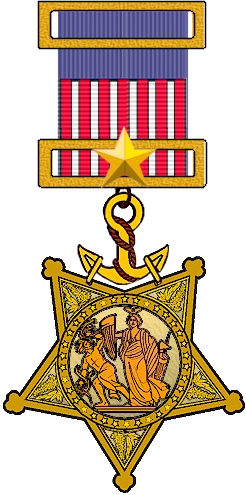
The correct historical decoration for his final profile is the Medal of Honor 1862–1912 Navy.
The Navy Medal of Honor had been established during the Civil War as the principal national decoration for sailors and Marines who demonstrated extraordinary gallantry and distinguished conduct.
Swatton’s award was officially recorded in General Order No. 59, dated June 22, 1865.
This means his bravery was recognized only a few months after the battle and shortly after the end of the Civil War.
No verified device, clasp, star, bar, or other attachment is associated with his Medal of Honor.
His final verified medal rack should therefore display the Medal of Honor 1862–1912 Navy without any additional device.
Swatton’s action rank was Seaman.
This is also his highest verified rank.
For his final database profile, both Rank and Highest Rank should therefore remain Seaman.
His combat classification requires an important distinction.
He belonged to the United States Navy and served aboard a surface warship, so Navy and Surface warfare are appropriate metadata categories.
However, his Medal of Honor action was not a conventional shipboard surface engagement.
He went ashore with a boat crew, entered Fort Fisher, and carried dispatches during direct land combat.
For that reason, Amphibious is the most accurate Combat Achievement Modifier for his heroic action.
The Second Battle of Fort Fisher became one of the most important Union victories of the final phase of the war.
The Union Navy subjected the Confederate fortifications to heavy bombardment while ground forces attacked the defenses.
The combined pressure eventually overwhelmed the Confederate position.
Fort Fisher fell on January 15, 1865.
The capture had immediate strategic consequences.
Without Fort Fisher, Wilmington could no longer function effectively as a protected blockade-running port.
This severely reduced the Confederacy’s ability to receive supplies from overseas.
The fall of Wilmington followed soon afterward.
Swatton’s Medal of Honor action therefore occurred during an operation that directly weakened Confederate logistics and accelerated the collapse of resistance along the Atlantic coast.
His role as a dispatch carrier also demonstrates an important aspect of nineteenth-century warfare.
Battlefield communication depended heavily on individual messengers.
There were no radios or modern communication systems.
Orders had to be carried by hand.
If a messenger failed to reach his destination, commanders could lose contact with units or miss critical information.
Swatton’s willingness to continue carrying dispatches through the fighting therefore had real operational value.
His heroism was based on courage, reliability, and the ability to keep functioning under extreme pressure.
Swatton’s medal history must remain limited to recipient-specific verified awards.
The Medal of Honor 1862–1912 Navy is his confirmed decoration.
The later Navy Civil War Medal should not be included in his final verified rack.
Available records indicate that Swatton died in 1865, so he did not survive to the later period relevant to that medal under the client’s rules.
His final verified medal count therefore remains one.
That single decoration, however, represents the highest military honor of the United States.
Swatton’s life after the Fort Fisher action was extremely short.
Because he died in the same year, there was little opportunity for a long postwar career or later military advancement.
As a result, the principal surviving record of his life is his wartime service and the Medal of Honor action that made his name part of naval history.
For his final hero profile, the essential facts are clear.
Edward Swatton served in the United States Navy.
He was a Seaman aboard USS Santiago de Cuba during the assault on Fort Fisher, North Carolina, on January 15, 1865.
He went ashore with a boat crew, entered the fort during the attack, and carried dispatches through intense fighting.
His conduct placed him among the small number of sailors from the fleet who penetrated the Confederate fortifications during the battle.
For these actions, he received the Medal of Honor 1862–1912 Navy.
The award was recorded in General Order No. 59 on June 22, 1865.
No verified device or clasp is associated with the decoration.
Edward Swatton should ultimately be remembered as a sailor whose heroism was demonstrated far from the normal duties of a shipboard Seaman.
He went ashore in the middle of a major assault, entered a heavily defended fort, and continued carrying vital dispatches while the battle raged around him.
The Medal of Honor 1862–1912 Navy remains the defining symbol of his service and preserves Edward Swatton’s place among the recognized heroes of the United States Navy.
Become the named supporter for this profile and edit the tribute biography and portrait (Owner account required). Proceeds help keep the archive online.
$25 USD / year — annual sponsorship renewal. Keeps the page online and, where enabled, the family anniversary remembrance emails active.