★
Loading archive…
Loading archive…
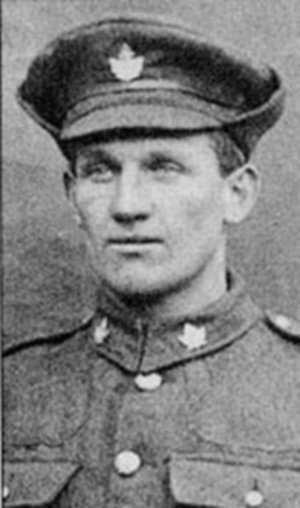
Lance Sergeant, 1914–1917
Support & adopt this hero ↓What would make a battalion driver leave the relative safety of his assigned duties and ask to serve in the front line? For Ellis Wellwood Sifton, the answer was simple. He wanted to stand with the men who were facing the enemy. On 9 April 1917, during the opening assault at Vimy Ridge, that decision placed him directly in the path of a German machine gun that was cutting down Canadian soldiers. Sifton charged the position alone, destroyed its crew and held off a counterattack long enough for his company to advance. He did not survive the battle, but his courage saved lives and earned him the Victoria Cross.
Ellis Wellwood Sifton was born in Wallacetown, Ontario, on 12 October 1891. The son of farmer John J. Sifton, he worked as a farmer before the First World War. On 23 October 1914, he enlisted in the Canadian Expeditionary Force at St. Thomas, Ontario, and received service number 53730. He was assigned to the 18th Battalion, Canadian Infantry, which later formed part of the 4th Canadian Infantry Brigade, 2nd Canadian Division. When the battalion sailed for Britain in April 1915, Sifton had already been promoted to lance corporal.
Sifton initially served as a battalion driver, an essential role that helped keep troops supplied and units moving. Yet he wanted a more direct part in the fighting. Veterans Affairs Canada records that before the Battle of Vimy Ridge, he asked to leave his driving duties so that he could take his chances with the soldiers in the front line. His request reflected the character later revealed in his final action. He did not seek protection from danger. He deliberately chose to share it.
The 18th Battalion entered the trenches in September 1915. Sifton served through some of the Canadian Corps’ most difficult fighting, including the operations at Saint-Eloi in April 1916 and the Somme offensive later that year. The battalion suffered heavily during the attack on Courcelette on 15 September 1916 and again during the unsuccessful struggle for Regina Trench in October. By March 1917, as the Canadians prepared for the assault on Vimy Ridge, Sifton had risen to the rank of lance sergeant.
On the morning of 9 April 1917, the Canadian Corps attacked Vimy Ridge through snow, sleet and intense German fire. The 18th Battalion advanced in support of the 21st Battalion toward the village of Les Tilleuls. The first defensive positions were taken quickly, but the next line contained machine-gun posts whose crews had survived the preliminary bombardment. One of those guns opened fire on Sifton’s company, inflicting serious casualties and stopping the advance.
Sifton located the machine-gun position and acted without waiting for support. He forced his way through the wire, crossed exposed ground and attacked the emplacement with grenades and his bayonet. After killing the gun crew, he turned the captured position against a German party advancing through the trench. He fought at close quarters, using his bayonet and the butt of his rifle to prevent the enemy from retaking the post. His resistance gave the rest of his company the time it needed to reach and secure the position.
The danger did not end when the machine gun was silenced. As Canadian soldiers reached him and prepared to relieve him, a wounded German soldier recovered a rifle and fatally shot Sifton. He was 25 years old. His official Victoria Cross citation stated that his conspicuous courage saved many lives and contributed greatly to the success of the operation. The award was announced in the London Gazette on 8 June 1917.
Sifton’s Victoria Cross was posthumous. Veterans Affairs Canada records that the decoration was presented to his father by the Governor General of Canada during a ceremony at the Canadian National Exhibition in Toronto. His complete wearable entitlement also included the 1914-15 Star, British War Medal and Victory Medal. These campaign medals recognized his overseas and operational service with the Canadian Expeditionary Force. No separate Mention in Despatches has been verified, so the Victory Medal ribbon is correctly displayed without an oak-leaf emblem.
Ellis Sifton was buried at Lichfield Crater, Thelus, in France, where he is commemorated on Panel 3, Column 2. Photographs preserved by Veterans Affairs Canada show fellow soldiers visiting and caring for his original battlefield grave in February 1918. His name is also recorded in the First World War Book of Remembrance, ensuring that his sacrifice remains part of Canada’s national memory.
Four Canadians earned the Victoria Cross during the Battle of Vimy Ridge, and Ellis Wellwood Sifton was among those recognized for actions on its opening day. His heroism was not the result of rank, command authority or an expectation of recognition. It came from a personal decision to move toward the gun that was killing his comrades. He charged alone, fought until others could reach him and died at the position he had captured. Lance Sergeant Ellis Wellwood Sifton VC remains one of the clearest examples of courage, self-sacrifice and devotion to duty in Canadian military history.
Become the named supporter for this profile and edit the tribute biography and portrait (Owner account required). Proceeds help keep the archive online.
$25 USD / year — annual sponsorship renewal. Keeps the page online and, where enabled, the family anniversary remembrance emails active.