★
Loading archive…
Loading archive…
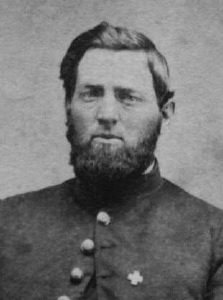
Major, U.S. Army
Support & adopt this hero ↓
Ephraim W. Harrington was a Union Army soldier and officer whose courage during the American Civil War earned him the Medal of Honor. He served in Company G of the 2nd Vermont Infantry and held the rank of Sergeant at the time of the action for which he was later recognized. Over the course of his military career, he advanced well beyond that enlisted rank and eventually reached the rank of Major.
Harrington’s defining act of heroism took place on May 3, 1863, at Fredericksburg, Virginia, during fighting connected with the Chancellorsville Campaign. Union forces were attempting to break through Confederate defenses that had previously proved extremely difficult to overcome.
The heights around Fredericksburg were strongly defended, and Confederate artillery and infantry positions dominated the approaches. Union soldiers advancing against these positions faced intense rifle and cannon fire.
Harrington was serving as a Sergeant in Company G, 2nd Vermont Infantry, during this dangerous action.
As the fighting developed, he took up the regimental colors and advanced with extraordinary courage toward the Confederate position.
Regimental colors were extremely important in Civil War combat.
In the smoke and confusion of battle, soldiers often relied on their flags to identify the position of their unit and maintain formation.
Because of this, color bearers were highly visible targets.
Enemy soldiers frequently concentrated fire on the colors because bringing down a regiment’s flag could create confusion and damage morale.
Harrington nevertheless carried the colors forward toward the heights.
He advanced so close to the Confederate artillery that he reached nearly to the muzzles of the enemy guns.
This act required exceptional courage.
He was exposing himself not only to rifle fire but also to artillery at extremely close range.
His willingness to continue advancing with the colors helped inspire the soldiers around him and demonstrated extraordinary battlefield determination.
For his conduct at Fredericksburg on May 3, 1863, Ephraim W. Harrington was awarded the Medal of Honor.
The correct historical version associated with his service is the Medal of Honor 1862–1895 Army.
The Army Medal of Honor had been established during the Civil War to recognize extraordinary gallantry and distinguished conduct.
The early Army version featured the distinctive five-pointed star design associated with the original generation of recipients.
Because Harrington’s heroic action occurred in 1863 while he was serving in the United States Army, the Medal of Honor 1862–1895 Army is the correct version for his profile.
No verified device or clasp is associated with his Medal of Honor.
Harrington did not receive the decoration immediately after the war.
His Medal of Honor was formally presented on December 13, 1893, approximately thirty years after the action.
Delayed awards were common among Civil War veterans.
Many acts of gallantry were reviewed years later, and veterans whose battlefield conduct had been documented were eventually recognized with the Medal of Honor.
Harrington’s action rank was Sergeant.
This is the rank that should be used when describing the specific event for which he received the Medal of Honor.
He later rose to the rank of Major.
This represented a remarkable progression from enlisted noncommissioned officer to senior field-grade officer.
A Sergeant was responsible for direct leadership among enlisted soldiers, maintaining discipline, transmitting orders, and helping control troops during combat.
A Major, by contrast, held much broader responsibilities and could assist in commanding a regiment or other major military formation.
Harrington’s advancement therefore demonstrates that his military career involved more than one extraordinary battlefield moment.
His highest rank of Major reflects continued service, leadership, and professional recognition.
Harrington’s combat specialization was Infantry.
The 2nd Vermont Infantry was a frontline infantry regiment, and his Medal of Honor action occurred during direct ground combat against Confederate defensive positions.
For the database, the appropriate metadata classification is Army and Ground combat (Army focus), with Infantry as the correct Combat Achievement Modifier.
The 2nd Vermont Infantry was part of the famous Vermont Brigade, a formation that earned a strong reputation for discipline and fighting ability during the Civil War.
The brigade participated in numerous major campaigns and battles in the Eastern Theater.
Serving in such a regiment meant repeated exposure to some of the hardest fighting of the war.
Harrington’s action at Fredericksburg demonstrated the qualities expected of experienced infantry leaders.
Carrying the colors was not simply symbolic.
A regiment’s flag served as a practical battlefield reference point.
When lines became disorganized by smoke, terrain, casualties, or artillery fire, soldiers could rally around their colors.
A man carrying those colors therefore had an important responsibility.
Harrington’s decision to advance with the flag toward the enemy guns placed him at the center of the action.
His bravery helped maintain the forward momentum of the attacking troops.
The fighting at Fredericksburg in May 1863 differed from the disastrous Union assaults of December 1862, but Confederate defensive positions remained formidable.
Union troops once again faced fortified ground and deadly artillery fire.
Harrington’s advance toward the enemy guns demonstrated personal courage under precisely these conditions.
His Medal of Honor therefore represents a specific act of battlefield gallantry performed in direct combat.
Harrington’s medal history also includes the Civil War Campaign Medal 1861–1865 Army under the client’s current database workflow.
This medal was established after the Civil War to recognize qualifying service in the United States Army during the conflict.
Harrington’s service with the 2nd Vermont Infantry clearly occurred during the qualifying Civil War period.
He also lived long enough to survive beyond the establishment of the Army Civil War Campaign Medal.
Ephraim W. Harrington died on October 19, 1914.
Because he remained alive well into the twentieth century, the Civil War Campaign Medal 1861–1865 Army is included in his final medal set under the current client workflow.
The two medals represent different aspects of Harrington’s service.
The Medal of Honor 1862–1895 Army recognizes his specific act of extraordinary courage at Fredericksburg on May 3, 1863.
The Civil War Campaign Medal 1861–1865 Army represents his broader qualifying service during the American Civil War.
No verified device or clasp is associated with either medal.
Harrington’s story also illustrates the importance of noncommissioned officers in Civil War combat.
Sergeants often operated close to the enlisted soldiers and were essential to keeping units organized during battle.
They helped maintain formations, encouraged men under fire, carried instructions, and stepped into leadership roles when officers were wounded or killed.
Harrington’s action while carrying the regimental colors demonstrated this leadership directly.
His later rise to Major further showed that his abilities were recognized beyond his initial enlisted service.
Advancing from Sergeant to Major was a significant achievement.
It reflected experience, leadership, and continued responsibility.
For his final hero profile, the central facts are clear.
Ephraim W. Harrington served in the United States Army.
He was a Sergeant in Company G, 2nd Vermont Infantry, when he performed his Medal of Honor action at Fredericksburg, Virginia, on May 3, 1863.
He carried the regimental colors forward toward the Confederate defenses and advanced almost to the muzzles of the enemy guns.
His highest confirmed rank was Major.
His final medal set includes the Medal of Honor 1862–1895 Army and the Civil War Campaign Medal 1861–1865 Army.
No verified device or clasp is associated with either decoration.
Ephraim W. Harrington should ultimately be remembered as a soldier and officer whose courage was demonstrated in the most visible and dangerous way possible: carrying the colors forward under concentrated enemy fire.
His advance toward the Confederate guns at Fredericksburg earned him the Medal of Honor and permanently secured his place among the recognized heroes of the United States Army.
The Medal of Honor remains the defining symbol of his personal bravery, while the Civil War Campaign Medal represents his broader wartime service.
Together, they preserve the military legacy of Ephraim W. Harrington as a Union infantryman whose courage, leadership, and advancement from Sergeant to Major reflected a distinguished Civil War career.
Become the named supporter for this profile and edit the tribute biography and portrait (Owner account required). Proceeds help keep the archive online.
$25 USD / year — annual sponsorship renewal. Keeps the page online and, where enabled, the family anniversary remembrance emails active.