★
Loading archive…
Loading archive…
Lieutenant Colonel, U.S. Army
Support & adopt this hero ↓
Ernest "Chief" Childers: Medal of Honor Hero of World War II
A fractured foot could not stop him. When German machine guns and snipers pinned down American soldiers near Oliveto, Italy, Second Lieutenant Ernest "Chief" Childers chose to lead the attack himself. Despite his painful injury, he advanced against enemy positions, killed enemy snipers, silenced machine-gun nests and captured an enemy mortar observer. His extraordinary courage earned him the Medal of Honor and secured his place among America's most distinguished combat heroes.
Born on 1 February 1918 in Broken Arrow, Oklahoma, Ernest Childers was a proud member of the Muscogee (Creek) Nation. He attended the Chilocco Indian Agricultural School, where he joined a National Guard unit in 1937. As the unit transitioned into active federal service, Childers became part of the 45th Infantry Division, known as the Thunderbirds. He trained with the division, advanced through its ranks and eventually received a battlefield commission during the Sicilian campaign.
During the Italian Campaign, Childers served with Company C, 180th Infantry Regiment, 45th Infantry Division. On 22 September 1943, near Oliveto, he led eight enlisted men up a dangerous hillside to attack German machine-gun positions. Although he had fractured his instep, he organized covering fire, killed two enemy snipers, neutralized the occupants of a machine-gun position and helped destroy a second. He then advanced farther uphill and captured an enemy mortar observer single-handedly. His leadership, initiative and determination under fire were formally recognized in his Medal of Honor citation, which praised his conspicuous gallantry and the inspiration he provided to his men.
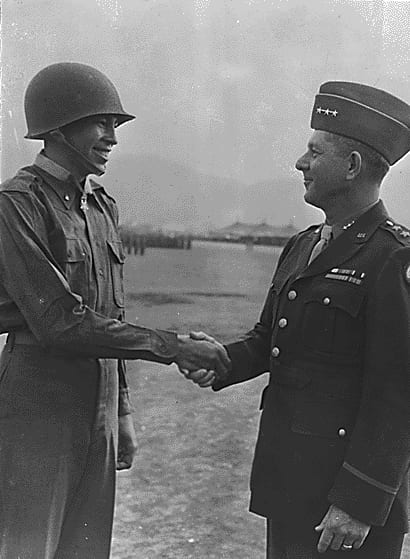
For this remarkable action, Childers received the Medal of Honor in April 1944 from Lieutenant General Jacob L. Devers while recovering in a military hospital in Naples. He became the first American Indian to receive the Medal of Honor during World War II. His other recorded military honours included the Bronze Star Medal, Purple Heart, Army Commendation Medal and Italian Cross of Valor. He also received the first Oklahoma Distinguished Service Medal ever awarded.
Childers' service did not end with the defeat of Germany. He continued his military career through the Korean War era and the early years of American involvement in Vietnam. His responsibilities extended beyond frontline operations to training, intelligence, ordnance, procurement, labour relations and fiscal administration. During his final five years of military service, he supervised Fifth Army ROTC reserve and component activities, including responsibilities involving Fort Riley and Alaska. He retired from the United States Army in 1965 with the rank of Lieutenant Colonel.
Following retirement, Childers continued serving the public as a regional coordinator for the Department of the Interior's Job Corps programme. Drawing upon his military experience and leadership, he helped support a programme focused on providing opportunities and practical training to young Americans.
Ernest "Chief" Childers passed away in 2005, leaving behind a legacy of courage, humility and lifelong service. From his beginnings in the Muscogee Creek community of Oklahoma to the battlefields of Sicily and Italy, and later decades of military and public service, his life represents the extraordinary contribution of Native American soldiers to the United States Armed Forces. His actions at Oliveto remain a powerful reminder that true courage is measured not by the absence of fear or hardship, but by the determination to protect others when the stakes are greatest.
Become the named supporter for this profile and edit the tribute biography and portrait (Owner account required). Proceeds help keep the archive online.
$25 USD / year — annual sponsorship renewal. Keeps the page online and, where enabled, the family anniversary remembrance emails active.