★
Loading archive…
Loading archive…
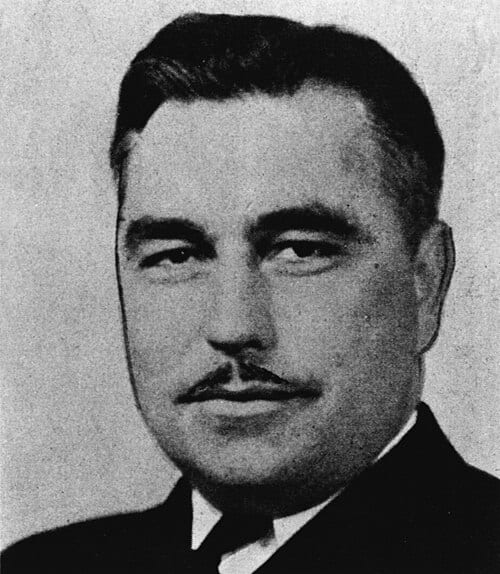
Commander, U.S. Navy
Support & adopt this hero ↓
What does courage look like when a single destroyer faces an enemy battle fleet? On 25 October 1944, Commander Ernest Edwin Evans answered that question with a decision that would make him one of the most legendary naval heroes of World War II. Outnumbered and outgunned, he led USS Johnston (DD-557) into a desperate battle against powerful Japanese warships off Samar, sacrificing his life to protect American escort carriers during the Battle of Leyte Gulf. His extraordinary leadership earned him the Medal of Honor, America's highest military decoration for valor.
Born on 13 August 1908 in Pawnee, Oklahoma, Ernest Edwin "Chief" Evans overcame prejudice to pursue a career in the United States Navy. He enlisted in 1926, earned admission to the U.S. Naval Academy, and graduated in 1931. During the early years of World War II, he served as executive officer aboard USS Alden during the Battle of the Java Sea before assuming command of that destroyer in March 1942. On 27 October 1943, he took command of the newly commissioned USS Johnston, declaring, "This is going to be a fighting ship. I intend to go in harm's way." His crew would soon discover just how deeply he believed those words.
Evans demonstrated exceptional combat leadership before his final battle. On 16 May 1944, while commanding Johnston during an engagement with Japanese submarine I-176, his aggressive antisubmarine tactics and skillful coordination of depth-charge attacks contributed to the enemy submarine's destruction. The action earned him the Bronze Star Medal with Combat "V" for meritorious achievement in combat. His wartime service also qualified him for the China Service Medal, American Defense Service Medal with Fleet Clasp, American Campaign Medal, Asiatic-Pacific Campaign Medal with six engagement stars, and World War II Victory Medal.
His defining moment came at dawn on 25 October 1944, when the American escort carrier force known as Taffy 3 unexpectedly encountered a vastly superior Japanese fleet that included battleships, cruisers and destroyers. Rather than retreat, Evans ordered Johnston to attack. His destroyer laid smoke, opened fire and launched a daring torpedo assault that severely damaged the Japanese heavy cruiser Kumano while drawing enemy fire away from vulnerable American carriers.
Even after Johnston suffered crippling damage and Evans was seriously wounded, he refused to abandon the fight. With communications and steering systems shattered, he shifted command to the ship's stern, shouting steering orders through an open hatch to sailors operating the rudder manually. For nearly three hours, his battered destroyer continued fighting against overwhelming odds. Johnston eventually sank, and Evans did not survive. His Medal of Honor citation recognized his extraordinary courage, professional skill and decisive contribution to turning back the Japanese attack. His original Navy Cross for the action was subsequently recalled and replaced by the Medal of Honor, while his fatal combat wounds were recognized with a posthumous Purple Heart.
The heroism of Evans and his crew helped earn Taffy 3 the Navy Presidential Unit Citation for extraordinary heroism during the Battle off Samar. His ship's qualifying Philippine campaign service also supported the Philippine Republic Presidential Unit Citation, while his documented Philippine honours include the Philippine Defense, Liberation and Independence Ribbons.
Commander Ernest E. Evans became the first Native American in the United States Navy to receive the Medal of Honor. His legacy lives on through the warships named in his honour, the remarkable story of USS Johnston, and the sailors whose lives his final stand helped protect. When the odds seemed hopeless, Evans chose to fight. He did not survive the Battle off Samar, but his courage helped change its outcome and secured his place among America's greatest naval heroes.
Become the named supporter for this profile and edit the tribute biography and portrait (Owner account required). Proceeds help keep the archive online.
$25 USD / year — annual sponsorship renewal. Keeps the page online and, where enabled, the family anniversary remembrance emails active.