★
Loading archive…
Loading archive…
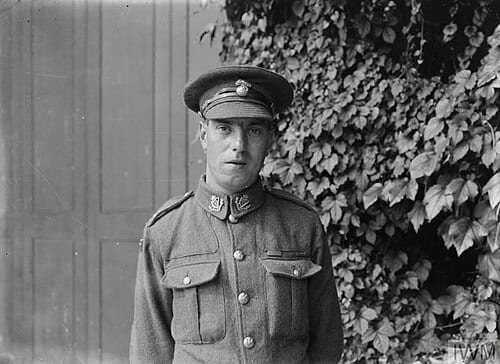
Private (or equivalent), British Army
Support & adopt this hero ↓
How many times would you walk into deadly machine-gun fire to save a wounded comrade? Once might demand extraordinary courage. Twice might seem almost impossible. Yet on 9 April 1917, amid the destruction of the First World War, Private Ernest Sykes repeatedly ventured into enemy fire to rescue wounded soldiers who could not reach safety. His remarkable bravery near Arras, France, would earn him the Victoria Cross, Britain's highest military decoration for gallantry.
Born in 1885 in Mossley, Ernest Sykes was a railway worker whose life changed with the outbreak of the First World War. On 31 August 1914, he enlisted in the Duke of Wellington's (West Riding) Regiment, beginning a military journey that would carry him from civilian railway employment to some of the most dangerous battlefields of the war.
His first overseas service took him to Gallipoli in 1915, where he experienced the brutal conditions of the campaign and suffered a severe foot wound. His injuries threatened to end his military career, and he required extensive treatment before he could return to duty.
After recovering, Sykes resumed military service and eventually joined the 27th Battalion of the Northumberland Fusiliers, part of the famous Tyneside Irish Brigade. With this unit, he served on the Western Front, where British and German forces fought a devastating struggle across the battlefields of France.
Then came 9 April 1917, the day that would place Ernest Sykes among Britain's most celebrated military heroes.
During the Battle of Arras, British troops advanced against strongly defended German positions. As the battalion pressed forward, devastating enemy machine-gun and rifle fire inflicted heavy casualties. Wounded soldiers lay exposed between the opposing forces, unable to reach safety.
For most men, entering that open ground meant facing an overwhelming risk of death.
Ernest Sykes went forward anyway.
Ignoring the deadly fire sweeping across the battlefield, he reached a wounded comrade and brought him back. Then he returned for another. Time after time, Sykes exposed himself to the same danger until four wounded soldiers had been rescued.
But his extraordinary actions did not end there.
Seeing other casualties who could not be moved, Sykes made a fifth journey into the killing ground. There, under continuing enemy fire, he remained with the wounded and dressed their injuries, refusing to abandon men who desperately needed help.
His courage was not demonstrated through a single dramatic attack. It was demonstrated through repeated acts of self-sacrifice, each one undertaken in full knowledge of the danger awaiting him.
For his remarkable gallantry and devotion to duty, Ernest Sykes was awarded the Victoria Cross. The award was announced in The London Gazette on 8 June 1917, and King George V personally presented him with the decoration at Buckingham Palace on 21 July 1917.
The achievement transformed the railway worker from Mossley into a nationally recognised war hero. Yet the true significance of his actions lay in the lives he had fought to preserve.
Sykes was eventually discharged from the Army through ill health in May 1918. He returned to civilian life and railway employment, remaining closely associated with the industry in which he had worked before the war. His courage was commemorated when a railway locomotive was named in his honour, ensuring that his story would travel far beyond the battlefields of France.
In 1937, he received the King George VI Coronation Medal. When the Second World War threatened Britain once again, Sykes returned to military service as a member of the 25th West Riding (Huddersfield) Battalion of the Home Guard, contributing to the defence of his country in another time of national danger.
Ernest Sykes died on 3 August 1949, leaving behind a legacy that continues to inspire admiration.
His Victoria Cross story is a reminder that battlefield heroism is not measured only by ground captured or enemies defeated. Sometimes the greatest act of courage is choosing to save another person's life while placing one's own in terrible danger.
Ernest Sykes VC was an ordinary railwayman who accomplished something extraordinary. In the chaos of the Battle of Arras, he repeatedly chose compassion over self-preservation.
More than a century later, his actions remain a powerful example of the highest traditions of British military gallantry.
His greatest victory was not an enemy position captured. It was the lives he helped save.
Become the named supporter for this profile and edit the tribute biography and portrait (Owner account required). Proceeds help keep the archive online.
$25 USD / year — annual sponsorship renewal. Keeps the page online and, where enabled, the family anniversary remembrance emails active.