★
Loading archive…
Loading archive…
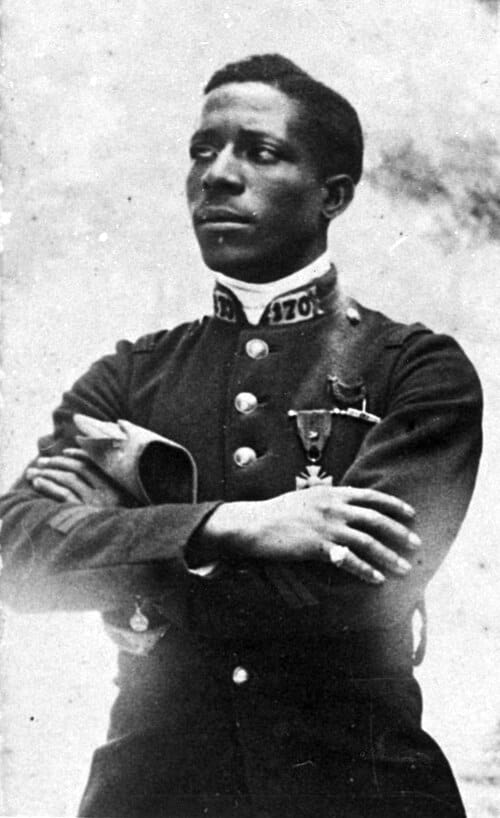
Second Lieutenant, U.S. Air Force
Support & adopt this hero ↓
Before the Tuskegee Airmen took to the skies, before the United States military allowed Black Americans to serve as combat pilots, Eugene Jacques Bullard had already fought above the Western Front. He had survived the trenches of Verdun, earned the Croix de guerre for bravery, learned to fly for France, and entered history as the first African American military pilot to fly in combat. France treated him as a war hero. The country of his birth would not recognize him as a military officer until more than thirty years after his death.
Eugene Jacques Bullard was born in Columbus, Georgia, on October 9, 1895. Some American military accounts later used 1894, a discrepancy connected with the age Bullard declared when he enlisted in France. He grew up in the violently segregated American South, and the racial hostility he experienced there shaped his determination to leave. As a boy he ran away from home, travelled through the United States, and in 1912 stowed away aboard the Marta Russ, eventually reaching Scotland. He worked in Britain as an entertainer and boxer before arriving in France in 1913, where he found a society that offered him opportunities largely denied to him at home.
When the First World War began, Bullard was still an American citizen and had no obligation to fight. He volunteered anyway. On October 19, 1914, he enlisted in the French Foreign Legion and went to war for the country he had chosen as his home. In 1915 he transferred to the French 170th Infantry Regiment as a machine gunner. French military records place him in fighting in Artois, Champagne, the Somme sector and Verdun.
Verdun changed his life. On March 5, 1916, Bullard was seriously wounded during the battle and evacuated from the front. His injuries left him medically unfit for continued infantry combat, but they did not end his war. French military records document a citation for his bravery in July 1916 and the award of the Croix de guerre on July 14, followed by the Médaille militaire. A surviving U.S. Air Force photograph of Bullard during flight training specifically identifies the decoration on his uniform as the Croix de Guerre with Star.
Unable to return to the trenches, Bullard found another way to fight. He entered French military aviation in October 1916, first training for aerial gunnery and then as a pilot. On May 5, 1917, he received Aéro-Club de France pilot certificate number 6950. He was promoted to corporal on June 28 and eventually joined Escadrille N.93 before serving with Escadrille N.85. In doing so, Eugene Bullard became the first African American military pilot to fly combat missions.
Bullard flew more than twenty combat missions over the Western Front in French Nieuport and SPAD fighters. His aerial victory record remains one of the disputed parts of his story. The French Service historique de la Défense profile and the National Museum of the United States Air Force credit him with one confirmed victory, while the Smithsonian National Air and Space Museum records two claimed victories and states that neither was confirmed. Because authoritative sources disagree, the most historically responsible conclusion is that Bullard flew more than twenty combat missions and made combat claims, but his final confirmed victory total remains disputed.
His aircraft has become almost as famous as the man himself. Bullard is closely associated with a bleeding-heart emblem and the phrase Tout le sang qui coule est rouge, commonly translated as "All blood runs red." He is also frequently pictured with his pet monkey, Jimmy. Both became enduring parts of the Bullard legend, although some details surrounding the aircraft markings and stories about Jimmy depend heavily on later accounts rather than surviving operational records.
After the United States entered the war in 1917, Bullard hoped to transfer into American aviation service alongside other Americans flying for France. He was not accepted. Contemporary American military policy and racial discrimination prevented Black men from serving as U.S. military pilots, despite Bullard already having combat experience in French service. He remained with the French, but his own flying career ended later in 1917 after a confrontation with a French officer. Bullard was returned to infantry duties and ultimately served away from front-line combat until his demobilization after the war.
Peace brought Bullard a very different life. He remained in Paris and became part of the city's celebrated interwar nightlife. He worked as a drummer, managed clubs, owned the nightclub Le Grand Duc and operated L'Escadrille, an American-style bar. His world intersected with major figures of the Jazz Age, including Langston Hughes and Josephine Baker. The former runaway from Georgia had become a decorated French veteran, businessman and well-known figure in Paris.
Then war returned.
By 1939, Bullard was working with French counterintelligence, using his familiarity with German and the international clientele of Paris to gather information. In 1940, despite being in his mid-forties and still carrying the effects of his First World War wounds, he again volunteered for French military service. He joined the 51st Infantry Regiment and fought during the defence of Orléans. On June 18, 1940, he was wounded by shell fragments in the head and back. He escaped through Spain and Portugal and reached the United States in July. From New York he continued supporting Free France, including through the France-Forever organization.
His second war brought further French recognition. French government sources confirm that Bullard became a holder of the Croix de guerre 1939-1945, adding a second Croix de guerre to the one he had earned in the First World War. By 1959, the French government explicitly recorded him as holding the Croix de guerre 1914-1918, Croix de guerre 1939-1945, Médaille militaire and Croix du combattant volontaire for his wartime service. The exact citation device associated with his 1939-1945 Croix de guerre has not yet been established from the surviving citation order, so it should not be guessed.
Back in the United States, Bullard's achievements were largely forgotten. He worked at jobs far removed from the life he had built in Paris, including employment as a security guard and elevator operator. In 1949 he attended the Paul Robeson concert events at Peekskill, New York, where he was beaten during the violence surrounding the gathering. The decorated veteran who had fought twice for France had returned to a country where racial discrimination remained a powerful part of everyday life.
France, however, had not forgotten Eugene Bullard. In 1954 he returned to Paris and was chosen as one of the veterans who rekindled the flame at the Tomb of the Unknown Soldier beneath the Arc de Triomphe. Five years later, in 1959, France appointed him Chevalier of the Légion d'honneur, one of the country's highest distinctions. In 1960, during President Charles de Gaulle's visit to the United States, Bullard was again recognized as a French war hero. French military historical records preserve de Gaulle's admiration for the veteran and identify Bullard as a man who had repeatedly fought for France when France needed him.
Eugene Jacques Bullard died of stomach cancer in New York on October 12, 1961, aged sixty-six, according to the French Service historique de la Défense. He was buried in the French military section of Flushing Cemetery in Queens wearing the uniform of the French Foreign Legion. French soldiers rendered military honours at his funeral.
The final recognition from the United States came posthumously. On September 14, 1994, the Secretary of the Air Force appointed Eugene Jacques Bullard a second lieutenant in the United States Air Force. The appointment did not rewrite his wartime service, which had been performed for France, but it formally placed him within the history of the American military institution that had once refused to let him fly.
Eugene Bullard's legacy is larger than the title of "first Black American combat pilot." He was a Foreign Legionnaire, infantryman, decorated combat veteran, pioneering fighter pilot, nightclub owner, counterintelligence operative and veteran of two world wars. He survived Verdun, flew combat missions over France, returned to fight again in 1940, and lived long enough to see France publicly honour what the United States had largely ignored.
His life carries a striking historical contradiction. America gave Eugene Bullard his birth. France gave him the opportunity to fight and fly. History eventually gave him the recognition both countries had owed him.
Become the named supporter for this profile and edit the tribute biography and portrait (Owner account required). Proceeds help keep the archive online.
$25 USD / year — annual sponsorship renewal. Keeps the page online and, where enabled, the family anniversary remembrance emails active.