★
Loading archive…
Loading archive…
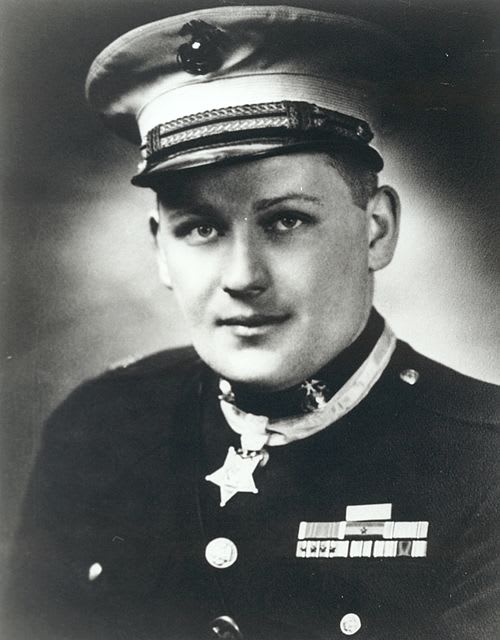
Major, U.S. Marine Corps
Support & adopt this hero ↓
Major Everett Parker Pope (16 July 1919 – 16 July 2009) was a United States Marine Corps officer and Medal of Honor recipient whose combat service spanned some of the most difficult Pacific campaigns of the Second World War. He fought at Guadalcanal, Cape Gloucester on New Britain, and Peleliu, where his leadership during the night of 19–20 September 1944 earned him the Medal of Honor. He later returned to active duty during the Korean War period, although the official Marine Corps record does not document a combat deployment to Korea.
Pope was born on 16 July 1919 in Milton, Massachusetts, and later moved with his family to North Quincy. He graduated with honor from North Quincy High School in 1936. He then attended Bowdoin College in Brunswick, Maine, where he distinguished himself academically and athletically. Pope captained the college tennis team and graduated in June 1941 with a Bachelor of Science degree, magna cum laude, with honors in French. He was also elected to Phi Beta Kappa.
Soon after graduation, Pope entered the United States Marine Corps Reserve. On 1 November 1941, he was commissioned a Second Lieutenant. He trained at Quantico, Virginia, and New River, North Carolina, before deploying overseas in June 1942 with 1st Battalion, 1st Marines.
On 7 August 1942, Pope participated in the landing on Guadalcanal as the leader of a machine-gun platoon. The Guadalcanal campaign was the first major Allied offensive against Japanese forces in the Pacific and marked the beginning of Pope's frontline combat career.
In 1943, Pope moved with his unit to Melbourne, Australia, as the 1st Marine Division rebuilt after the Guadalcanal campaign. He subsequently returned to combat as a company commander with the 1st Marines, 1st Marine Division, during the Cape Gloucester campaign on New Britain, which lasted from December 1943 through April 1944.
During the mopping-up operations that followed the main Cape Gloucester fighting, Pope led a 14-man patrol through approximately twelve miles of jungle trails. According to the official Marine Corps biography, the patrol killed 20 enemy soldiers and captured seven in a single day.
Bowdoin College records that Pope received the Bronze Star Medal for valor for his service at Guadalcanal and during the New Britain campaign. His later combat service at Peleliu also resulted in the award of the Purple Heart.
Peleliu and the Medal of Honor
By September 1944, Pope had been promoted to Captain and was commanding Company C, 1st Battalion, 1st Marines, 1st Marine Division during the invasion of Peleliu in the Palau Islands. He participated in combat on Peleliu from 12 to 30 September 1944.
His defining action occurred on 19–20 September 1944. Pope's company was ordered to assault a steep, barren coral hill that formed part of the heavily defended Japanese ridge system. The position was exposed to point-blank cannon fire as well as machine-gun, mortar and sniper fire from nearby Japanese positions. The bombardment inflicted severe casualties and badly disrupted the attacking Marines.
Despite the losses, Pope rallied his men and personally led them to the summit. By dusk, after hours of fighting, his depleted force had captured the position. The circumstances then became even more difficult: his machine guns were out of action, ammunition and water were running dangerously low, and his Marines were exposed to attack from several directions.
Rather than abandon the ground that had been won at such cost, Pope chose to hold the hill through the night. His remaining force consisted of only twelve men and one wounded officer. Japanese troops repeatedly attacked from three sides, first in small infiltrating groups and later in larger assault parties of approximately twenty to twenty-five men.
As their ammunition dwindled, Pope and his Marines used whatever was available to maintain the defense. Marine Corps accounts describe them throwing rocks among their remaining grenades in an attempt to confuse the attackers. By sunrise, the fighting had deteriorated to extremely close range, with the defenders using improvised weapons and even their bare hands. Only eight effective riflemen remained when daylight exposed the position to renewed Japanese fire and Pope was finally ordered to withdraw.
Pope himself was wounded on 20 September, but returned to duty the following day. He remained overseas until November 1944.
His actions at Peleliu earned him the Medal of Honor. The official citation praised his leadership in holding the exposed position against overwhelming attacks and emphasized that his defense protected American forces positioned below the hill.
President Harry S. Truman personally presented the Medal of Honor to Pope at the White House on 15 June 1945. The Congressional Medal of Honor Society confirms both the presentation date and the White House ceremony.
Pope's highest wartime decoration was therefore the Medal of Honor, while institutional records also confirm his Bronze Star Medal and Purple Heart.
Promotion and postwar service
Pope was promoted to Major in January 1945. He was then assigned to Yale University, where he studied Japanese for approximately one year. On 16 July 1946, his twenty-seventh birthday, he was placed on inactive duty and returned to civilian life in Massachusetts.
He did not, however, immediately sever his connection with the Marine Corps. Pope remained in the Marine Corps Reserve and commanded the 2nd Infantry Battalion, USMCR, at Hingham, Massachusetts.
In August 1950, following the outbreak of the Korean War, Pope and his reserve battalion were recalled to active duty. He subsequently served as Executive Officer of 3rd Battalion, 2nd Marines, at Camp Lejeune, North Carolina.
An important distinction should be preserved in his biography: although Pope was recalled during the Korean War and served on active duty during the conflict, the official Marine Corps biography does not document a deployment to Korea or Korean combat service. His documented Korean War-era assignment was at Camp Lejeune.
In September 1951, Pope was released from active duty. Shortly afterward, he resigned his Marine Corps commission, ending a military career that had begun shortly before America's entry into the Second World War. His highest rank was Major.
Civilian career
Pope built a successful career in banking after leaving active military service. He joined Workingmen's Cooperative Bank in Boston and became its president in 1953, at only thirty-four years of age. Bowdoin records describe him at the time as one of the youngest bank presidents in New England.
His work extended beyond conventional banking. He became involved in higher-education financing and was a strong supporter of programs designed to make college education more financially accessible. He later served as the first chairman of the board of the Massachusetts Higher Education Assistance Corporation in 1982. He retired from banking in 1983.
Pope also maintained a lifelong relationship with Bowdoin College. He served as an overseer from 1961 to 1977, became president of the Board of Overseers from 1973 to 1977, and then served as a trustee until 1988. He eventually chaired Bowdoin's Board of Trustees from 1984 to 1987.
Bowdoin recognized his achievements with honorary degrees, including one shortly after the Second World War and another in later life. He also helped establish scholarships and supported memorial efforts honoring Bowdoin alumni who had served in America's wars.
Family and later years
Pope and his wife Eleanor Hawkins Pope were married for more than six decades. They had two sons, Laurence E. Pope and Ralph H. Pope. Laurence later pursued a distinguished diplomatic career and served as the United States Ambassador to Chad.
After retiring from banking, Pope eventually moved to Maine. Despite the extraordinary nature of his wartime record, accounts of his later life consistently describe him as reluctant to glorify his own role in combat. His connection to the Marines, Bowdoin College and the memory of the men with whom he served remained important throughout his life.
Death and burial
Everett Parker Pope died in Bath, Maine, on 16 July 2009, his 90th birthday. At the time of his death he was Maine's last surviving Medal of Honor recipient from the Second World War.
He was buried at Arlington National Cemetery in Arlington, Virginia. The Marine Corps History Division and Congressional Medal of Honor Society both record Arlington as his final resting place.
Legacy
Everett Parker Pope's military career was defined by sustained combat leadership rather than a single isolated moment. He led a machine-gun platoon at Guadalcanal, commanded Marines in the New Britain campaign, and then commanded Company C during the brutal fighting on Peleliu. Bowdoin's historical records confirm recognition for his valor at Guadalcanal and New Britain, while the official Marine Corps account records the wounds and extraordinary leadership that culminated in his Medal of Honor at Peleliu.
His Medal of Honor action remains the defining episode of his military career. With his company devastated by casualties, weapons failing, water and ammunition nearly exhausted and enemy troops attacking from three sides, Pope chose to hold the position through the night. Even after the defense had been reduced to only eight effective riflemen, he maintained the position until ordered to withdraw.
His later recall during the Korean War demonstrated his continuing commitment to the Marine Corps, but it should be described accurately: he served during the Korean War period as an executive officer at Camp Lejeune, not as a documented combatant in Korea.
From his commissioning in 1941 to his final release from active service in 1951, and from his wartime combat leadership to his decades of civic, banking and educational service, Major Everett Parker Pope left a record distinguished by military courage, leadership and public service.
Become the named supporter for this profile and edit the tribute biography and portrait (Owner account required). Proceeds help keep the archive online.
$25 USD / year — annual sponsorship renewal. Keeps the page online and, where enabled, the family anniversary remembrance emails active.