★
Loading archive…
Loading archive…

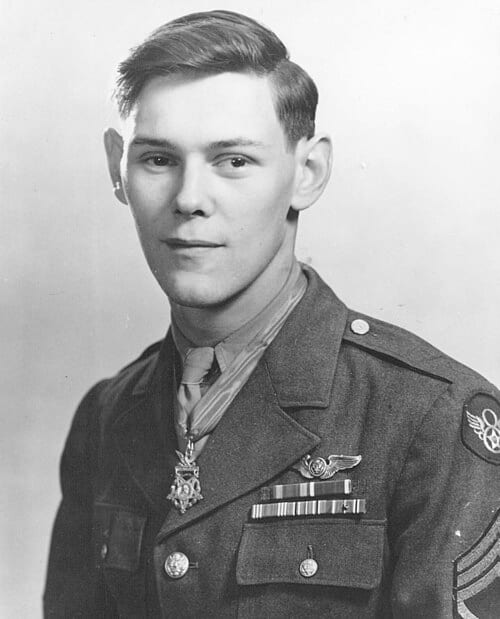
Blinded by shrapnel, he radioed for aid to save all his crew
Forrest Lee Vosler was born at Lyndonville, New York, on 29 July 1923. After school he worked at General Motors before enlisting in the Army in October 1942. Radio and gunnery training took him to the 358th Bombardment Squadron, 303rd Bombardment Group, in England. His actions restoring oxygen to unconscious comrades in November 1943 later brought an Air Medal.
On 20 December 1943, his B-17 was crippled after bombing Bremen. Cannon fire wounded his legs; another explosion injured his face and eyes. Despite failing sight, he kept defending the aircraft. When ditching became inevitable, he repaired the radio by touch and transmitted distress calls through bouts of unconsciousness. After the bomber hit the sea, he held the badly wounded tail gunner on its wing until help arrived.
Promoted to technical sergeant, Vosler underwent prolonged treatment and received the Medal of Honor from President Franklin Roosevelt in August 1944. Discharged that October, he studied at Syracuse, worked in radio and spent three decades with the Veterans Administration. He married Virginia Slack and raised a family. He died in Florida on 17 February 1992 and was buried at Arlington.
Official Medal of Honor citation:
For conspicuous gallantry in action against the enemy above and beyond the call of duty while serving as a radio operator-air gunner on a heavy bombardment aircraft in a mission over Bremen, Germany, on 20 December 1943. After bombing the target, the aircraft in which T/Sgt. Vosler was serving was severely damaged by antiaircraft fire, forced out of formation, and immediately subjected to repeated vicious attacks by enemy fighters. Early in the engagement a 20-mm. cannon shell exploded in the radio compartment, painfully wounding T/Sgt. Vosler in the legs and thighs. At about the same time a direct hit on the tail of the ship seriously wounded the tail gunner and rendered the tail guns inoperative. Realizing the great need for firepower in protecting the vulnerable tail of the ship, T/Sgt. Vosler, with grim determination, kept up a steady stream of deadly fire. Shortly thereafter another 20-mm. enemy shell exploded, wounding T/Sgt. Vosler in the chest and about the face. Pieces of metal lodged in both eyes, impairing his vision to such an extent that he could only distinguish blurred shapes. Displaying remarkable tenacity and courage, he kept firing his guns and declined to take first-aid treatment. The radio equipment had been rendered inoperative during the battle, and when the pilot announced that he would have to ditch, although unable to see and working entirely by touch, T/Sgt. Vosler finally got the set operating and sent out distress signals despite several lapses into unconsciousness. When the ship ditched, T/Sgt. Vosler managed to get out on the wing by himself and hold the wounded tail gunner from slipping off until the other crewmembers could help them into the dinghy. T/Sgt. Vosler's actions on this occasion were an inspiration to all serving with him. The extraordinary courage, coolness, and skill he displayed in the face of great odds, when handicapped by injuries that would have incapacitated the average crewmember, were outstanding.
Become the named supporter for this profile and edit the tribute biography and portrait (Owner account required). Proceeds help keep the archive online.
$25 USD / year — annual sponsorship renewal. Keeps the page online and, where enabled, the family anniversary remembrance emails active.