★
Loading archive…
Loading archive…

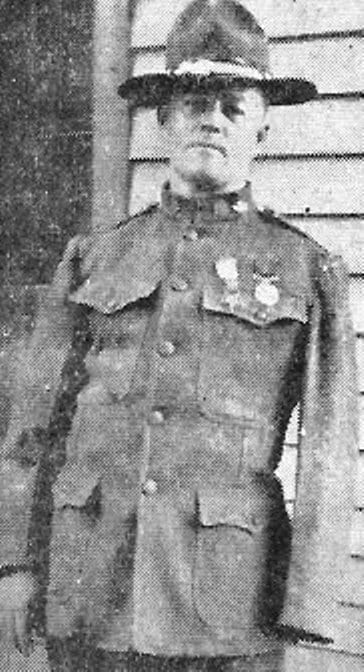
When every other man in his squad had fallen, Frank Joseph Gaffney pressed forward alone. Facing a German machine-gun position near Ronssoy, France, this American infantryman fought through enemy defences, captured the weapon, attacked occupied dugouts and held his ground until reinforcements arrived. His extraordinary courage helped secure 80 German prisoners and earned him the Medal of Honor, America's highest military decoration.
Frank Joseph Gaffney was born in Buffalo, New York, in December 1883. Before becoming a soldier, he worked as a papermaker in western New York. Following America's entry into the First World War, he joined the United States Army and served with Company G, 108th Infantry Regiment, 27th Division. After training at Camp Wadsworth, South Carolina, his regiment embarked for Europe in 1918, joining the American Expeditionary Forces on the Western Front.
The 27th Division entered combat in Belgium and northern France, participating in operations against the German forces defending the Hindenburg Line. Gaffney served as an automatic rifleman, a role that placed him among the infantrymen advancing directly against fortified enemy positions. His defining moment came on 29 September 1918 near Ronssoy, France, during the Somme Offensive.
As the fighting intensified, Gaffney found himself alone after the other members of his squad had been killed. Rather than withdraw, he pushed forward and discovered German soldiers positioning a heavy machine gun. He attacked the crew, killed its members and captured the weapon. Continuing his advance, he bombed several enemy dugouts and killed four additional German soldiers with his pistol. Despite the danger, he held the captured position until American reinforcements arrived. The operation resulted in the capture of 80 German prisoners.
For this extraordinary act of heroism, Gaffney received the Medal of Honor. His courage also attracted international recognition. He was awarded the British Distinguished Conduct Medal, France's Médaille militaire and Croix de Guerre 1914–1918, Italy's Croce al Merito di Guerra, Montenegro's Medal for Military Bravery and Portugal's Medalha da Cruz de Guerra. He also received the Purple Heart for his combat wounds. These decorations made him one of the internationally recognised American infantry heroes of the First World War.
Gaffney's wartime ordeal was not over after Ronssoy. On 15 October 1918, during further fighting near Saint-Souplet, France, he suffered a devastating wound that resulted in the loss of his left arm. His injuries ended his front-line military service, but they did not erase the extraordinary courage he had demonstrated on the battlefield. His service and sacrifice remained an enduring part of the history of the 108th Infantry Regiment and the 27th Division.
After returning to the United States, Gaffney settled in Niagara Falls, New York. He married Marie Georgen in 1920 and subsequently worked for the International Paper Company. Despite the permanent consequences of his wartime injuries, he rebuilt his civilian life and remained connected to the community that remembered his military service.
Frank Joseph Gaffney died on 25 May 1948, in Niagara Falls, New York. He was laid to rest at the United German and French Roman Catholic Cemetery near Buffalo. His remarkable story continued to be remembered through historical accounts, military commemorations and the preservation of his decorations.
From the battlefields of the Western Front to the fortified defences of the Hindenburg Line, Frank Gaffney demonstrated extraordinary courage when confronted with overwhelming danger. His solitary advance at Ronssoy remains one of the remarkable acts of individual heroism in American military history. Remembered as a Medal of Honor recipient and a soldier decorated by six nations, he represents the determination, sacrifice and fighting spirit of the American doughboys who served in the First World War.
Become the named supporter for this profile and edit the tribute biography and portrait (Owner account required). Proceeds help keep the archive online.
$25 USD / year — annual sponsorship renewal. Keeps the page online and, where enabled, the family anniversary remembrance emails active.