★
Loading archive…
Loading archive…
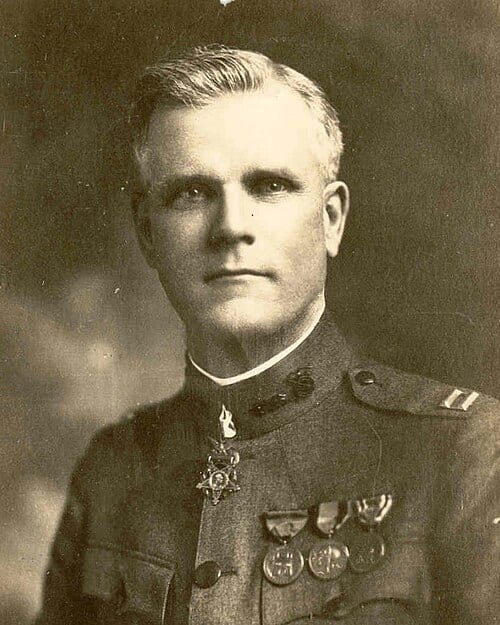
Major, U.S. Army
Support & adopt this hero ↓
Medal of Honor Hero of the Philippine-American War A daring charge against an entrenched force of approximately 300 enemy soldiers made Frank Lafayette Anders one of America's most distinguished military heroes. Yet the story of this Medal of Honor recipient extends far beyond the battlefield. From a young man who left school to support his family to a decorated U.S. Army officer, accomplished engineer and influential civic leader, Anders devoted his life to service, determination and achievement.
Born on November 10, 1875, at Fort Abraham Lincoln in Dakota Territory, Frank Lafayette Anders faced hardship early in life. Following the death of his father in 1890, he left school at the age of fifteen and began working for the Northern Pacific Railroad to help support his family. His early employment in the railroad's maintenance shops gave him practical experience and technical skills that would later contribute to his successful engineering career. In 1894, he enlisted in the North Dakota National Guard, joining Company B of the 1st North Dakota Infantry.
When the Spanish-American War broke out in 1898, Anders was serving in the regiment that was deployed to the Philippine Islands. His unit participated in the American campaign against Spanish forces and subsequently remained in the islands during the Philippine Insurrection. It was during this deployment that Anders performed the act of extraordinary courage that would secure his place in American military history.
On May 13, 1899, near San Miguel de Mayumo on the island of Luzon, Corporal Anders and eleven other scouts faced an entrenched enemy force of approximately 300 men. Recognizing the urgency of the situation, the small group launched a daring frontal assault without waiting for their supporting battalion to arrive or establish a position from which to assist them. Crossing approximately 150 yards under enemy fire, the scouts charged directly into the opposing position and completely routed the much larger force. Their action demonstrated extraordinary courage and determination against overwhelming odds. Anders's conspicuous gallantry during this engagement earned him the Medal of Honor, the United States' highest military decoration for valor.
The Medal of Honor was officially awarded to Anders on March 3, 1906. The recognition acknowledged not only his personal bravery but also the remarkable achievement of the small group of scouts who had undertaken an assault that appeared overwhelmingly unequal in strength. Decades later, on May 2, 1963, Anders was among the distinguished veterans honoured at a White House reception hosted by President John F. Kennedy.
Following his discharge from military service in 1899, Anders pursued opportunities in the mining industry before turning his attention to higher education. Despite having left formal schooling at an early age, he enrolled at Ripon College in Wisconsin in 1902 and graduated in 1906 with an engineering degree. His academic achievements opened the door to a successful professional career. He subsequently worked in engineering and became City Engineer of Fargo, North Dakota, in 1910, where he played an important role in the development of the city's water filtration system.
Anders returned to military service during the First World War. Although initially considered too old for enlistment, his persistence eventually secured him a commission in the United States Army Corps of Engineers in 1918. Initially commissioned as a Captain, he served at Fort Dodge, Iowa, and subsequently at Fort Riley, Kansas, where he was assigned responsibilities involving military hospital facilities. His wartime service also included assignments in Washington, D.C., and Michigan. He was discharged on October 21, 1919, having attained the rank of Major.
His contributions continued well beyond his military career. Anders became general manager of the Lucky Strike Coal Company in North Dakota and later served as a consulting engineer and secretary of the North Dakota State Capitol Commission. Through this role, he contributed to the development of the state's present Capitol building. He also remained actively involved in veterans' organizations, engineering societies and historical research. His interest in military history led him to undertake research into historic military routes and campaigns, including efforts to document the route of General George Custer's 1876 expedition from Fort Abraham Lincoln.
Frank Lafayette Anders's life represents an exceptional combination of battlefield courage, professional accomplishment and public service. Remembered first as a Medal of Honor recipient for his extraordinary actions at San Miguel de Mayumo during the Philippine-American War, he also left a lasting mark as an Army officer, engineer, businessman and North Dakota civic leader. His journey from a fifteen-year-old railroad worker to a Major in the United States Army and one of America's most respected military heroes remains an enduring example of perseverance and service. He died in 1966 at the age of ninety, leaving behind a legacy that extended far beyond the battlefield.
Become the named supporter for this profile and edit the tribute biography and portrait (Owner account required). Proceeds help keep the archive online.
$25 USD / year — annual sponsorship renewal. Keeps the page online and, where enabled, the family anniversary remembrance emails active.