★
Loading archive…
Loading archive…
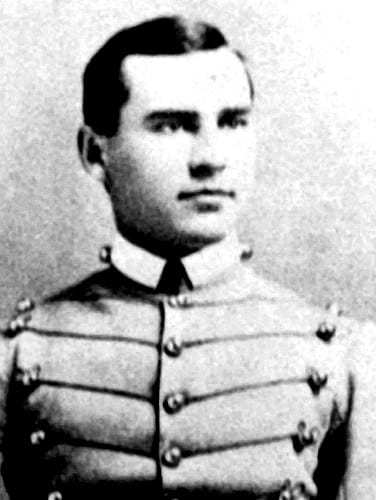
Colonel, U.S. Army
Support & adopt this hero ↓
On 17 July 1882, at Big Dry Wash in the Arizona Territory, First Lieutenant Frank West faced a fortified Apache position that threatened his cavalry command. Rather than allow the enemy's defensive position to halt his advance, West rallied his men and personally led them forward. His courage and leadership earned him the Medal of Honor, America's highest military decoration. Yet the Battle of Big Dry Wash was only one chapter in a remarkable military career that took him from the American frontier to the battlefields of Cuba and the Philippine Islands.
Born on 26 September 1850 in Mohawk, Herkimer County, New York, Frank West graduated from the United States Military Academy at West Point on 14 June 1872. Commissioned into the United States Army, he was assigned to the 6th Cavalry Regiment, beginning a distinguished career that would span more than four decades. His early service took him into the turbulent American West, where he participated in campaigns against the Cheyenne, Kiowa and Comanche during the Indian Wars. His gallantry in actions along the Washita River in September 1874 earned him recognition through a brevet promotion to First Lieutenant. He subsequently served on frontier expeditions in Arizona, New Mexico and Mexico, gaining extensive experience in cavalry operations across some of the most challenging terrain of the American Southwest.
West's defining moment came during the Battle of Big Dry Wash on 17 July 1882. Serving as commander of Troop I, 6th Cavalry, with a detachment of Indian Scouts, he led his men against a strong Apache position concealed across a deep canyon. As the engagement developed, West rallied his command and directed the advance against the fortified position. His determined leadership contributed to the defeat of the hostile force and the recovery of captured horses and military property. For his distinguished conduct in this engagement, he was awarded the Medal of Honor, which was presented to him on 12 July 1892, nearly a decade after the action. He continued his frontier service, participating in the 1883 Sierra Madre expedition and the campaigns against Geronimo in 1885 and 1886. He also served during the 1892 Wyoming conflict known as the Cowboy War and performed military duties during the Chicago disturbances of 1894.
When the Spanish-American War began in 1898, West again found himself in active service. He participated in the Santiago Campaign in Cuba and saw action during the Battle of San Juan in July 1898. His performance during the campaign earned him a recommendation for brevet Major. Following the war, he continued his military career in the United States and the Philippines. Transferred to the 9th Cavalry in 1900, he later returned to the 6th Cavalry and accompanied his regiment to the Philippine Islands. On 11 October 1901, while commanding the 2nd Squadron, 6th Cavalry, he took part in an engagement with insurgents at Mount Durungoa in Batangas. He subsequently performed important inspection and administrative duties in the Philippines and the United States, demonstrating his capabilities beyond the battlefield. Promoted Lieutenant Colonel of the 5th Cavalry in March 1903, he later advanced to Colonel of the 2nd Cavalry on 1 October 1906.
West's responsibilities expanded further as a senior cavalry commander. After commanding the 2nd Cavalry at posts in Montana and Iowa, he returned to the Philippine Islands in 1909 with his regiment. His later service included assignments at Jolo and Camp Overton on Mindanao, where he commanded the Department of Mindanao on several occasions. In December 1911, he commanded the Jolo Field Forces during operations against Moro forces. Following his return to the United States in 1912, he commanded the 2nd Cavalry and the 1st Cavalry Brigade at Fort Bliss, Texas. His final active-duty assignment was at Fort Slocum, New York, where he commanded the Recruit Depot. After more than forty years of military service, Colonel Frank West retired from the United States Army on 26 September 1914, his sixty-fourth birthday.
Frank West died on 26 August 1923 in his hometown of Mohawk, New York. He was buried at Arlington National Cemetery, Virginia. His military legacy extends well beyond his Medal of Honor action at Big Dry Wash. From the Indian Wars of the American frontier and the campaigns against Geronimo to the Spanish-American War and the Philippine campaigns, West served through a transformative period in United States military history. His progression from a young West Point graduate to a decorated cavalry officer and commanding Colonel of the 2nd Cavalry reflects a lifetime of leadership, field experience and dedicated service to the United States Army.
Become the named supporter for this profile and edit the tribute biography and portrait (Owner account required). Proceeds help keep the archive online.
$25 USD / year — annual sponsorship renewal. Keeps the page online and, where enabled, the family anniversary remembrance emails active.