★
Loading archive…
Loading archive…
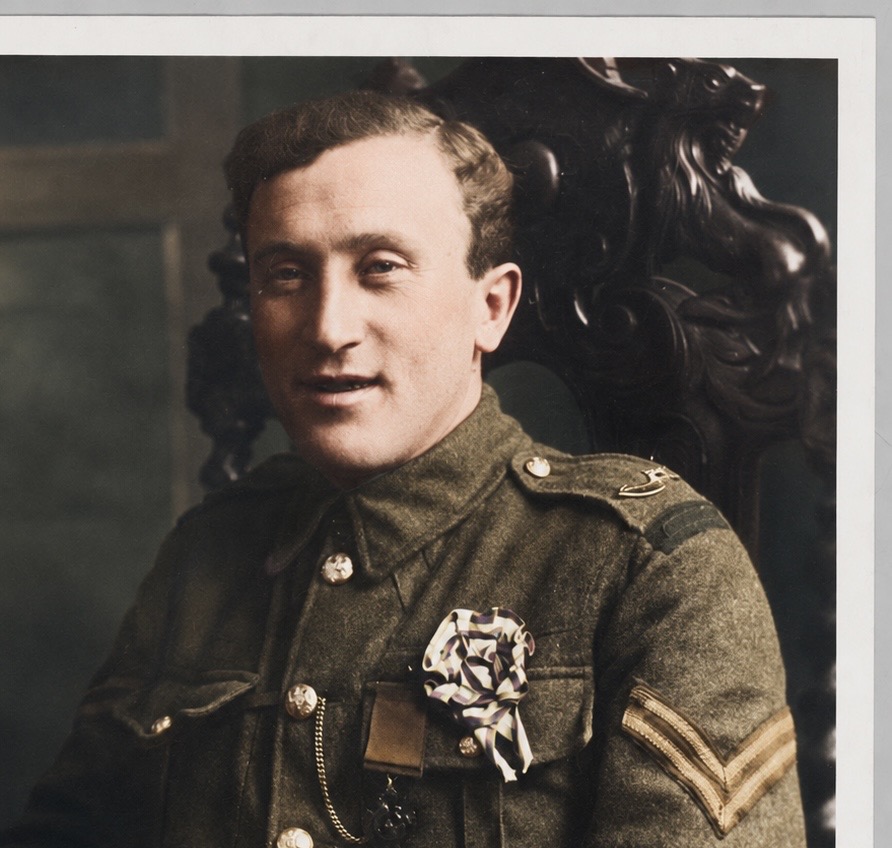
Corporal, British Army
Support & adopt this hero ↓
Frederick Jeremiah Edwards VC
Frederick Jeremiah Edwards was born at Queenstown, County Cork, Ireland, on 3 October 1894. Educated at the Royal Hibernian Military School in Dublin, he later served in the British Army during the First World War as a private in the 12th Battalion, The Duke of Cambridge’s Own Middlesex Regiment.
On 26 September 1916, during the Battle of Thiepval Ridge on the Somme, Edwards performed the act of gallantry for which he received the Victoria Cross. Part of the British advance had been stopped by heavy machine-gun fire, and all the officers in the immediate area had become casualties. With the line confused and signs of withdrawal beginning to appear, Edwards immediately grasped the danger of the situation. Acting entirely on his own initiative, he dashed forward towards the enemy gun and knocked it out with bombs. His courage, presence of mind, and disregard for personal danger cleared a dangerous situation and allowed the advance to continue.
For this action, Edwards was awarded the Victoria Cross, the highest award for gallantry in the face of the enemy available to British and Commonwealth forces. King George V presented him with the medal at Buckingham Palace on 5 February 1917. After receiving the award, Edwards returned to his old school in Dublin, where he was honoured with a silver flask and a cheque to invest in War Bond certificates.
Edwards continued to serve after his VC action. In February 1918, following the disbandment of the 12th Middlesex, he transferred to the 2nd London Regiment, and on 13 April 1918 he moved to the Royal Fusiliers. Later that month, on 24 April 1918, he was taken prisoner near Amiens. He survived captivity and was demobilised on 20 March 1919, later holding the rank of corporal.
His post-war life was difficult. Edwards is believed to have worked in the family business, which later failed, and then returned to employment with the Western Electric Company at Woolwich. Like many veterans, he struggled financially. In 1928 he pawned his Victoria Cross. A national newspaper later bought it back for him, but hardship forced him to pawn it again. By 1930 he was working as a temporary messenger at Holborn Town Hall and became Mace Bearer to the Mayor of Holborn, a position he held until ill health overtook him.
In 1954, Edwards suffered a serious stroke which severely affected his speech. He was later admitted to the Royal Star and Garter Home at Richmond, Surrey, on 27 April 1955. He remained there until his death on 9 March 1964 from acute coronary thrombosis following bronchitis.
Frederick Jeremiah Edwards was given a full military funeral, with an escort from the Middlesex Regiment. Among those present were fellow Victoria Cross recipients Bob Ryder VC, Ted Veale VC, and Percy Valentine Storkey VC. He was buried in the Star and Garter plot at Richmond Cemetery on 16 March 1964.
In addition to the Victoria Cross, Edwards received the 1914–15 Star, British War Medal 1914–20, Victory Medal 1914–19, Defence Medal 1939–45, George VI Coronation Medal 1937, and Elizabeth II Coronation Medal 1953. His medals were eventually acquired by the Middlesex Regiment through private subscriptions after being sold and later auctioned. When the Middlesex Regiment Museum at Bruce Castle closed, the collection passed to the National Army Museum.
Frederick Jeremiah Edwards VC was one of the ordinary soldiers of the First World War whose single moment of decision changed the course of a fight. With no officer left to command, he took the initiative himself, attacked the machine gun that had stopped the line, and restored the advance. His later poverty and ill health make his story especially poignant, but his gallantry at Thiepval remains clear: one man, acting alone, turned confusion into movement and danger into victory.
Become the named supporter for this profile and edit the tribute biography and portrait (Owner account required). Proceeds help keep the archive online.
$25 USD / year — annual sponsorship renewal. Keeps the page online and, where enabled, the family anniversary remembrance emails active.