★
Loading archive…
Loading archive…
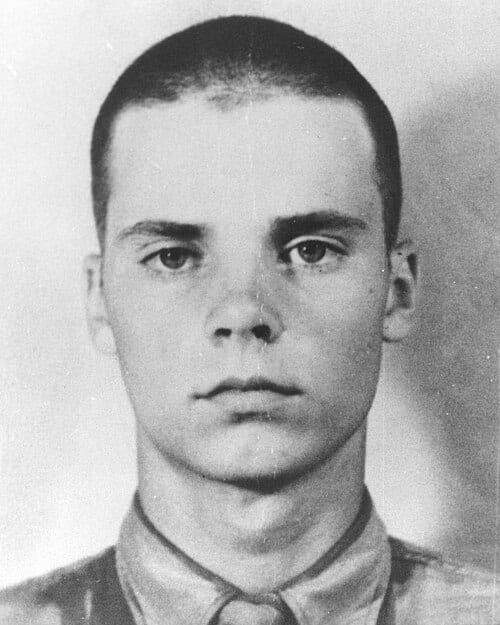
Sergeant, U.S. Marine Corps
Support & adopt this hero ↓
He charged the bunkers after rescuing two badly wounded men.
Frederick William Mausert III grew up in the northeastern United States and joined the Marine Corps on 21 June 1948. Born in Cambridge, New York, in 1930, he attended schools in New York and Massachusetts and worked in Pennsylvania before enlistment. Recruit training at Parris Island was followed by postings at Cherry Point and Camp Lejeune.
In July 1951 he went to Korea and became a squad leader with Company B, 1st Battalion, 7th Marines, 1st Marine Division. The fighting in the eastern mountains placed small infantry units against entrenched positions on steep, heavily defended ground. By September he was a sergeant responsible for leading his men through those assaults.
On 12 September 1951 during the Battle of the Punchbowl near Songnap-yong, Mausert's company attacked a hill fortified with bunkers and machine guns. When he saw two critically wounded Marines lying ahead, he left cover, crossed a mined and fire-swept area and carried them back. A head wound did not stop him. Refusing evacuation, he returned to his squad and led it forward in the renewed attack.
As enemy fire intensified, Mausert deliberately exposed himself to draw attention away from his men and allow them to move into assaulting positions. Although wounded again, he pressed forward with grenades against the machine-gun defences. He helped destroy two positions and continued to inspire the platoon until he was killed. His example sustained the assault that finally secured the objective.
He was twenty-one. His mother received his posthumous Medal of Honor at the Pentagon on 4 September 1952, and he was buried at Arlington National Cemetery. He had already been wounded in Korea before his final action, and his decorations included two Purple Hearts.
Official Medal of Honor citation
For conspicuous gallantry and intrepidity at the risk of his life above and beyond the call of duty while serving as a squad leader in Company B, in action against enemy aggressor forces. With his company pinned down and suffering heavy casualties under murderous machine gun, rifle, artillery, and mortar fire laid down from heavily fortified, deeply entrenched hostile strongholds on Hill 673, Sergeant Mausert unhesitatingly left his covered position and ran through a heavily mined and fire-swept area to bring back two critically wounded men to the comparative safety of the lines. Staunchly refusing evacuation despite a painful head wound sustained during his voluntary act, he insisted on remaining with his squad and, with his platoon ordered into the assault moments later, took the point position and led his men in a furious bayonet charge against the first of a literally impregnable series of bunkers. Stunned and knocked to the ground when another bullet struck his helmet, he regained his feet and resumed his drive, personally silencing the machine gun and leading his men in eliminating several other emplacements in the area. Promptly reorganizing his unit for a renewed fight to the final objective on top of the ridge, Sergeant Mausert boldly left his position when the enemy's fire gained momentum and, making a target of himself, boldly advanced alone into the face of the machine gun, drawing the fire away from his men and enabling them to move into position to assault. Again severely wounded when the enemy's fire found its mark, he still refused aid and continued spearheading the assault to the topmost machine-gun nest and bunkers, the last bulwark of the fanatic aggressors. Leaping into the wall of fire, he destroyed another machine gun with grenades before he was mortally wounded by bursting grenades and machine-gun fire. Stouthearted and indomitable, Sergeant Mausert, by his fortitude, great personal valor, and extraordinary heroism in the face of almost certain death, had inspired his men to sweep on, overrun, and finally secure the objective. His unyielding courage throughout reflects the highest credit upon himself and the U.S. Naval Service. He gallantly gave his life for his country.
Become the named supporter for this profile and edit the tribute biography and portrait (Owner account required). Proceeds help keep the archive online.
$25 USD / year — annual sponsorship renewal. Keeps the page online and, where enabled, the family anniversary remembrance emails active.