★
Loading archive…
Loading archive…
Commander, U.S. Navy
Support & adopt this hero ↓
With one hand, he held a compress against a wounded sailor's injury. With the other, he continued firing at the enemy. In the chaos of battle, George Cregan made a choice that would define his legacy. His extraordinary courage during the 1914 Battle of Veracruz earned him the Medal of Honor, America's highest military decoration, but his remarkable naval career was far from over.
Born on December 11, 1886, in New York City, George Cregan entered the United States Navy in 1907. By April 21, 1914, he was serving as a coxswain aboard USS Florida when American forces landed at Veracruz, Mexico. As fighting intensified, Cregan volunteered to join an assault detail led by Ensign George Maus Lowry against the heavily defended customhouse.
Advancing through a narrow alley under enemy fire, Cregan encountered a wounded fellow sailor, J. F. Schumaker. Rather than abandon his comrade, he stopped to provide aid while continuing to defend their position. His Medal of Honor citation, issued under General Order No. 101 on June 15, 1914, recognized his extraordinary heroism and specifically described how he held a compress with one hand while firing with the other. Secretary of the Navy Josephus Daniels formally presented the Medal of Honor aboard USS Florida at the Brooklyn Navy Yard on January 6, 1915.
Yet Cregan's courage was not limited to the battlefield. More than thirteen years later, another naval tragedy would test his leadership, judgment, and determination.
On December 17, 1927, the submarine USS S-4 sank following a collision off Provincetown, Massachusetts. Serving as Chief Boatswain, Cregan was credited in his Navy Cross citation with commanding USS Sagamore during the difficult salvage operation that continued into March 1928. His seamanship, judgment, efficiency and untiring devotion to duty contributed to the successful recovery operation, earning him the Navy Cross for distinguished service.
Cregan's naval career spanned four decades, including service during both World Wars. His recognized service also included the Navy Good Conduct Medal, Mexican Service Medal, World War I Victory Medal, American Defense Service Medal, American Campaign Medal, and World War II Victory Medal. Rising from an enlisted sailor to the rank of Commander, he retired in 1947 after a lifetime devoted to the United States Navy.
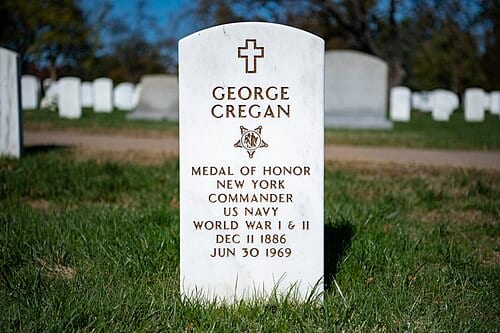
George Cregan died on June 30, 1969, in Manasquan, New Jersey, and was laid to rest at Arlington National Cemetery.
His legacy extends beyond the medals he earned. At Veracruz, he demonstrated that courage means protecting others even when one's own life is in danger. During the USS S-4 disaster, he proved that exceptional service also demands skill, persistence and unwavering responsibility.
From the gunfire of Veracruz to the challenging waters off Cape Cod, Commander George Cregan exemplified two enduring qualities of naval heroism: courage when lives are at risk and devotion to duty when every decision matters.
Become the named supporter for this profile and edit the tribute biography and portrait (Owner account required). Proceeds help keep the archive online.
$25 USD / year — annual sponsorship renewal. Keeps the page online and, where enabled, the family anniversary remembrance emails active.