★
Loading archive…
Loading archive…
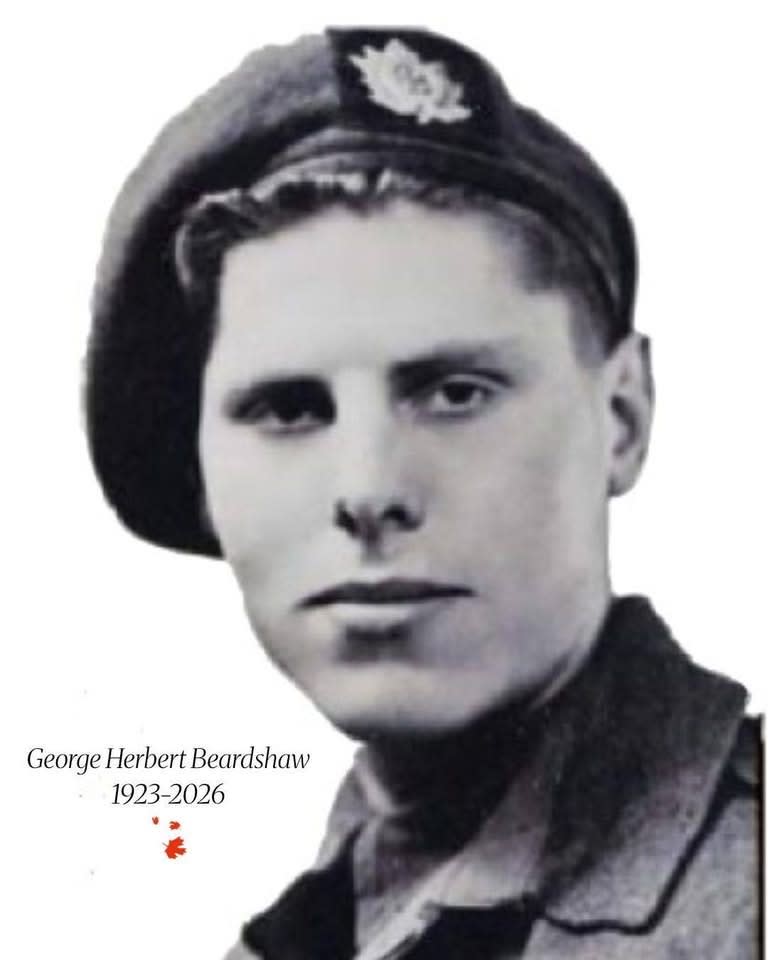
Corporal, Canadian Army
Support & adopt this hero ↓
Corporal George Herbert Beardshaw: Canadian Second World War Veteran, POW and British Home Child Advocate
He crossed the Atlantic as a vulnerable child labourer, returned to Europe as a Canadian soldier, survived capture by German forces, and spent the rest of his 102-year life fighting a different battle: the struggle against forgetting.
Corporal George Herbert Beardshaw was a Canadian Second World War veteran, prisoner of war, British Home Child and lifelong advocate for veterans and displaced children. His story was shaped by hardship, courage and service, but it was his determination to preserve the experiences of others that transformed a remarkable life into an enduring legacy.
George Herbert Beardshaw was born in Yorkshire, England, on 14 September 1923. He was the fourth of five children and entered the Barnardo Homes at a young age. In 1938, when he was fourteen, he was sent to Canada through the British Home Children migration program. Like many children sent overseas under the scheme, George did not fully understand what awaited him. He believed Canada might offer adventure and freedom. Instead, he was placed as an agricultural labourer on a farm near Little Britain, Ontario, where he faced isolation, demanding work and an uncertain future.
The difficult years on the farm tested his endurance, but they did not break his spirit. When the Second World War created an opportunity to serve, Beardshaw first attempted to join the Royal Canadian Air Force. After learning that his limited formal education restricted his prospects there, he volunteered for the Canadian Army and joined The Queen’s Own Rifles of Canada. Military service also gave him the chance to return to England and reconnect with members of the family from whom he had been separated since childhood.
Beardshaw arrived in northwest Europe as a reinforcement after D-Day and was taken on strength of The Queen’s Own Rifles on 7 September 1944. Serving with 8 Platoon, he fought as Canadian forces advanced through France, Belgium and the Netherlands. He was promoted lance-corporal on 8 February 1945, later served as an acting corporal, and ultimately reached corporal status within the regiment.
The fighting left memories that remained with him for the rest of his life. Beardshaw recalled the sound of artillery as he approached the front and the deaths of men who had served beside him. These were not distant events from a history book. They were personal losses experienced by a young soldier who had already endured separation and hardship long before entering combat.
On 30 April 1945, with the war in Europe nearing its end, Beardshaw was reported missing and captured near Deventer in the Netherlands. His patrol encountered German troops near a destroyed bridge and was forced to surrender after a brief exchange of fire. He and his fellow prisoners were marched away in wet and filthy uniforms and remained in captivity through the final weeks of the war. Beardshaw later recalled spending 28 days as a prisoner of war.
His verified Second World War entitlement reflected the full arc of that service. The 1939–1945 Star recognized his qualifying operational service during the war. The France and Germany Star recorded his campaign service in France, Belgium and the Netherlands between D-Day and victory in Europe. The Canadian Volunteer Service Medal with Overseas Clasp recognized his voluntary wartime service and more than 60 days outside Canada, with the clasp represented by a silver maple leaf on the undress ribbon. The War Medal 1939–1945 recognized his full-time service in the armed forces during the conflict.
After returning to Canada, Beardshaw made his home in London, Ontario, with his wife, Emma. Peace did not end his service. Instead, he began the long process of turning memory into public education. He became a dedicated advocate for Canadian veterans and a prominent voice for the British Home Children, thousands of whom had been sent to Canada and placed in domestic or agricultural labour.
Beardshaw spoke at commemorative ceremonies, educational programs, interviews and regimental events. He helped Canadians understand that many British Home Children were not orphans and that their migration stories often involved separation, exploitation and silence. In 2014, he participated in a ceremony honouring British Home Children who served and died during the First World War. His message was not rooted in bitterness. Despite the hardships he endured, he remained proud of the country he had served.
His military service received one of its most significant international recognitions on 29 August 2022, when France appointed him a Knight, or Chevalier, of the National Order of the Legion of Honour. France’s highest national order recognized Beardshaw’s contribution to the liberation of France and northwest Europe during the Second World War. His Knight’s ribbon was correctly represented as plain red, without the rosette used by higher grades.
On 20 June 2025, Beardshaw received the Canadian King Charles III Coronation Medal. The award recognized individuals whose service and contributions had strengthened their communities and Canadian society. For Beardshaw, it acknowledged a lifetime devoted not only to wartime service, but also to remembrance, advocacy and public education.
One final honour arrived shortly before his death. On 9 June 2026, at the age of 102, Wilfrid Laurier University presented Beardshaw with an Honorary Doctor of Laws during its Brantford spring convocation. The university recognized his extraordinary lifetime of resilience, service and advocacy for British Home Children and members of the Canadian Armed Forces. Beardshaw described the degree as the most treasured honour he had received at the age of 102.
By then, George Beardshaw was recognized as Canada’s last surviving British Home Child and one of the last surviving Second World War veterans of The Queen’s Own Rifles of Canada. He had become a living connection between generations, carrying the memories of child migration, infantry combat, captivity and the long return to peace.
Corporal George Herbert Beardshaw died in London, Ontario, on 11 July 2026, aged 102. He had survived childhood displacement, war and imprisonment, yet he chose to dedicate his later life to service, education and remembrance.
His legacy cannot be measured only by the campaigns in which he fought or the honours he received. It lives in the stories he preserved, the forgotten children he helped bring into Canada’s historical memory, and the generations who heard the realities of war from someone who had endured them.
George Herbert Beardshaw spent his youth searching for belonging. He spent his adulthood serving Canada. He spent his final decades ensuring that those who had suffered and served beside him would never disappear from history.
Become the named supporter for this profile and edit the tribute biography and portrait (Owner account required). Proceeds help keep the archive online.
$25 USD / year — annual sponsorship renewal. Keeps the page online and, where enabled, the family anniversary remembrance emails active.