★
Loading archive…
Loading archive…

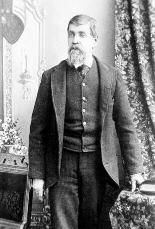
George J. Shopp was a Union Army soldier whose Civil War service stretched from the early years of the conflict to the final Appomattox Campaign. The official Medal of Honor record identifies him as George J. Shopp; reliable Federal records do not establish the full form of his middle initial, so his name should remain in that form. His birth information presents an unusual documentary conflict. Modern Federal Medal of Honor records list his birthplace as Equinunk, Pennsylvania, while autobiographical notes written by Shopp late in life state that he was born on September 8, 1834, in the village of Dorst in Alsace, France, and immigrated to the United States as a young man. Because both traditions survive in the historical record, the discrepancy should not be silently erased.
According to Shopp’s own later recollections, he came to the United States while still a young man and initially worked on a farm in Sullivan County, New York. He later moved into Wayne County, Pennsylvania, purchased timber land, established a home, married, and began raising a family. When the American Civil War began, he left civilian life for military service in defense of his adopted country.
Shopp entered Union service in 1861 with the 6th Regiment, Pennsylvania Reserve Infantry. His later autobiographical account remembered the regiment’s early service around Washington and its participation in major Eastern Theater operations. He recalled serving during the Peninsula Campaign and the Seven Days fighting, then participating in the Second Battle of Bull Run before moving into Maryland during the campaign that culminated at Antietam.
During the Maryland Campaign, Shopp was wounded at the Battle of South Mountain and was sent to a hospital at Frederick, Maryland. His surviving recollections make clear that his Medal of Honor action in 1865 was not his first experience under fire. By then he had already spent years in the Union Army and had experienced the physical cost of combat personally.
Shopp reenlisted as a veteran during the war. When the Pennsylvania Reserve formations were reorganized in 1864, veterans and recruits from the Reserve Corps were used to form the 191st Pennsylvania Infantry. Shopp was transferred into Company E of the 191st Pennsylvania Infantry on May 31, 1864.
The 191st Pennsylvania became part of the Army of the Potomac’s V Corps. After its organization, the regiment took part in the closing stages of the Overland Campaign and the long operations around Petersburg. Its official service history includes Cold Harbor, Bethesda Church, the initial operations before Petersburg, the Siege of Petersburg, Weldon Railroad, Poplar Springs Church, Boydton Plank Road, Hatcher’s Run, and eventually the Appomattox Campaign.
The regiment’s service during this period was demanding. Union troops around Petersburg spent months attacking and defending trenches, roads, railroads, and supply lines as Lieutenant General Ulysses S. Grant gradually tightened his hold on General Robert E. Lee’s Army of Northern Virginia.
By the spring of 1865, Confederate defenses around Petersburg were weakening. Grant launched a new series of operations designed to break Lee’s remaining supply routes and force him out of the Petersburg-Richmond defensive system.
One of the most important objectives was the crossroads at Five Forks, Virginia. Five Forks controlled roads that were vital to the Confederate position and threatened the South Side Railroad, one of Lee’s remaining supply connections.
On April 1, 1865, Union cavalry under Major General Philip Sheridan, supported by infantry from V Corps, attacked Confederate forces defending the Five Forks area. The resulting battle became one of the decisive Union victories of the final campaign.
The Confederate position collapsed under the combined Union assault. Thousands of Confederate soldiers were captured, and the defeat opened the way for Grant to attack Petersburg more aggressively on the following day.
George J. Shopp was serving as a Private in Company E, 191st Pennsylvania Infantry during the Battle of Five Forks. It was there that he performed the action that permanently defined his military career.
During the fighting, Shopp captured an enemy flag. His official Medal of Honor citation is extremely brief, stating simply: “Capture of flag.”
The brevity of the citation should not obscure the danger involved in such an act. Civil War battle flags were not merely ceremonial objects. They helped units maintain formation and direction amid smoke, confusion, gunfire, and rapidly changing battlefield conditions.
Because a regiment’s colors served as both a practical rallying point and a powerful symbol of honor, they were normally guarded closely. Capturing an opposing flag usually required a soldier to reach the center of an enemy formation or seize the colors during the collapse of that formation while exposed to direct hostile fire.
Shopp’s capture therefore represented a highly visible battlefield achievement during one of the final and most important Union victories of the Civil War.
The Battle of Five Forks had immediate strategic consequences. Lee’s position at Petersburg became increasingly untenable, and on April 2 Union forces broke through the Confederate defenses. Richmond and Petersburg were evacuated, and Lee’s army began its final retreat westward.
The 191st Pennsylvania continued into the Appomattox Campaign. The regiment’s official service history carries it through the final pursuit and to Appomattox Court House, where Lee surrendered the Army of Northern Virginia on April 9, 1865.
Only twenty-six days after his heroic action, Shopp received formal recognition from the United States government. His Medal of Honor was issued on April 27, 1865.
This rapid recognition distinguishes Shopp from many other Civil War Medal of Honor recipients whose decorations were not awarded until years or even decades after their battlefield actions. Shopp’s medal was issued while the Civil War was only just coming to an end.
The Army Medal of Honor itself had been created during the Civil War. Congress authorized the Army version in 1862, establishing the decoration that became the highest military award of the United States.
The nineteenth-century Army did not yet possess the extensive hierarchy of personal valor decorations developed in the twentieth century. During the Civil War, the Medal of Honor therefore served as the principal Federal decoration available for recognizing exceptional acts of military courage.
Flag captures were among the actions frequently recognized with the Medal of Honor during the conflict because taking enemy colors normally required direct exposure to hostile fire and close contact with opposing troops.
Shopp’s award belongs to the original Army Medal of Honor period. Because his decoration was issued in 1865, the historically correct project database selection is Medal of Honor 1862–1895 Army — 1865.
No additional star, clasp, bar, oak leaf cluster, or other device has been verified for his Medal of Honor. His decoration should therefore be represented as a single Medal of Honor with no device or clasp.
Shopp’s military career did not end at Five Forks. The official Medal of Honor record identifies his action-time rank as Private, while later service evidence shows that he ultimately reached the rank of Corporal. For the final profile, Private is the correct rank for the April 1, 1865 Medal of Honor action, while Corporal is his highest verified rank.
The 191st Pennsylvania remained in service after Lee’s surrender. The regiment marched to Washington in May 1865, participated in the closing period of the Army of the Potomac’s wartime service, and was mustered out on June 28, 1865.
Shopp’s discharge record places him in the grade of Corporal at the end of his service. This distinction is important because his later rank must not be retroactively substituted for the rank he actually held when he captured the Confederate flag at Five Forks.
Decades later, Shopp’s Medal of Honor status remained officially recognized. Under legislation passed in 1916, his name was entered on the Army and Navy Medal of Honor Roll in 1917, confirming his continued recognition as a Medal of Honor recipient and qualifying him for the special pension associated with that roll.
The later Army Civil War Campaign Medal requires different treatment. Shopp unquestionably performed qualifying Civil War military service and lived well beyond the creation of the campaign medal in 1907.
However, surviving long enough to be potentially eligible does not prove that an individual veteran actually received or was officially issued the medal. The Civil War Campaign Medal was created more than four decades after Shopp’s wartime service, and recipient-specific evidence is required before placing it in his ribbon rack.
No sufficiently strong individual issuance record, named medal record, or equivalent authoritative evidence has yet been established showing that George J. Shopp personally received the Army Civil War Campaign Medal.
For that reason, the Army Civil War Campaign Medal remains HOLD / DO NOT ADD under the project’s evidence-first rules. It should not be included merely because Shopp was a Civil War veteran who survived into the twentieth century.
His final verified medal rack therefore contains only one decoration: Medal of Honor 1862–1895 Army — 1865 — with no device or clasp.
After leaving the Army, Shopp returned to civilian life. His own later account describes years of work, family responsibilities, and eventually a move westward. He became associated with Yuma, Colorado, where he lived for many years and became known locally as a Civil War veteran and Medal of Honor recipient.
Late in life, Shopp wrote autobiographical recollections describing his immigration, family, wartime service, wounds, and reasons for fighting for the Union. Those recollections provide a rare personal perspective on a soldier whose official Medal of Honor citation itself contains only three words.
He eventually moved to Denver, Colorado. Modern Medal of Honor records give his death as March 24, 1924, in Denver, although an early local obituary reports a slightly different March date. He was buried in Yuma Cemetery in Yuma, Colorado, where his grave commemorates his status as a Medal of Honor recipient.
George J. Shopp’s military legacy centers on the Battle of Five Forks. By April 1865 he was already an experienced Union veteran who had served for years, suffered wounds, reenlisted, and transferred into the 191st Pennsylvania Infantry.
At Five Forks he captured a Confederate flag during the attack that shattered an important part of Lee’s defensive position. Twenty-six days later, the United States formally recognized that action with the Medal of Honor.
His career also demonstrates the importance of distinguishing rank at action from highest rank. At Five Forks he was Private George J. Shopp; by the end of his military service he had become Corporal George J. Shopp.
His verified decoration record is equally clear. One Medal of Honor was issued on April 27, 1865, for his capture of an enemy flag at Five Forks on April 1, 1865. No additional device or clasp has been verified, and the later Civil War Campaign Medal remains excluded unless recipient-specific entitlement evidence is found.
George J. Shopp is therefore remembered as a veteran of the United States Army, a soldier of the Pennsylvania Reserves and the 191st Pennsylvania Infantry, a participant in the final campaigns against the Army of Northern Virginia, and a Medal of Honor recipient whose courage at Five Forks secured his permanent place in the military history of the American Civil War.
Become the named supporter for this profile and edit the tribute biography and portrait (Owner account required). Proceeds help keep the archive online.
$25 USD / year — annual sponsorship renewal. Keeps the page online and, where enabled, the family anniversary remembrance emails active.