★
Loading archive…
Loading archive…

He crawled to his wounded captain within yards of enemy guns
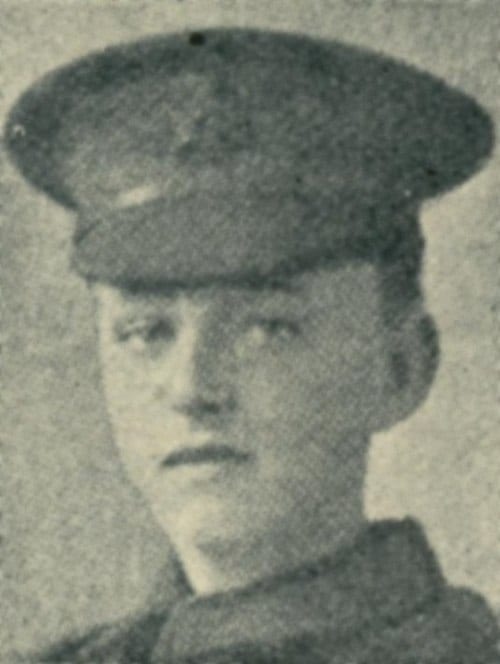
George Stanley Peachment was born in Bury, Lancashire, on 5 May 1897. His father worked as a hairdresser and newsagent, and his mother had been a schoolteacher. He attended local schools and Bury Technical School, studied engineering and became an apprentice fitter. When war began, he was still too young for normal overseas military service.
After an unsuccessful attempt to enlist, Peachment joined the King’s Royal Rifle Corps in April 1915 by overstating his age. He trained with the 5th Battalion before being sent to the 2nd Battalion in France in July. His short military record also contained minor disciplinary offences.
At Loos on 25 September 1915, his battalion encountered fierce resistance near Hulluch. When the forward line withdrew to reorganize, Peachment saw his company commander, Captain Guy Dubs, lying wounded close to the German position. Instead of taking shelter with other men in a nearby shell hole, he crawled to the officer and attempted to help him. He remained kneeling in the open under fire. A grenade wounded him, and a rifle bullet then inflicted a fatal injury.
Dubs survived and described Peachment’s conduct in the recommendation for the Victoria Cross and in a letter to his mother. Peachment was eighteen and had spent only a few months in uniform. His body was not recovered, and he is commemorated on the Loos Memorial.
King George V presented the posthumous decoration to his mother in November 1916. His surviving four-medal group records both his courage and the brief 1915 service that brought an apprentice engineer from Bury to the Western Front.
Official Victoria Cross citation
For most conspicuous bravery near Hulluch on 25th September, 1915. During very heavy fighting, when our front line was compelled to retire in order to reorganise, Private Peachment, seeing his Company Commander, Captain Dubs, lying wounded, crawled to assist him. The enemy’s fire was intense, but, though there was a shell-hole quite close, in which a few men had taken cover, Private Peachment never thought of saving himself. He knelt in the open by his Officer and tried to help him, but while doing this he was first wounded by a bomb and a minute later mortally wounded by a rifle bullet. He was one of the youngest men in his battalion and gave this splendid example of courage and self-sacrifice.
Third Supplement to The London Gazette of 16 November 1915. 18 November 1915, Numb. 29371, p. 11450
Become the named supporter for this profile and edit the tribute biography and portrait (Owner account required). Proceeds help keep the archive online.
$25 USD / year — annual sponsorship renewal. Keeps the page online and, where enabled, the family anniversary remembrance emails active.